
Competition. Finally.

The announcements of the Nikon D300 and D3 cameras are good news… for Nikon and Canon photographers.

Until recently, Canon arguably had the DSLR market pretty much locked down. When other manufacturers were selling 6 MP crop sensor bodies, Canon’s bodies used 8 MP sensors. While other manufacturer’s high speed pro bodies used 1.6x crop sensors, Canon’s used a 1.3x sensor. While other manufacturer’s only offered cropped sensors, Canon produced two full frame models.

This week’s announcements may indicate how things will shift in the future. Canon announced the long-expected 1DsMKIII, a 21 MP full frame flagship camera that competes with MF film bodies. At the same time Canon announced the also-expected 40D, a crop sensor 10MP camera with improved features (dust reduction, faster burst rate, etc.) compared to the older 30D.

Meanwhile, Nikon announced the D300, a crop sensor 12+ MP body with state of the art features including a 9 fps burst rate, improved AF system, improved body sealing… and a price that is competitive with the 30D. While Canon users are not likely to sell their cameras and switch to Nikon, first time DSLR buyers and those without large investments in lenses will find that the Nikon camera to surpasses the equivalent Canon on a number of counts.

Nikon also announced the D3, a 12+ MP full frame body. This is a very interesting camera in many ways. It provides the first non-Canon full frame body, finally introducing some competition to the Canon full frame cameras. It offers fast burst rates of 9 (or, with limits, 11) fps in a full frame body, providing serious competition for the Canon 1DMKIII’s 10 fps with a 1.3x crop body.

Additional rumors and announcements indicate that Sony may offer a full frame DSLR before long and that Nikon won’t be the only manufacturer of 12+ MP crop sensor bodies.

I use a Canon 5D and Canon lenses. You might think that I’d be a bit upset to see my company losing its clear lead. On the contrary, I’ve felt for some time that effective competition would be a good thing for Canon photographers and for the camera marketplace in general. With at least three manufacturers now able to compete fairly effectively (and others like Pentax and Olympus offering interesting and novel alternatives) I’m hopeful that we’ll see more attention to careful design and that we’ll see greater price competition in the pro and semi-pro DSLR market.

(Right after posting this message I saw Michael Reichmann’s post on more or less the same subject.)


G Dan Mitchell is a California photographer and visual opportunist. His book, “California’s Fall Color: A Photographer’s Guide to Autumn in the Sierra” (Heyday Books) is available directly from him.

G Dan Mitchell: Blog | Bluesky | Mastodon | Substack Notes | Flickr | Email


All media © Copyright G Dan Mitchell and others as indicated. Any use requires advance permission from G Dan Mitchell.
A Question About the Lowepro Slingshot 200AW

Wendy asks:

I am writing you because I saw your rave about the LowePro Slingshot. Since you use one and I cannot find the answer online could you tell me if my gear would fit in the 200? I have a Canon XTi with grip, Canon 70-200 f/4 which I would like to leave attached (w or w-o the hood), Sigma 17-70, Canon 60mm, 18-55mm and Canon 350xt body. Throw in the battery charger, disk reader and if necessary I will carry my underwater Inon strobe just in case I am unable to carry my pelican case on the plane. If you don’t mind 1 more question. I would like to get a monopod-so many brands-anything in particular I should look for. Weight is a consideration, cost-would like to keep it under $100, would I need a ball head? Manfrotto, Slik? Currently I have been using my Taylormade driver as a monopod on the golf course to shoot a pair of eagles and their baby! A tripod is more than I want to carry.

Yes, I am a big fan of the Lowepro Slingshot 200 AW. It is relatively small for a bag that will carry a basic kit, the single shoulder strap design is very flexible, and it has a waterproof cover. That said, I’m not sure that the 200 is going to be the right bag for you.

While it might be just barely possible to squeeze all that equipment into the Slingshot 200 AW, I think that accessing it would be a real problem – you’ d have to pack the bag very carefully and very tightly. I certainly recommend that you try this out at a photography store before you buy, both to make sure that the gear will fit and to make sure that once you load it up you’ll still be able to access the equipment.

When I shot with the 350D(XT) I found my 200 AW would just barely carry the camera with the EF 24-105mm f/4 L attached (hood reversed) plus with the EF 17-40mm f/4 L (no hood – I used the 24-105 hood on it with the crop sensor body), the EF 70-200mm f/4 L (hood reversed), and the EF 50mm f/1.4. I carried a few other odds and ends (batteries, filters, etc.) in the small outer pocket and the upper pocket. (The upper pocket is large enough that it could carry a prime lens, though it isn’t padded.)

There is a larger version of the Slingshot, the 300 AW. I haven’t used it, but I’ve heard that it is a fine bag – though if you really load it up it may be too heavy for the single shoulder strap suspension, and a real backpack model may be more appropriate.

(One final note on the Slingshot. I’ve used mine heavily for a year and a half or so and it has generally performed well. However, last week I discovered that one of the main zippers is coming apart where it curves around the “top” of the bag. I’ll have to reserved final judgment until I find out what Lowepro has to say about replacement or repair when I contact them later this month. UPDATE 8/29/07: Lowepro really came through on this. Today I received a brand new Slingshot 200 AW from the Lowepro customer service center – only two business days after I sent my damaged bag to them. I’m very impressed!)

I’m afraid I can’t offer any really good monopod advice since I don’t own one. I sometimes do use a tripod as a monopod (leaving the legs pushed together) but that’s about it. I do like using the ball head when I use the tripod this way since I can adjust the shooting angle of the camera independent of the leg angle – this is useful if you are shooting down (from a balcony at a concert or theatrical event, for example) or up (photographing birds, for example.)

Post that monopod question at one or more of the photo discussion web sites: DP Review, photo.net, Fred Miranda, etc.

Good luck,

Dan

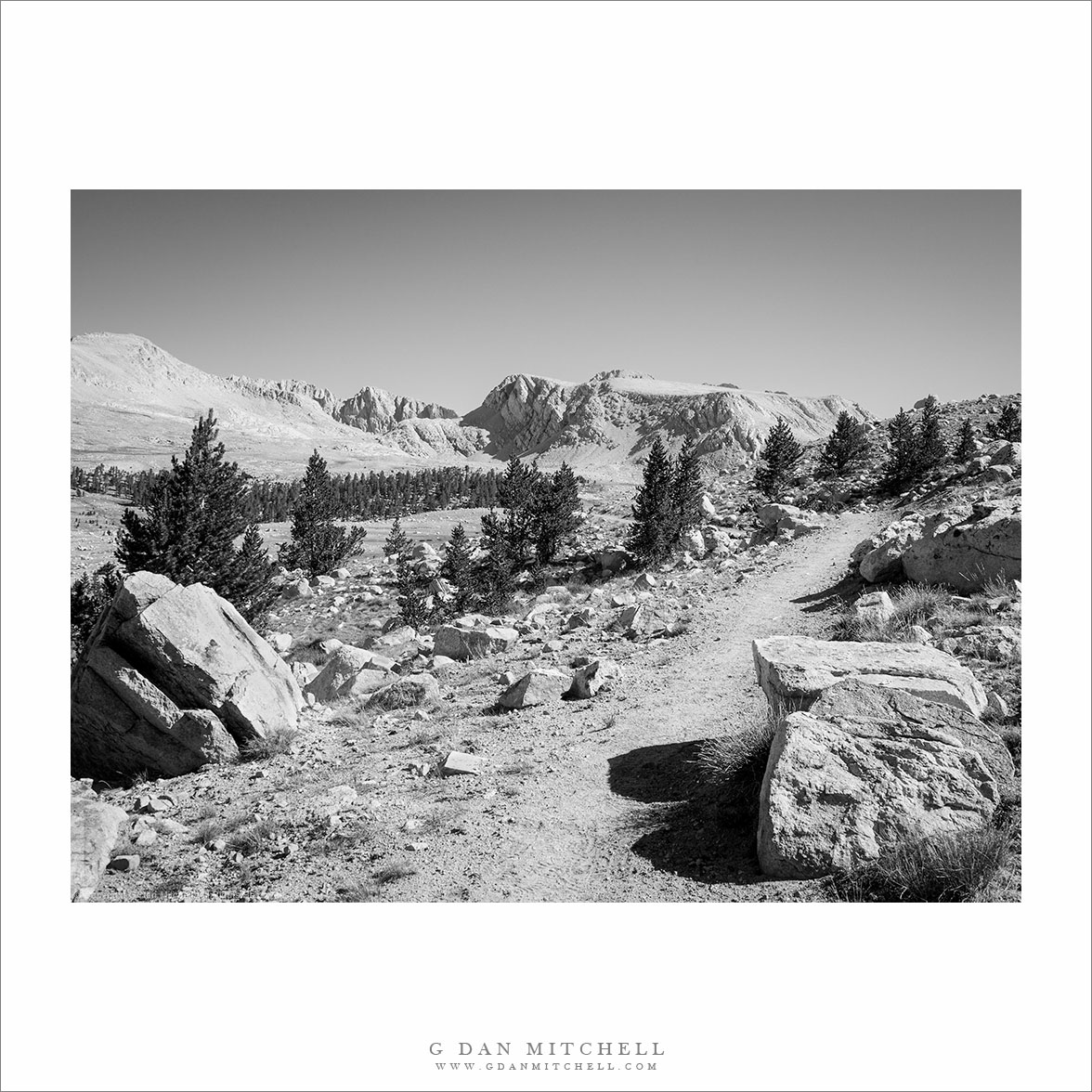
Diamond Mesa, Shepard Pass Trail

Diamond Mesa, Shepard Pass Trail
“Diamond Mesa, shepard Pass Trail” — Diamond Mesa and the trail to Shepard Pass, Sierra Nevada.

This post originally consisted on the photograph and no significant accompanying text. This website has been going for two decades, and early on I often simply posted photographs without commentary. The post has now been updated on April 8, 2026 to include some description.

In 2007 I was part of a group of Sierra Nevada backpackers that traveled into the backcountry together every summer. This trip began in the Cottonwood Basin, crossed a pass at the upper end of Mitre Basin, and eventually headed north on the John Muir trail. From Tyndall Creek we made a big loop up to Lake South America and then back down the upper drainage of the Kern river before taking Shepard Pass out of the mountains.

Continue reading Diamond Mesa, Shepard Pass Trail