
Reader question: How to add borders to online photographs

From time to time people ask what techniques I use to create the simple frames for versions of my photographs that I post online. A while ago I wrote about this: Creating Frames for Online Photos: My Method. The explanation involves the use of Photoshop CS3, but the technique is essentially the same in the current version of the program.

You can read the details at the link above, but the process is basically fairly straightforward. I use Image –> Canvas size to add a series of borders to the original image: a one-pixel gray border immediately around it, a larger white border beyond that with a bit more width at the bottom, and finally a one-pixel black border at the outer edge. I turn this into an action that I can apply by selecting it and clicking a button to run it.

The approach to creating the text incorporated into the web images is similar, though it requires a bit of tweaking with each photograph. Essentially, I create three text layers: one for the large type at the bottom, one for the small embedded copyright notice, and a slightly larger “watermark” that will go over the image itself. The action I recorded creates the three layers and inserts the boilerplate text, but I always have to do a bit of alignment manually, and I may also have to make some decisions about opacity and so on depending upon the characteristics of the individual image. Still, it takes less than a minute to do the whole thing even in the wost cases.

Why apply a border, “branding” text, and copyright to the photographs?

  • If people like your photograph, it makes sense to make it easy for them to find you – so I include the easily readable text with my name and web site URL. No matter where the unaltered file ends up, viewers will be able to find the source.
  • The use of consistent presentation helps to establish the photographer’s “brand.” This is true even when the image is displayed in ways that are out of your control, including search engine results.
  • Inclusion of the copyright information is a formality to remind viewers that use of my photographs requires advance permission.
  • Although the inclusion of a watermark cannot stop a dedicated image thief, I think it reduces the likelihood of misappropriation – and that is probably about all that one can really hope for on the basis of a watermark. It may tweak the conscience of the typical user, who may perhaps simply not have thought about the issues of legal usage, and it may encourage others to look for a different image that won’t expose their illegal use and/or require them to take the intentional step of trying to remove the text to cover up the source.
I also addressed these issues in a separate post at this blog.
(Occasionally a person interested in purchasing a print or licensing a photograph for some other use wonders if the embedded watermarks, copyright information, and branded borders are part of the original images. No. When you purchase a print there is nothing on the paper but the photograph itself and my signature. Photos licensed for other uses – books, magazines, web site, etc – are normally provided without added text.)
Articles in the “reader questions” series:

G Dan Mitchell is a California photographer and visual opportunist. His book, “California’s Fall Color: A Photographer’s Guide to Autumn in the Sierra” is available from Heyday Books and Amazon.
Blog | About | Flickr | Twitter | FacebookGoogle+ | 500px.com | LinkedIn | Email


All media © Copyright G Dan Mitchell and others as indicated. Any use requires advance permission from G Dan Mitchell.
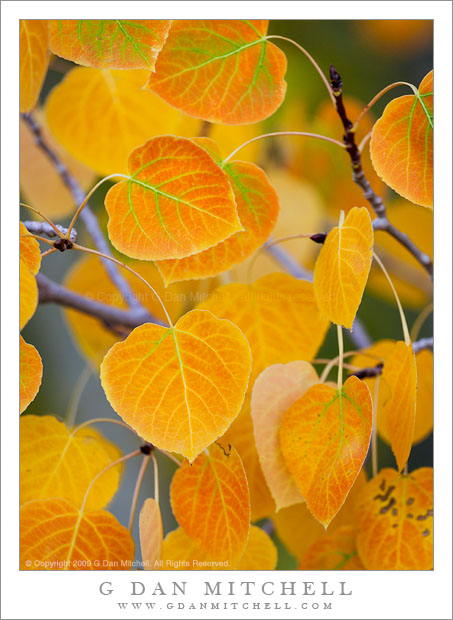
Aspen Leaves in Transition – Near Conway Summit

Aspen Leaves in Transition - Near Conway Summit
Aspen Leaves in Transition – Near Conway Summit

Aspen Leaves in Transition – Near Conway Summit. Sierra Nevada, California. September 27, 2009. © Copyright 2009 G Dan Mitchell – all rights reserved.

Aspen leaves in transition from green to fall hues in the shade of a grove above Conway Summit, Sierra Nevada, California.

This is another of my close-up aspen detail photographs from my one-hour or so shoot in the eastern Sierra near Conway Summit on the last Sunday of September. I took a quick detour to this part of the “east side” after completing a short photographic backpack trip to Cathedral Lakes that weekend.

I’ve photographed this grove before, so I stop every season and see what I can find. This time I think I arrived a few days earlier than usual in the color transition. There were still a lot more leaves on trees in the grove than I’ve seen in the past and a nearby grove was still completely green. (This grove is among the first you encounter as you drive up the road from Highway 395/Conway Summit toward Virginia Lake, right by a dirt road turnoff on the left side.)

As I walked into the lower edge of the grove, I discovered that among leaves that were for the most part either green or yellow, there were a few here that had a wider range of colors – some residual green, yellow, gold, orange, and even verging on red. So, in addition to shooting the larger view of the grove, I decided to use a long lens and work on a few close shots of the leaves that most caught my attention.


G Dan Mitchell is a California photographer and visual opportunist whose subjects include the Pacific coast, redwood forests, central California oak/grasslands, the Sierra Nevada, California deserts, urban landscapes, night photography, and more.
Blog | About | Flickr | Twitter | FacebookGoogle+ | 500px.com | LinkedIn | Email

Text, photographs, and other media are © Copyright G Dan Mitchell (or others when indicated) and are not in the public domain and may not be used on websites, blogs, or in other media without advance permission from G Dan Mitchell.
Things that sometimes baffle me about photographers and photography

This is by no means a complete list, but inspired by seeing one of these oddities in a post earlier today I thought I’d write it up.

  • “Unboxing videos” of new cameras. Why would someone make a 5 or 10 minute video of the act of opening the box that their new camera came in and then lovingly taking out… the manual, the USB cables, the styrofoam inserts, the warranty card, and on and on and on – often with narration and sometimes even background music. Do people actually watch these?
  • Spending thousands and thousands of dollars on “the best” camera, lens, etc. when one isn’t really a photographer and doesn’t really make photographs all that much and perhaps only shares the odd jpg or letter size print with friends and family.
  • Getting caught up in the “brand wars” between manufacturers like Nikon and Canon. They both make really, really fine equipment. Both are used by a lot of excellent photographers. Really wonderful photographs are produced using both systems every day.
  • Assuming that there is only one best “whatever” in photography. There is no such thing as “The Best… camera, lens, tripod, photographer, memory card, place to shoot, time of day to shoot, filter, brand, store, paper…” First, there are many good versions of each. Second, what is best for one person may not be best for another.
  • Obsessing over very tiny and insignificant equipment “flaws” or differences. The classic is, of course, choosing a less functional lens over a more functional lens because the less functional lens might measure .001% better resolution at 100% magnification on the test bench. Related are obsessions over very tiny differences in noise in digital cameras, concern about small difference in camera burst rate, worry that your lens might vignette some…
  • Thinking that you have to “take a position” on zooms versus primes. (Zooms and primes are both great, and you have my permission to use both… ;-)
  • Secret shooting locations – unless the area is fragile and too much use would damage it, if ten good photographers shoot it you’ll get ten different interpretations.

Anyone else?

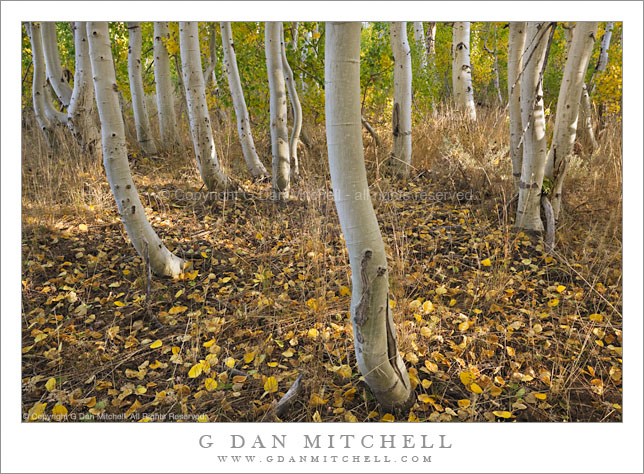
Aspen Grove Near Conway Summit

Aspen Grove Near Conway Summit

Aspen Grove Near Conway Summit. Sierra Nevada, California. September 27, 2009. © Copyright G Dan Mitchell – all rights reserved.

Newly fallen leaves litter the ground among softly lit trunks of aspen trees in a grove near Conway Summit in the eastern Sierra Nevada, California.

During my one hour (!) of fall aspen photography in the eastern Sierra on Sunday, I spent most of the time in one small grove of trees up the road to Virginia Lake from highway 395 at Conway Summit just north of Lee Vining. If you leave 395 and head up the road to Virginia Lakes, this is the first grove you encounter on your left – not far up the road and at a point where a small dirt road heads off from the main paved road.

I’ve photographed this grove before, but frequently I’ve arrived a bit after the peak. If anything, on this visit I was possibly a few days early. There were still a good number of green leaves in the grove, and across the road another large grove was completely green. However, here there were some great colors ranging from green to red and orange and yellow. I wandered up the hill through the grove and came to this spot where the ground was relatively clear but partially littered with fallen leaves, and a clear view of the many interesting shapes of the tree trunks was available.


G Dan Mitchell is a California photographer and visual opportunist. His book, “California’s Fall Color: A Photographer’s Guide to Autumn in the Sierra” (Heyday Books) is available directly from him.

G Dan Mitchell: Blog | Bluesky | Mastodon | Substack Notes | Flickr | Email


All media © Copyright G Dan Mitchell and others as indicated. Any use requires advance permission from G Dan Mitchell.