
Corn Lily Plants

Corn Lily Plants
Corn Lily Plants

Corn Lily Plants. Yosemite National Park, California. June 30, 2010. © Copyright G Dan Mitchell – all rights reserved.

New corn lily plants emerge alongside a stream in the Yosemite National Park high country.

Shortly after the winter’s snow melts, the Sierra corn lily plants begin to grow quickly in wet areas, especially those next to streams and lakes. This year I saw them earlier in the season than usual, and for the first time I saw them as they first emerged. I’m used to seeing them in the form shown in this photograph, with the large curving leaves that I assumed were responsible for the “corn” part of the plant’s name. However, as the plants first break through the soil they look almost exactly like unhusked corn, and now I wonder if that is the actual reason for the name.

These specimens, as is often the case, were growing in a tightly packed group along the banks of a fast-flowing stream that meanders through a nearly flat meadow. The plants remain beautiful throughout the season, though the nature of that beauty changes. Soon they will lose the lush green of spring and become somewhat tougher looking. At some point in late August they will begin to show some brown edges, and a bit later they will turn brilliant golden, yellow, and brown colors as the short Sierra summer comes to an end.

G Dan Mitchell Photography
About | Flickr | Twitter | Facebook | Google+ | 500px.com | LinkedIn | Email

Text, photographs, and other media are © Copyright G Dan Mitchell (or others when indicated) and are not in the public domain and may not be used on websites, blogs, or in other media without advance permission from G Dan Mitchell.

(Basic EXIF data may be available by “mousing over” large images in posts. Leave a comment if you want to know more.)


Disclosing Photo Locations: How Much Information is Too Much?

(NOTE: This post originally included only the first section, based on the story that begins the article. The longer second part added in 2014 addresses some important related issues. A third section added in early 2017 recognizes a new and dangerous political factor. Additional editing is done from time to time.)

In the summer of 2010 I had the good fortune to join friends and fellow photographers (Charlie Cramer, Mike Osborne, and Karl Kroeber) for a few days of photography in the Tuolumne Meadows/Tioga Pass area of Yosemite National Park. Spending time with photographers who have so much experience and knowledge of Yosemite is always inspiring, and I was grateful to join them.

Pond with Boulders and Trees

While sitting around during the “boring light” midday hours — before early dinner and travel to an evening location for the good light — Mike mentioned that they were going to a place that was best not publicized, and he joked (at least if think he was joking) that he “might have to blindfold Dan” if I came along.

Mike was a Yosemite ranger for decades, and he loves and cares for the place deeply. He was concerned about posts on my website in which I had named locations and given more information than necessary about them. He has seen first-hand the damage caused by too much publicity about fragile locations. He suggested that it is often better to share or acquire information about these places the old fashioned way — by word of mouth from an acquaintance or through on-the-ground exploration. He also noted that many of my photographs are not so much about the specific place as they are about some thing I saw there that is not location-specific — so specific location titles aren’t important and may even be a distraction from the real value of the photographs.

Mike’s comments caused me to think quite a bit about this issue. First, a few words of self-defense, but then some changes that I made at my website, on social media, and in other places where I share my photographs.

As we sat around the motel room talking about this, my first thought was, more or less, “How can my little photography blog have any serious effect!?”

Continue reading Disclosing Photo Locations: How Much Information is Too Much?

Shoreline Reflections, Trees and Rocks

“Shoreline Reflections, Trees and Rocks” — Silhouetted trees and boulders and their reflections lining a flooded section of the shoreline of Tenaya Lake.

During peak snow melt many Sierra Nevada lakes overflow and flood surrounding meadows and forest. Although the water level was lower at the end of June when I made this photograph than it had been three weeks earlier during my first visit of the year, many areas in the margins of the lake were flooded. (This, of course, makes the mosquito population very happy – and human visitors less so!) The early morning sun back-lit these closely spaced trees and the rocks ringing this quiet flooded area along the shoreline.

I have visited this lake for many years. I’ve long been intrigued by this particular spot, where flat granite slabs line the shoreline, allowing the lake to expand and contract across shallows as the season progresses. Later in the season this spot can be dry, but early season in this wetter-than-usual year the water flooded this small pool and what might otherwise be shoreline trees were on a rocky peninsula. Those trees have been a subject for other photographers— being aware of this I wanted to avoid a photograph that imitated their beautiful work. I arrived in the early morning, when the air was still and cool and the water smooth. I walked about a bit and just looked, then came to this spot, where the complex patterns of the trees and their reflections in the water fill the frame, creating for me a sense of stillness and calm and quiet.

This photograph was a prize winner in the Yosemite Renaissance 2013 show in Yosemite Valley. Prints are available. Email me and/or see the Sales link at the top of this page.

This photograph is the subject of one of my “Photograph Exposed” posts, in which I share more of the story behind the image.


G Dan Mitchell is a California photographer and visual opportunist. His book, “California’s Fall Color: A Photographer’s Guide to Autumn in the Sierra” is available from Heyday Books and Amazon.

Blog | About | Flickr | FacebookEmail

Links to Articles, Sales and Licensing, my Sierra Nevada Fall Color book, Contact Information.


All media © Copyright G Dan Mitchell and others as indicated. Any use requires advance permission from G Dan Mitchell.

Cascade, Afternoon Light

Cascade, Afternoon Light

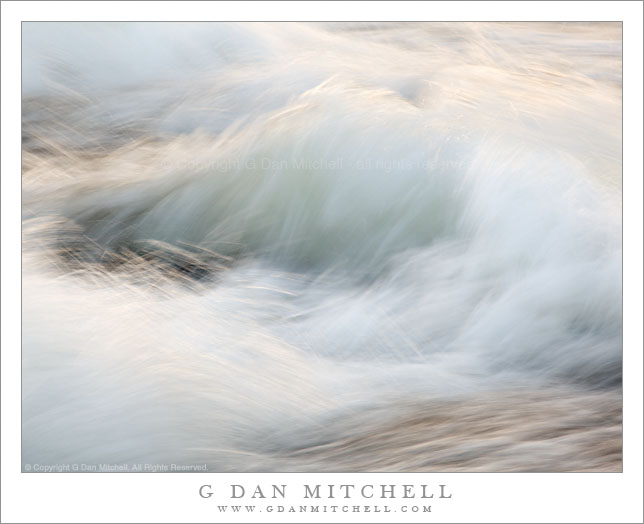
Cascade, Afternoon Light. Yosemite National Park, California. June 28, 2010. © Copyright G Dan Mitchell – all rights reserved.

A back-country creek cascades across granite in afternoon light reflected from nearby rock faces, Yosemite National Park, California.

In places where a fast-moving stream drops rapidly down a glaciated granite slope (such places are found in various locations in the Yosemite high country) and the late afternoon sunlight reflects on the far side of the stream, the water can pick up the golden color of the reflected light. In this photograph I found a standing wave in the middle of turbulent section of water, and I positioned myself so that the reflected light was directly opposite my location.

G Dan Mitchell Photography
About | Flickr | Twitter | Facebook | Google+ | 500px.com | LinkedIn | Email

Text, photographs, and other media are © Copyright G Dan Mitchell (or others when indicated) and are not in the public domain and may not be used on websites, blogs, or in other media without advance permission from G Dan Mitchell.

(Basic EXIF data may be available by “mousing over” large images in posts. Leave a comment if you want to know more.)