Aspen Color, North Lake

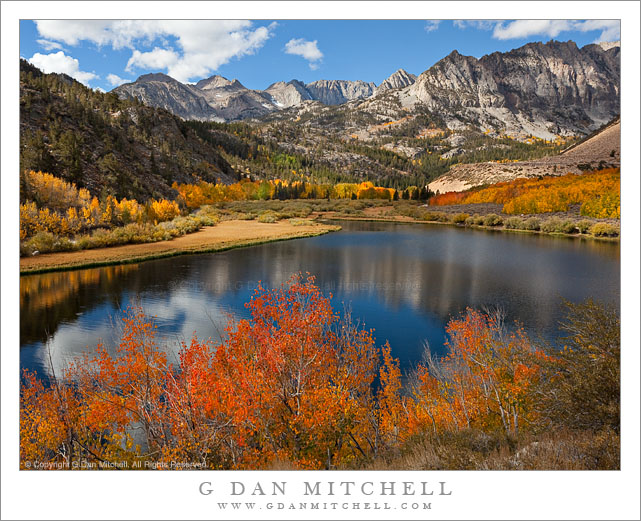
Aspen Color, North Lake

Aspen Color, North Lake. Sierra Nevada, California. October 2, 2010. © Copyright G Dan Mitchell – all rights reserved.

Colorful autumn aspen colors surround the shores of North Lake with the Sierra Crest beyond.

I should probably hand out sunglasses and an Official Icon Alert warning with this one. Yes, it is that North Lake.

Later on this morning, after shooting elsewhere around the lake in the early hours, and after the workshop shooters had mostly moved on (after all, the good light was gone… ;-), I decided to cross the outlet stream and see about climbing up a hill above that lake that I had been thinking about. I found an easy trail along the side of the lake, but then had to more or less bushwhack my way up the slope to get above the tops of the very red lakeside aspens, which is no easy task when carrying a large photo pack and a good size tripod. (Once up there, I discovered a very easy trail going straight to my position. Sigh.)

Although it was no longer the “golden hour” and the morning was well along, there were scattered clouds. These shadows from these clouds moved rapidly across the landscape, sometimes producing almost uniform shade and sometimes lighting up some features while leaving others less visible. When I see conditions like this I often imagine the perfect positioning of the clouds and the light effects they produce – some primary feature caught in the spot light of a beam of sun, others in sunlight muted by thin clouds, and any spots that happen to be a bit too bright and distracting miraculously muted by a perfectly placed shadow. Yeah, right. But if I watch and wait long enough, something interesting almost always happens, and sometimes the moving clouds do momentarily solve composition and exposure problems. Here, the light on the bright red trees in the foreground is momentarily diminished by a passing cloud shadow and the shoreline trees are in sunlight… and the big cloud at upper left is reflecting on the surface of the water just beyond the foreground trees.

This photograph is not in the public domain and may not be used on websites, blogs, or in other media without advance permission from G Dan Mitchell.

G Dan Mitchell Photography | Twitter | Friendfeed | Facebook | Facebook Fan Page | Email

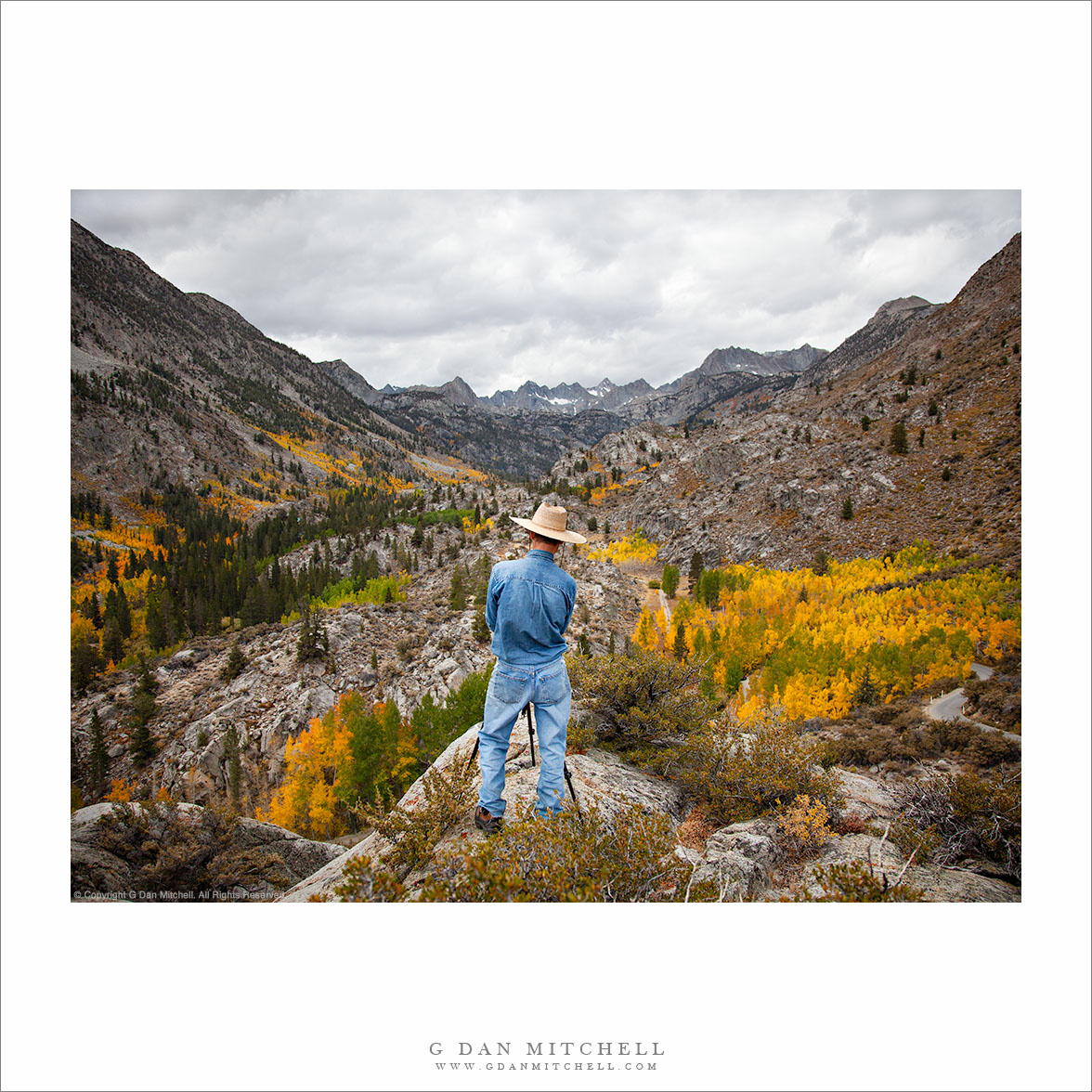
Photographer, Sabrina Basin

Photographer, Sabrina Basin" — A photographer working the autumn colors from a ridge in Sabrina Basin, Sierra Nevada, as an early fall storm comes in.
“Photographer, Sabrina Basin” — A photographer working the autumn colors from a ridge in Sabrina Basin, Sierra Nevada, as an early fall storm comes in.

I wandered out onto this ridge above Sabrina Basin, a spot that I know for its unobstructed view of the valley and the peaks of the Sierra crest above Sabrina Lake, far up the canyon. I had my eyes on some rocky benches that run along the top of the ridge As I approached I saw that I wasn’t the only photographer with this idea. As I crossed the rocks toward the overlook, he was working my intended camera position, so I decided to sit back and let him finish. (The ridge wasn’t wide enough for both of us to work together there.)

As I waited, I thought there was something interesting about his position above the valley, his concentration on shooting, his all-blue outfit (shirt and jeans, on a cold and rainy day!), and that wide brimmed hat. So I decided to make a few photographs of him. We barely talked at all. I hoped to get his name, but that didn’t happen. The best I was able to do was give him a card, and offer him a copy of the photo if he contacted me. Never heard from him…


G Dan Mitchell is a California photographer and visual opportunist. His book, “California’s Fall Color: A Photographer’s Guide to Autumn in the Sierra” (Heyday Books) is available directly from him.

G Dan Mitchell: Blog | Bluesky | Mastodon | Substack Notes | Flickr | Email


All media © Copyright G Dan Mitchell and others as indicated. Any use requires advance permission from G Dan Mitchell.

10 Critical Tips for Landscape Photographers

1. Use a camera. The most important and basic tool of the landscape photographer is the camera. Using a camera greatly simplifies the process of capturing photographic images, and without one you’ll likely feel a bit lost. You may have noticed that pretty much all great landscape photographers use a camera – some use more than one! – so take a cue from the pros and make sure you have a camera, too!

2. Get a lens. Having a lens makes your camera much more useful. While a camera is critical to your work as a landscape photographer, without a lens the usefulness of the camera is greatly diminished. For this reason, virtually all successful landscape photographers end up, sooner or later, getting a lens to use with their camera. You’ll definitely want one, too – just like the pros! (Some cameras come with a lens built in – what a useful idea!)

3. Remove your lens cap. How many photographers can tell stories of forgetting to remove the lens cap before making a photograph, only to discover that the results were not what they had hoped for? But you don’t have to learn the hard way! Practice removing your lens cap at home – that way, when you are in the field you will have developed “photographer’s instincts” that will ensure that you remove the lens cap. (The good news is that with digital cameras you don’t have to worry about whether you loaded the film – but don’t forget your memory card!)

4. Photograph interesting things. Although it isn’t universally true, you will probably get more interesting photographs if you photograph interesting things. There are many things in the world, and not all of them are interesting. Look for the interesting things and photograph them. Look around – it is an interesting thing to do! Interesting, yes?

5. Pick the right brand. There are many brands of photographic equipment out there – cameras, lenses, filters, bags, you name it. Picking the wrong brand may hamper your photography; pick the right brand and you may not hamper your photography so much. So be sure to pick the right brand. If you aren’t sure which brand is best, talk to photographers – any one of them can tell you which is best… and why!

6. Light is important. Without light it would be pretty much impossible to make photographs, at least the typical landscape photographs. So if you plan to make typical photographs, look for scenes that are illuminated by… light! Light is your friend. Seek out light and when you see it make photographs. Think about it… how many of the photographers you admire work without light? So, do what the pros do – use light!

7. Pick the right subject. Pick the wrong subject and your photograph won’t be what you wanted it to be, so be sure to photograph the right subject. Seek it out and when you see the right subject make a photograph. Perhaps make several. There are so many subjects in the world that finding the right one can be a challenge, so be sure to apply yourself carefully to this task.

8. Colors are important. Unless you are making black and white photographs – in which case the only important colors are black and white. You’ll want to pay careful attention to color. The most important advice is to focus on color in your color photographs – just like the pros!

9. Focus on what is most important. Some people think that mastering technical issues is the most important thing. Others think that having the right equipment is critical. Some claim that the artistic quality of the photograph is important. (Don’t forget – color is important, too!) Before you make great photographs you’ll have to decide which is the most important in your work. Don’t waste your time being a generalist and trying to do everything – pick one and focus on it!  Successful photographers develop a speciality and stick to it.  And don’t forget the rule of thirds!

10. Find good locations. There are many popular spots to make photographs, and you can make photographs just like the pros if you seek out these locations and shoot there, too. You’ll have to be attentive, since these spots are easy to miss if you are talking on your cell phone as you drive past them. Some telltale hints include parking lots full of cars and lines of people with tripods. Stop and make a photograph – there is always room for one more tripod! You can probably make one that looks just like those that the other photographers are making! (Hint: You can also visit online photography sites ahead of time – both to find the locations and to save yourself from spending too much time searching for compositions when you actually get there. Your time is precious!)

Good luck!

(I probably should have saved this for April 1, but I couldn’t wait… :-)

For those whose first experience with my blog is this tongue-in-cheek post, I write serious stuff, too, and a related recent post might interest you: Photographic Myths and Platitudes – ‘Landscape Photography Lenses’ (Part I)

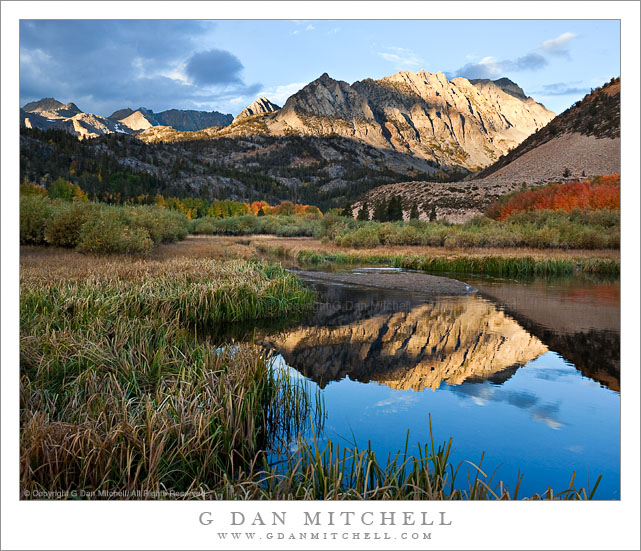
Autumn Sunrise, Piute Crags

Autumn Sunrise, Piute Crags

Autumn Sunrise, Piute Crags. Sierra Nevada, California. October 2, 2010. © Copyright G Dan Mitchell – all rights reserved.

Autumn morning light on Piute Crags, reflected in the shoreline waters of a Sierra Nevada lake.

I made a lot of photographs during the past few months, traveling to the Sierra and a number of other places frequently. I often go through the photographs from the most recent shoot and post images soon after, but when I’m on to the next adventure fairly quickly I don’t always have time to get to everything in one batch before I shoot the next one. Inevitably, some images get “left behind.” Things have slowed down just a bit, and now I’m finding time to go back through some of that earlier work and pull out a few more images that I like. This is one of them.

Folks who photograph in the eastern Sierra will likely recognize this location. The long, rugged ridge of Piute Crags is striking, especially in the morning light, more so in the fall when the aspens change color, and double-especially on such a fall morning when clouds are moving in and out of the scene. I’m not going to say much more about the location beyond telling a little story. As I made this photograph there were perhaps 50 photographers set up more or less tripod-to-tripod a ways away shooting the same general subject from the place where almost everyone shoots. Their location is, indeed, a beautiful spot and I’ve shot there myself. (Heck, I shot there later on this same trip, though at a time of day when the workshops had gone elsewhere.) But there is more than one way to photograph a scene, and with a bit of thought and some wandering around it is usually possible to find a perspective that isn’t quite the same as the familiar one.

(If you know where I stood, please resist the temptation to say too much. This precise spot could not withstand the stress of dozens of photographers. Thanks!)

This photograph is not in the public domain and may not be used on websites, blogs, or in other media without advance permission from G Dan Mitchell.

G Dan Mitchell Photography | Twitter | Friendfeed | Facebook | Facebook Fan Page | Email