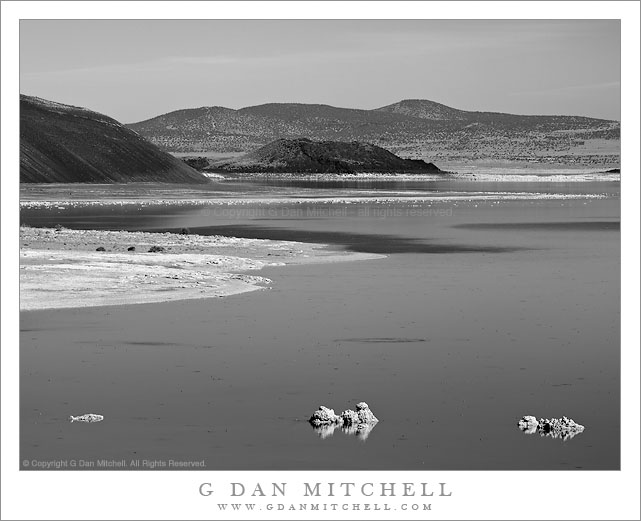
Black Point and Negit Island, Mono Lake Shoreline

Black Point and Negit Island, Mono Lake Shoreline

Black Point and Negit Island, Mono Lake Shoreline. Mono Lake, California. October 10, 20120. © Copyright G Dan Mitchell – all rights reserved.

The north shoreline of Mono Lake leads from foreground offshore tufa past the base of Black Point to Negit Island and beyond.

You would never know it from this black and white photograph of the austere desert landscape around Mono Lake, but I was there to photograph… fall aspen color! Earlier in the day I had photographed further south along the eastern slopes of the Sierra, gradually working my way north with a plan of heading back to the “west side” over Tioga Pass at the end of the day after doing a last bit of  fall color photography near Conway Summit and Dunderberg Road in late-afternoon light. By mid-afternoon I had made it to Lee Vining for an espresso stop at Latte Da and a break to check some email and so forth. Soon it was time to get into position for the low angle sun that would light the aspens a bit later, so I headed north out of town.

The road north from Lee Vining skirts the west shore of Mono Lake. Before leaving the lake there is a turn-off to another road that passes along the north shore of Mono Lake and can take you to places such as Black Point. I often stop at this turn-off since it provides a slightly elevated view of the larger terrain around the lake including the low hills to the east and Mono Craters and higher mountains to the south. On a typical blue sky mid-afternoon I might not make any photographs, but something about the light and the forms of the shoreline, Black Point, and Negit Island leading into the distance convinced me to make a few exposures, using a long lens to compress the distance.

This photograph is not in the public domain and may not be used on websites, blogs, or in other media without advance permission from G Dan Mitchell.

G Dan Mitchell Photography
Flickr | Twitter | Facebook Fan Page | Facebook | Friendfeed | Email
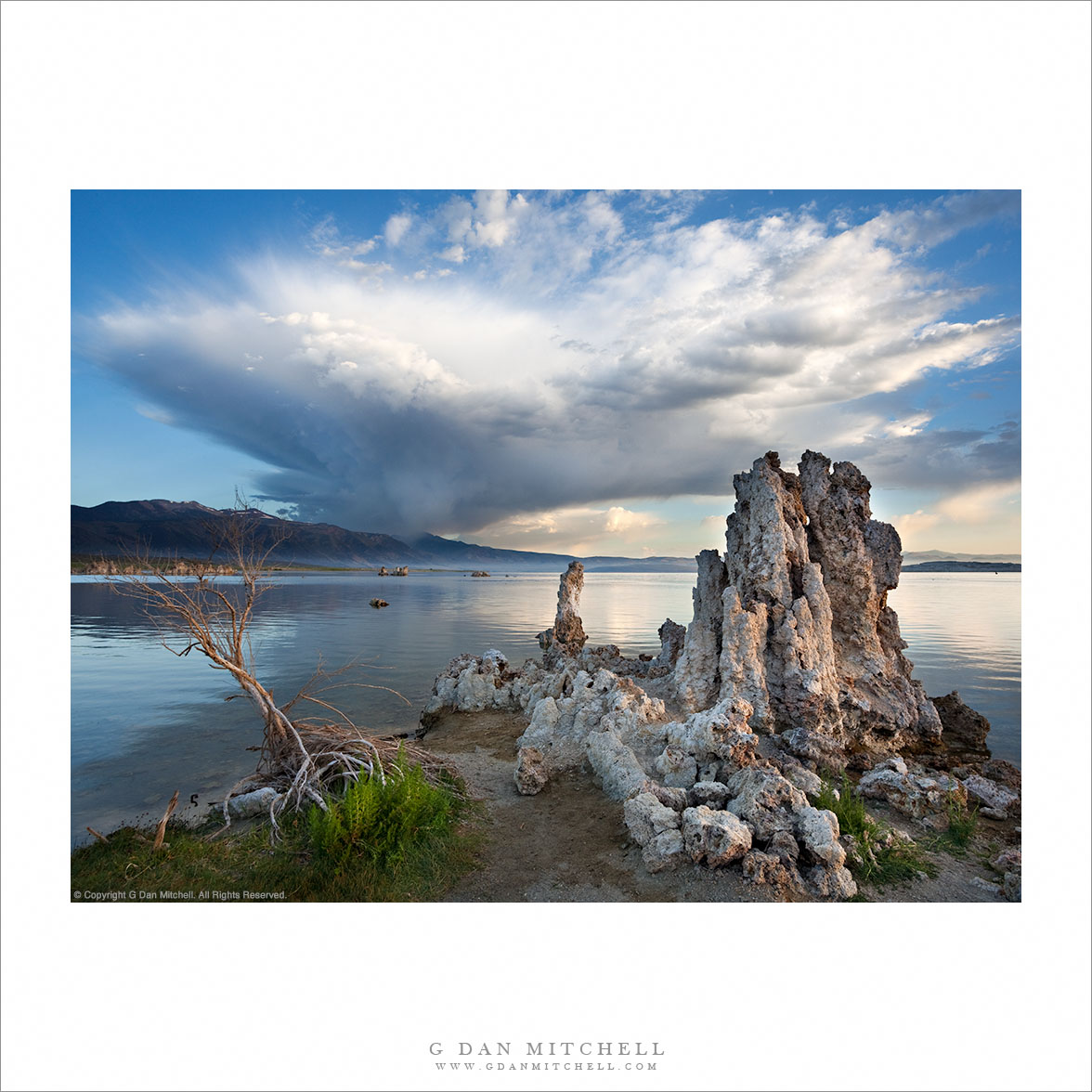
Alien Life at Mono Lake?

A thunderhead builds over Mono Lake.
“MorningSquallSouthTufa20100725” — The shoreline of Mono Lake as a morning squall drops rain over the Sierra Crest near Lee Vining, California.

I think I may have been there when the “alien life”* arrived at Mono Lake… ;-)

* Just kidding, of course, but given the recent stories about “alien life” (or, more correctly, some very strange terrestrial life) this cloud came to mind. The original post is here.

G Dan Mitchell Photography
Flickr | Twitter | Facebook Fan Page | Facebook | Friendfeed | Email

Tripods and Shooting in High Winds

I recently saw – and replied to – a question posted in a photography forum regarding tripods and shooting in high winds. The poster wrote something very similar to the following:

I realized that many shots from a recent trip are blurry because of wind shaking the tripod. Even hanging 10lb weight did not help. So now, I am looking for a new tripod that won’t be affected by wind.

What the writer has discovered is that no tripod is immune to strong winds, especially if you make long exposures and/or use long focal length lenses. Even if you had an absolutely rock-solid tripod, in a 40 mph wind your camera and lens will vibrate enough to create a slightly less sharp image.

So, what to do? You could get the heaviest tripod you can find and weight it down with bags of rocks and what not. But then you are stuck hauling around the dead weight of this tripod the other 95% of the time when you don’t need it.  Yes, get a good solid tripod and a good head with good camera brackets, but other things can help in high winds and, in fact, may be necessary even with the best tripod:

  • Use a shorter focal length if possible.
  • Use a higher shutter speed, even at the expense of a higher ISO, larger aperture, and accept the slightly increased noise or slight loss of DOF.
  • Consider using image-stabilization (IS) even with the camera on the tripod in extreme conditions.
  • Don’t extend the tripod legs all the way – if possible shoot from down low to the ground with the legs retracted.
  • try to brace the tripod against something – rocks, your legs, anything that will dampen vibrations a bit.
  • Try to use natural wind screens when you set up – sometimes being in the lee of a wall or tree or rock can diminish the wind enough to make a difference.
  • Time your shots for moments of less wind.
  • If your exposure times are not extremely long, gently resting a hand on the lens or camera body can dampen the wind-caused vibrations.
  • Rather than relying on a single exposure, make many redundant exposures – some will likely be less affected by the wind than others.
  • If you have a strap attached to your camera, take steps to make sure it doesn’t flap. Wrapping it around the tripod may be sufficient.
  • If conditions permit, consider removing your lens hood.

I recall once shooting on top of a bluff at the far reaches of Point Reyes, normally a very windy place and on this day windy enough to almost be scary. But the light was beautiful and I wanted to make photographs from the edge of the bluff. I ended up retracting the tripod legs so that the camera would be lower to the ground, sitting with the tripod braced between my legs, using IS, leaving a hand on the camera to dampen vibrations, raising the shutter speed, and making many exposures. In the end, a good percentage of the images were adversely affected by the wind… but among them were some good ones that were sharp.

Point Reyes Shoreline

G Dan Mitchell Photography | Twitter | Friendfeed | Facebook | Facebook Fan Page | Email

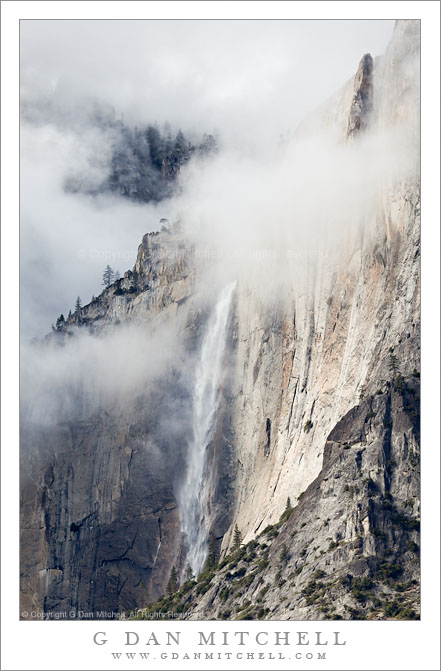
Upper Yosemite Fall and Lost Arrow, Autumn Storm Clouds

Upper Yosemite Fall and Lost Arrow, Autumn Storm Clouds

Upper Yosemite Fall and Lost Arrow, Autumn Storm Clouds. Yosemite Valley, California. October 30, 2010. © Copyright G Dan Mitchell – all rights reserved.

Autumn storm clouds swirl around the Upper Yosemite Fall, Lost Arrow, and the cliffs of Yosemite Valley.

Shooting with a long lens, I watched as the clouds floated in and out of this scene, at times almost completely obscuring Upper Yosemite Fall and then clearing. At this instant the clouds cooperated for a few seconds, lining up so that the fall was completely visibly, parting enough to let the pinnacle of the Lost Arrow appear at upper left, and revealing just a bit of the tree covered ridge in the background. A few seconds later the clouds again thickened and this view was gone.

I posted a black and white version of the same photograph perhaps two weeks ago. I have since printed the monochrome version and I like it a great deal. Today I returned to these files and since I feel that it also works in color I decided to post it again.

This photograph is not in the public domain and may not be used on websites, blogs, or in other media without advance permission from G Dan Mitchell.

G Dan Mitchell Photography
Flickr | Twitter | Facebook Fan Page | Facebook | Friendfeed | Email