Regarding Sharpness. And Obsession.

We have all seen the lengthy discussions about “which lens is sharpest.” While the ability of a lens to resolve detail is certainly important, it is not the only thing that is important. And in many cases, knowing which is the sharpest lens is not as important as know which among a number of sharp alternatives best suits your needs. I stumbled into another discussion of this topic online today and posted the following as my contribution. (Slightly edited here from the original post.)


Folks sometimes allow themselves to become completely distracted by “sharpness” to the point that they overlook a whole bunch of other important issues in their quest to find the holy grail of “sharp.” This can become the equivalent to realizing that good tires are important on a car, and then deciding to buy a particular car because it comes with the “best” tires… but is too big to fit in your garage, costs twice your annual income, has a terrible repair record, needs a tune-up every 750 miles, and only comes in a color your spouse hates.

For a few people doing certain types of very critical work, printing very large, working slowly and methodically, and willing to forego the compensatory advantages of other lens options, lenses like the excellent TS models, lenses from another manufacturer that only work with adapters, classic primes, and so forth might make some sense.

But just because a lens might measure a bit better to some extent in one of the areas that is measurable (e. g. “sharpness”), it does not necessarily follow that it is a better lens, nor that alternatives that may measure differently in sharpness – but are very nearly as good – will not also be excellent performers. It is also not true that these specialized lenses are required to produce large and effective prints.

It is interesting to watch people go through a process that may look something like the following at times, as they…

1. decide they need a sharper kens.
2. research lens sharpness.
3. consider only sharpness and overlook or dismiss other issues, including those mentioned in the sources analyzing sharpness.
4. decide that some lens is the “sharpest” – frequently some expensive prime, the most expensive zoom they can find, an alternative brand, a specialized TS, etc.
4.5. lust after said lens for some period. The excitement builds…
5. purchase the aforementioned Really Really Sharp Lens.
6. use the new lens and glory in it’s pure Divinely Sharp Wonderfulness, thereby confirming their wise choice.
7. share their wonder with others.
8. make more photographs, and eventually come to find out that a) in real photography the sharpness difference is rarely visible, b) there are downsides to using the sharper lens, c) the downsides sometimes compromise or lose the shot, and d) in many cases their previous “less sharp” lens proves just as useful and effective.
9. note that the new super Super Lens, while useful, begins to spend more time in the bag, and…
10. learn an important lesson or two about Lens Lust… or else repeat the cycle with a different WonderLens. :-)


To be clear, I’m not suggesting that sharpness is unimportant. I’m just encouraging people to keep things in perspective.

G Dan Mitchell Photography | Twitter | Friendfeed | Facebook | Facebook Fan Page | Email

Winter Dusk, Carmel Highlands Near Yankee Point

Winter Dusk, Carmel Highlands Near Yankee Point

Winter Dusk, Carmel Highlands Near Yankee Point. Carmel Highlands, California. January 2, 2010. © Copyright G Dan Mitchell – all rights reserved.

Winter dusk light and clouds over the Pacific Ocean at Carmel Highlands near Yankee Point, Pacific Coast Highway, California.

This is the companion image to the black and white photograph I posted yesterday, Before I made the exposures that I used to create that black and white landscape-orientation image, I first made a quick series of bracketed exposures in portrait mode. As I photographed, I knew that the dynamic range was going to be too large for a singe exposure so I quickly made a series of four exposures, from which I selected two that have blended to produce this image.

This photograph is not in the public domain and may not be used on websites, blogs, or in other media without advance permission from G Dan Mitchell.

G Dan Mitchell Photography
Flickr | Twitter | Facebook Fan Page | Facebook | Friendfeed | Email

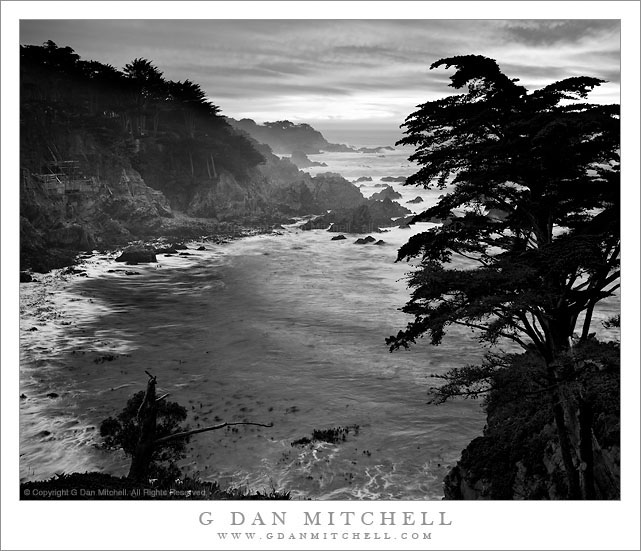
Yankee Point and Cypress, Carmel Highlands, Dusk

Yankee Point and Cypress, Carmel Highlands, Dusk

Yankee Point and Cypress, Carmel Highlands, Dusk. Big Sur, California. January 2, 2010. © Copyright G Dan Mitchell – all rights reserved.

A Carmel Highlands cypress trees stands at the edge of a cliff above the Pacific Ocean and Yankee Point at dusk.

Oddly, this is a photograph that sort of “didn’t make the cut” the first time I went through the batch shortly after making the photographs in early 2010. I had spent the afternoon photographing further south in the Big Sur area and several other photographs from the set turned out more as I expected – and this one seemed like a sort of problem child photograph, so I didn’t take the time needed to work with it. Eventually I forgot about it as I went on to other projects.

The photo had been almost a bit of a grab shot. As I was heading north back up the coast, thinking I had finished my shooting and was now on the way home, I was stunned to catch a glimpse of some intense post-sunset light as I rounded the bend at the head of this cove in Carmel Highlands. I wasn’t certain that I could find a composition and work out a photograph in the brief interval the probably remained before the light faded, but I quickly put on the wide angle zoom, attached the camera to the tripod, and headed over to the edge of the bluff. Exposure was a terrible problem because the brilliant and very colorful sky was quite bright, while the close side of the foreground tree was nearly black. I made managed to shoot the scene a few times, shifting from landscape to portrait mode and making three bracketed exposures of each composition.

When I got home and looked at the raw files I think I decided that it was just going to be too much work for too little reward, and I instead went to work on more promising shots from earlier in the afternoon. This week I came upon the series of shots again and wondered what I could do with them. My first inclination was to go with the color, and I did come up with a portrait orientation image in color that I will probably post before long. Then, as I began to work on the landscape mode image, I started to see it as having potential as a monochrome image. I tried it. I liked it. And here it is!

This photograph is not in the public domain and may not be used on websites, blogs, or in other media without advance permission from G Dan Mitchell.

G Dan Mitchell Photography
Flickr | Twitter | Facebook Fan Page | Facebook | Friendfeed | Email

Two Holiday Rituals

I have two holiday photographic rituals this time of year. I have begun one and will soon get to work on the other.

Today I began going through all of my raw files from 2010. I don’t even know how many thousands of files there must be, and it is perhaps better that I don’t know! Each time I do this year-end review I find a number of photographs with potential that I did not see right after I made them. Sometimes it simply takes a bit of distance in order to see what is there; other times I just moved on to another project before I was truly finished with the previous one. Don’t be surprised to see of these photographs posted here over the next few weeks.

Soon I’ll begin the second task, trying to pick my favorite photographs of 2010. I also enjoy this since the process lets me revisit and relive some of the experiences I had as I made the photographs. Given that I work from my “daily photograph” pool, it should be easier than reviewing the raw files – instead of thousands of files there are only a few hundred. However, it always turns out to be harder than I think it will be. I think there are perhaps two reasons. First, while most of the raw files are not really worth a second look, the photographs from which I select the “favorite of the year” images are all images that I like. This makes it very hard to narrow the selection down to perhaps ten or twelve photographs. Second, in some ways I am the least qualified to understand my photographs. That may sound odd, but no one else can see them in the same way that I do since I was there when they were made and thus know things about them that only I can know. Other viewers are perhaps better able to simply view them “as photographs.”

Regarding the second task, feel free to share your ideas and suggestions concerning the selection process or even to suggest specific photographs that might have connected with you.

G Dan Mitchell Photography | Twitter | Friendfeed | Facebook | Facebook Fan Page | Email