
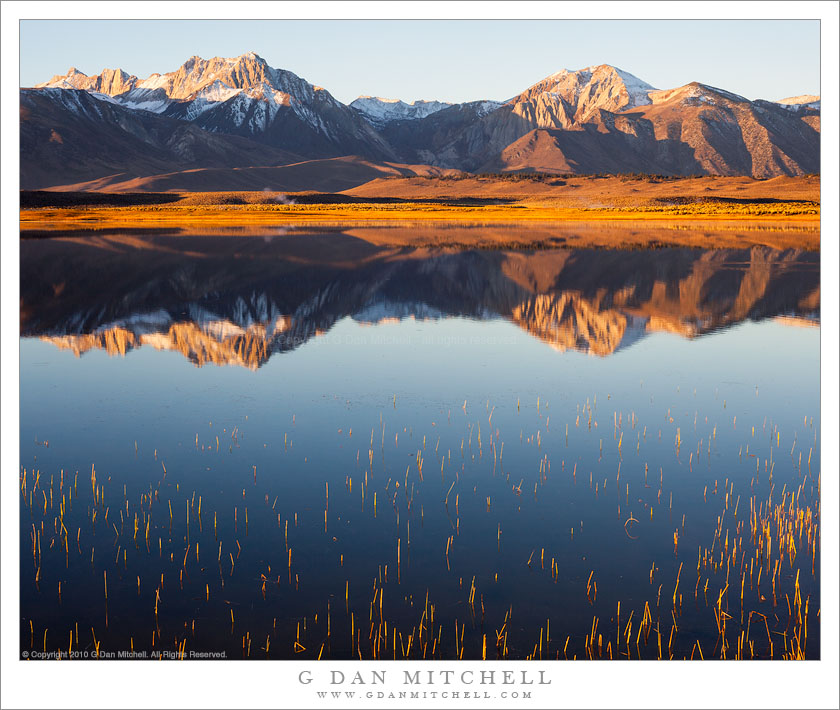
Dawn, Alkali Lake, Eastern Sierra

Dawn, Alkali Lake, Eastern Sierra
Dawn light on Alkali Lake and the peaks of the eastern Sierra Nevada near Convict Lake.

Dawn, Alkali Lake, Eastern Sierra. Owens Valley, California. October 10, 2010. © Copyright G Dan Mitchell – all rights reserved.

Dawn light on Alkali Lake and the peaks of the eastern Sierra Nevada near Convict Lake.

I posted a photograph very much like this one a month or so ago, but I like this place and the morning light so much that I’m posting this similar photograph. The location is on the shore of a small alkali lake out in Owens Valley/Long Valley, in an area that is full of hot springs. On this very cold early October morning, steam was rising from the many hot springs in the area as the sun rose, lighting the eastern face of the Sierra Nevada near Convict Lake, the sagebrush-covered hills below the Sierra, and finally the surface of the small lake.

For many years after I started visiting the east side of the Sierra Nevada I mostly ignored the high desert terrain such as the area around this lake. As time went on and I looked further east I began to venture out here, and I discovered a beautiful landscape that is affected by proximity to the Sierra but which is not really “Sierra Nevada” itself. The bulk of the eastern escarpment is a constant presence here, but the character of this place is more that of the basin and range country — dry, full of sagebrush, with playas and rocky outcroppings.


G Dan Mitchell is a California photographer and visual opportunist. His book, “California’s Fall Color: A Photographer’s Guide to Autumn in the Sierra” is available from Heyday Books and Amazon.

Blog | About | Flickr | FacebookEmail

Links to Articles, Sales and Licensing, my Sierra Nevada Fall Color book, Contact Information.


All media © Copyright G Dan Mitchell and others as indicated. Any use requires advance permission from G Dan Mitchell.

Basin Mountain, Afternoon Light and Haze

Basin Mountain, Afternoon Light and Haze

Basin Mountain, Afternoon Light and Haze. Round Valley, California. October 9, 2010. © Copyright G Dan Mitchell – all rights reserved.

Basin Mountain and the Sierra Nevada crest rise above Round Valley on a hazy afternoon.

There is a certain kind of afternoon light in the eastern Sierra that is hard to photograph – looking up at the range from Owens Valley into the afternoon sun the haze can be bluish and decrease detail and the light can be very bright. But it is a part of the experience of the “east side” that we all know, I think. I can’t say that I’ve tried to photograph it very often, but I stopped just off of highway 395 in the Round Valley area on this early October afternoon when I saw the rugged foothills rising above the sagebrush towards the Buttermilks and Basin Mountain and the Sierra crest around Mount Humphreys beyond.

For me, this is one sort of classic eastern Sierra view. Imagine a very warm or even hot afternoon. You are driving through high desert sagebrush country – which often surprises people who are headed to the Sierra and are thinking about high mountains and cool temperatures. The mountains to the west rise precipitously from the floor of Owens Valley, with peaks that can be nearly 10,000 feet higher than the lowlands in some places. You see snow on the peaks and sometimes on the slopes of the mountains. You know that there are places up there where you can park a car and walk out in cool mountain air and head up a trail through meadows and forests and cross a ridge into the alpine world – but the terrain gives little hint of this from below. The light gleaming on snow fields and rock projected into the sky reminds you of this other world high above.

This photograph is not in the public domain and may not be used on websites, blogs, or in other media without advance permission from G Dan Mitchell.
G Dan Mitchell Photography
Flickr | Twitter | Facebook Fan Page | Facebook | Friendfeed | Email

More Thoughts About the Pentax 645D ‘mini MF’ Camera

I responded to a post today in an interesting forum discussion about the new Pentax 645D “medium format” (or, as I prefer to call it, “mini MF” format) digital camera. This is a potentially game-changing camera. I has a 33mm x 44mm 40MP sensor and a body-only price of under $10,000. Its cost is far below that of competing mini MF bodies and a fraction of the cost of recent larger MF systems – and the price isn’t much above that of the high end full frame DSLR systems. While larger is not always better, for some types of photographers this puts a level and type of digital camera performance within reach.

In the discussion forum thread I referred to above, a writer had suggested that the 1.7x size differential between the Pentax 645D and full frame DSLRs would not be significant. In a sense he is right – it will not be significant to most photographers, and I surely cannot imagine why anyone would get one in order to make family photos to post on the web. However, I thought I’d share what I wrote concerning why I think that this might be significant for at least some photographers. My response (slightly edited) follows:

Photosite density is rarely the limiting factor when it comes to maximum print size from DSLR originals. As [the other poster] points out, “technique” stuff tends to be much more critical. Enlargement limits are more likely the result of stuff like camera movement, slight mis-focus, lens issues, etc.

I disagree that the size difference between the 24mm x 36mm full frame DSLR sensor and the 33mm x 44mm “mini MF” sensor isn’t significant. There are several reasons I feel this is the case: Continue reading More Thoughts About the Pentax 645D ‘mini MF’ Camera

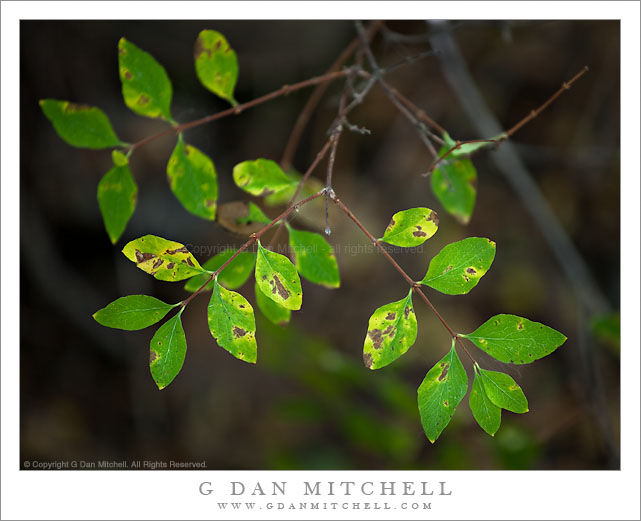
Fall Leaves, Lundy Canyon

Fall Leaves, Lundy Canyon

Fall Leaves, Lundy Canyon. Eastern Sierra Nevada, California. October 10, 2010. © Copyright G Dan Mitchell – all rights reserved.

Leaves transition from summer to fall colors in a deeply shaded area of forest in Lundy Canyon.

Since it was the second week of October, and the time at which I’ve seen Lundy Canyon aspens change color in the past, I headed up into the canyon on the last day of this visit to the eastern Sierra to look for aspen color. As I drove up the canyon from highway 395 I could see some brilliant color far above on the ridges above the canyon, but I wasn’t seeing much down in the bottom of the canyou. I continued up the canyon past Lundy Lake and the resort – closed up for the season – and then continued on the one-lane dirt road that goes on up to the trailhead, passing some flooded flats along the way. There is often color in these areas and then again in the grove of aspens near the trailhead… but not this time.

(Looking back on this “aspen season” from an early-December perspective, it was a bit of a strange one. It seemed to begin early at the higher elevations and there were stunningly colorful trees up high during the first week of October. However, storms soon came in and took down many leaves – and then there was a “dead zone” period of nearly two weeks before the color resumed at lower elevations. This visit to Lundy Canyon took place near the start of this slow period.)

After figuring out that the color I had coming looking for was not to be found, I started back down the canyon. I stopped briefly by the ponds but the light was not quite what I was looking for – it was still a bit too early in the afternoon and the light was harsh and coming from the “wrong” direction for my purposes. However, elsewhere in the canyon I decided that I had to photograph something before leaving the canyon for a planned evening shoot nearby, so I simply pulled out on a short dirt side road where I had earlier seen some tree trunks leaning against rocks. It turned out that I couldn’t find a composition there either – sometimes this is just the way it goes! However, I found these leaves nearby next to the path I had taken down to the river. I thought that the contrast between the green and yellow and the very dark forest floor might be interesting, so I put on a long lens (to minimize depth of field and to give myself some working distance) and I made a few exposures.

This photograph is not in the public domain and may not be used on websites, blogs, or in other media without advance permission from G Dan Mitchell.

G Dan Mitchell Photography
Flickr | Twitter | Facebook Fan Page | Facebook | Friendfeed | Email