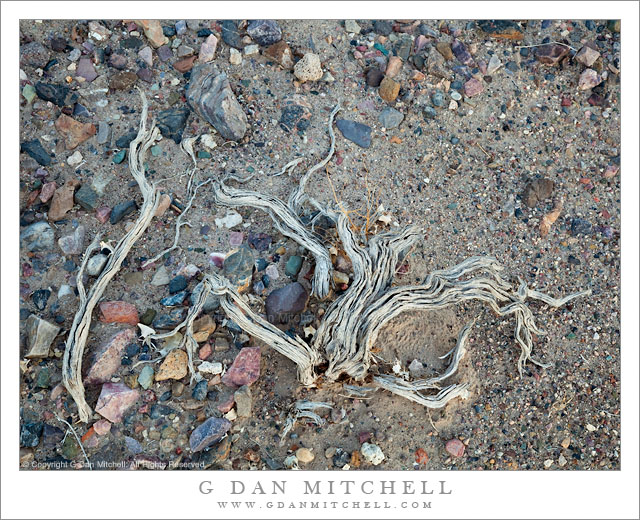
The skeletal branches of a dead plant against the pebbles of a desert wash, Death Valley National Park, California.
I came across the skeletal remains of this desert plant while photographing along the east side of Death Valley near the area identified on some maps as the Kit Fox Hills. I had just finished photographing across the floor of the Valley, capturing an area full of sparse desert plants backlit by the very last rays of sun, and the light had diminished after the sun dropped below the tops of the ridges on the west side of the Valley.
I saw this bit of dead plant near the edge of a wash among the rubble of many-colored rocks and pebbles that had, I presume, been washed down from the canyons in the mountains to the east. For a place that seems so colorless from a distance, there is an astonishing variety of color in these rocks. I can see greens, blues, various shades of pink and purple, and some that almost are orange. The branches are just as I found them, and the soft light with just a bit of directionality from the right fills the shadows that would otherwise be very dark.
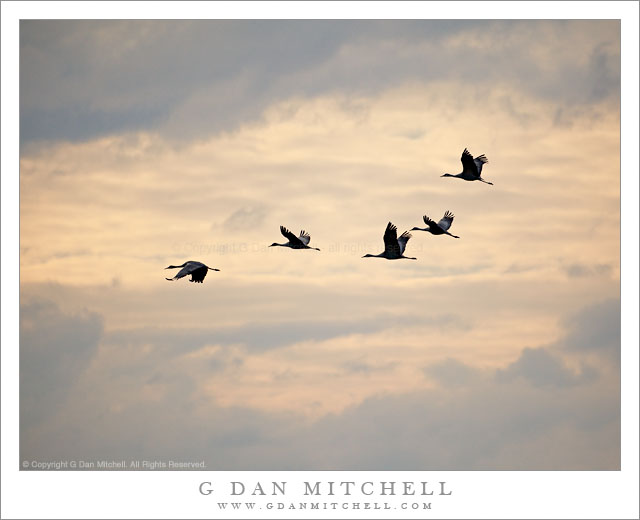
Five sandhill cranes take flight above the Merced National Wildlife Area in evening light.
Migratory birds have always been a subject that I’ve been aware of, but that I haven’t really paid enough attention to. Intellectually I know of their amazing travels between arctic and more temperate regions and I had heard about their appearance in California each winter season. I recall one magical evening a few years back when I began a long drive from the San Francisco Bay Area to Seattle late on a winter day, and as I travelled up the Sacramento Valley at twilight I saw huge flocks of birds and thought that I’d like to try to photograph this scene. I’ve seen and photographed a few interesting birds such as egrets and pelicans. But I somehow managed to mostly remain uninformed about their presence not far from where I live.
This season several things came together, seemingly by chance, to encourage me to actually make the effort to get out into California’s Great Central Valley to see (and hear!) the birds. The first was a chance meeting with one of my colleagues in front of the college espresso stand one morning. We were having a casual conversation and she mentioned that she had been out in the Cosumnes River area looking for birds recently. We talked a bit more and I asked her for more information. Being a librarian, she provided me with lots of information, including details of how to find some interesting places out there. A day or two later I found my way out to that part of the Valley and saw, for the first time close-up, the flocks of winter birds… and I was hooked. Within a few weeks I saw posts on the Chuq 3.0 blog where Chuq wrote about his photography of these birds. Then I saw a couple videos at Michael Frye’s blog that captured the “fly in” and “fly out” phases at the Merced National Wildlife Area. (This place is located out on a road that has to have my all-time favorite Central Valley road name: Sandy Mush Road ;-)
Fast forward a week or two and I was returning from shooting for four days in Death Valley, and driving into the Central Valley near Bakersfield. I looked at my watch and realized that I could probably make a small detour and be at the Merced National Wildlife Area before sunset. So I headed up highway 99 (rather than the more usual route up highway 5), found the turn off to Sandy Mush Road, and arrived at the area an hour or so before sunset on an evening when the clouds from a departing cold front lingered. I basically had no idea where I was going, since I had done literally no prior research other than finding the location via my iPhone. As I arrived in the general area I found a large field filled with what seemed like several hundred sandhill cranes. Slowly and quietly I stopped my car and got out on the side away from the birds and began to watch. I never did get to see the fly-in up close (though I could see a huge cloud of birds landing at a pond north of my position) but some of these cranes did depart from time to time, and I was able to photograph this group of the magnificent birds against the clouds in the western sky.
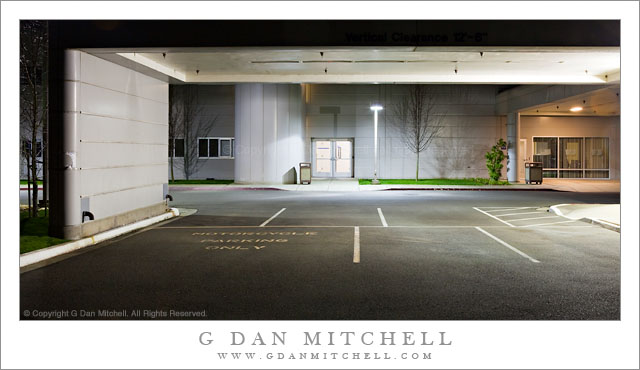
Night photograph of a covered area for motorcycle parking at the front of a clinic, Mare Island Naval Ship Yard.
This should be the final image in the recent run of night photography from Mare Island Naval Ship Yard, near Vallejo, California. To recap, near the end of February I joined my fellow night photographers from The Nocturnes for a “Mare Island Alumni” meetup and shoot. I’ve shot this location – virtually always at night – for something like five years now, and I still find new things to shoot on each visit.
Early on I mostly focused on what some call the “historic core” of the place – an area of dry docks, giant cranes, and old shops and factory buildings. Later I began to investigate areas around the periphery of this location and to poke my lens into odd little alleys and corners that I didn’t see at first. More recently I have begun to look at smaller and less obvious features of the place and I continue to expand the boundaries of the areas that I know and shoot. This shot and the companion shot I posted just before it are a bit of a departure from my usual Mare Island work in that the scene is a more modern sort of urban landscape illuminated by modern lighting that doesn’t have the warm glow of the security lights and other forms of illumination found elsewhere.
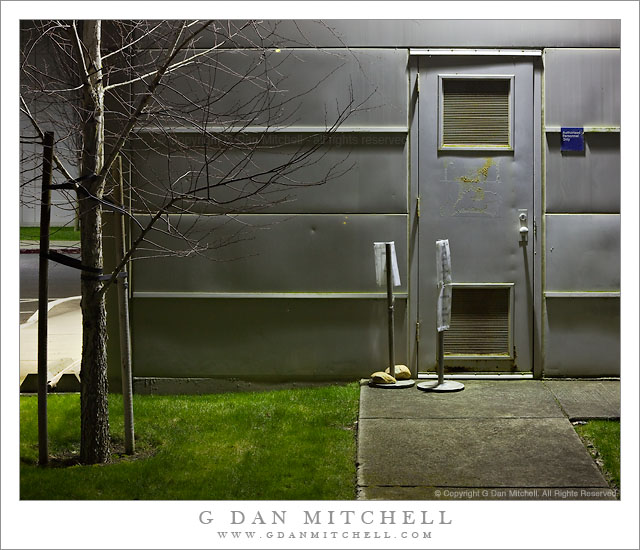
Night photograph of a metal walled building with a door, sidewalk, lawn, and tree – Mare Island Naval Ship Yard.
This is a bit of a different sort of night photograph compared to the others I have posted in this recent series. (Most of those were shot at some distance from my subjects – generally old, historic buildings – and in very saturated and colorful light.) Near the end of my evening shoot at Mare Island in late February I was walking back from a dark and lonely corner of the place when I passed a more modern facility, an out-patient clinic of some sort. This facility is something of a stark contrast to the surrounding area. The building is relatively new and the walls are not the usual brick and/or corrugated metal, but instead are a more modern-looking sort of metal paneling. There is landscaping, including small patches of lawn and small trees. And the light is completely different. Elsewhere in the darker areas of Mare Island the lighting tends toward yellow, coming from sodium vapor lamps, though it also includes green and occasionally other hues. But here the light is fairly neutral and actually looks almost white. I wasn’t quite sure what to do! :-)
But then it seemed to me that it might be interesting to see what I could do with this modern (though not flawless) structure and its surrounding landscaping. Here a small door, partly blocked by some sort of signs, leads into a very small section of a building and is lit a bit mysteriously from above. Sidewalks lead away from the door and a small, forlorn patch of lawn sits near the corner of the building, with a single leafless tree supported by stakes. When I saw this spot and when I look at the photograph now I get this feeling that there should be some story behind all of this… but I have no idea what it might be.
Photographer and visual opportunist. Daily photos since 2005, plus articles, reviews, news, and ideas.
Manage Consent
To provide the best experiences, we use technologies like cookies to store and/or access device information. Consenting to these technologies will allow us to process data such as browsing behavior or unique IDs on this site. Not consenting or withdrawing consent, may adversely affect certain features and functions.
Functional
Always active
The technical storage or access is strictly necessary for the legitimate purpose of enabling the use of a specific service explicitly requested by the subscriber or user, or for the sole purpose of carrying out the transmission of a communication over an electronic communications network.
Preferences
The technical storage or access is necessary for the legitimate purpose of storing preferences that are not requested by the subscriber or user.
Statistics
The technical storage or access that is used exclusively for statistical purposes.The technical storage or access that is used exclusively for anonymous statistical purposes. Without a subpoena, voluntary compliance on the part of your Internet Service Provider, or additional records from a third party, information stored or retrieved for this purpose alone cannot usually be used to identify you.
Marketing
The technical storage or access is required to create user profiles to send advertising, or to track the user on a website or across several websites for similar marketing purposes.