
Category Archives: Commentary

Photographic Myths and Platitudes: No Post-Processing!

(The following is another (more or less stream of consciousness) post that I wrote in reply to a comment I read somewhere else, in this case suggesting that photographic history implies that post-processing or manipulating photographs after the shutter has been clicked is ethically questionable and should be avoided. I’ll start with a modified version of the message I saw.)

…it is invalid to claim that Adams was a modern photoshoppe[r]… 

I… recommend to every beginner to do film… to develop a better feeling for composition… The most difficult in digital is to restrict yourself to [taking] a limited number of photos… in the beginning…

…I want to leave my photos as natural looking as possible…

This is an important conversation, for the beginner and for people who have been making photographs for a long time.

When people make pronouncements about how photography is supposed to be done or has been done based on notions about what great photographers do or have done, it is important to check those notions against reality. In photography there is a frequent mantra about “no post processing” and “get it right in camera” that has been, in my view, perverted to suggest that photographs are created in certain ways that do not correspond to reality – and worse, that other photographers should adhere to these false “rules.” It obviously is important to develop an eye for composition and an ability to operate a camera, but that is most certainly not the end of it, nor is there much of any evidence to indicate that great photographers have felt that photography is limited to what happens in the camera.

Did Adams ever make a “bad” negative look good in post? That depends on what you think of as bad. I’m can’t think of photographs that were poorly composed and where post-processing compensated for this. (However, there are some negatives that were damaged in the fire at the Yosemite studio very early on, and in which the composition is affected by this. I’m pretty certain that “Monolith” was burned along its top edge, which is partly responsible for the crop with which we are familiar today.)

Adams did, by the reports that I have heard first hand from people who knew him, make a good number of banal and boring exposures. In fact, like photographers today, he made far, far more uninteresting and forgettable photographs than great ones. His famous statement about a dozen successful photographs in a year being a good crop is a partial acknowledgment of this truth about photography.

Some of Adams’ most famous, most successful, and most universally admired photographs would have been forgettable without extensive work in post. It still surprises me how many photographers don’t know this and, in fact, believe that the opposite is the case. A number of other photographers who knew and worked with him regularly point this out in their presentation on Adams. One of their favorite and most compelling examples is the iconic “Clearing Winter Storm” photograph of Yosemite Valley. There are three powerful pieces of evidence in this case: the straight prints of the negative (which has been printed by others), Adams’ own shorthand instructions for his extensive dodging and burning of the image when producing prints, and the profoundly different appearance of the print we all know, in which clouds that were almost uniformly near white become a dramatic mixture of very contrasting tones. Further, Adams made a number of exposures of this exact composition – most of which are not as spectacular – but he selected one from which to create the brilliant print in post that became so famous. Continue reading Photographic Myths and Platitudes: No Post-Processing! →
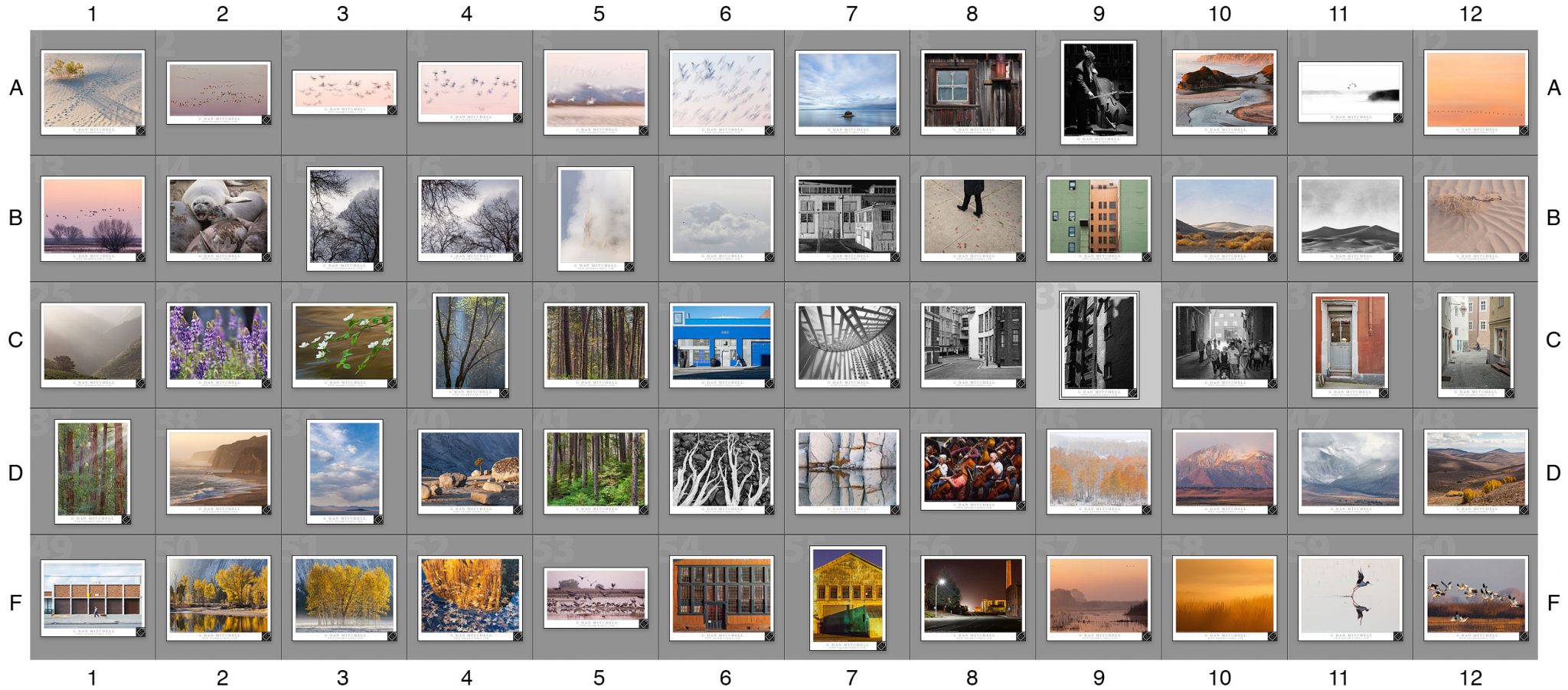
2013 Favorite Photographs – First Cut

Each year at about this time I participate in the annual ritual of selecting a set of favorite photographs from the past year. It is a really interesting task – to review a year’s worth of photographs and relive some of the experiences and places from which they came. But it is also a daunting task! It is hard to be objective about my own photography, and I invariably end up with a list of possible candidates that is way too long.

G Dan Mitchell 2013 Favorites - First Cut
G Dan Mitchell 2013 Favorites – First Cut (click for larger version)

This years way-too-long list included 60 photographs! The usual process is to strip images out of this set one by one until a reasonable number remain and there is a good balance among different sorts of photographs. But saying “no” to a photograph that I like is often pretty difficult. Yesterday I tried to opposite approach – instead of identifying what I might dismiss, I went through and simply picked the photographs that I was (fairly) certain would have to be included. There were a dozen, though after some further thought and getting feedback from others, there might actually be a dozen and a half.

So here is a set of thumbnails of the full 60 photo set. I’d love to hear what on this list jumps out at you? Do you have favorites? Are there some here that you remembered from when I first shared them? Thanks in advance! (Click the image to see a larger version.)

© Copyright 2013 G Dan Mitchell – all rights reserved.

G Dan Mitchell is a California photographer and visual opportunist whose subjects include the Pacific coast, redwood forests, central California oak/grasslands, the Sierra Nevada, California deserts, urban landscapes, night photography, and more.
Blog | About | Flickr | Twitter | Facebook | Google+ | 500px.com | LinkedIn | Email

Text, photographs, and other media are © Copyright G Dan Mitchell (or others when indicated) and are not in the public domain and may not be used on websites, blogs, or in other media without advance permission from G Dan Mitchell.

Where has Dan been?

I haven’t exactly been hiding, but I have been way off the grid for about a week and a half while photographing with a group of friends at a beautiful Sierra Nevada back-country location. I returned very early this morning to find that a number of people have left comments here at the blog. Thanks for that! As soon as I have a chance to file through all of them (and dismiss the portion captured by the spam trap!) I will try to comment and respond where appropriate.

About the Yosemite “Rim” fire… and more

UPDATE and a NOTE:

Update: Shortly after I posted this, my reports on highway 120 through the park via the Tuolumne Meadows area  were rendered incorrect/outdated by way of an updated announcement from the park service as follows:

“Beginning at 12:00pm on Wednesday, August 28th, Tuolumne Meadows and the High Sierra will only be accessible via Highway 120 East through Lee Vining.  The Tioga Rd/Hwy 120 East will be temporarily closed between White Wolf Lodge and the Big Oak Flat Rd./Hwy 120 West at Crane Flat; the closure is estimated to be 3 to 4 days.  Tuolumne Meadows Lodge, the High Sierra Camps, and Tuolumne Meadows and Porcupine Flat campgrounds all remain open.”

Basically, this means that you will not be able to use highway 120 as a route across the Sierra until further notice. I’m not surprised – in fact, I’ve been somewhat surprised that the road remained open this long. Apparently the following URL is also a good source of updates from the park: http://www.yosemitepark.com/yosemite-fire-update.aspx

Note: All of which brings me back to my original statement that I don’t have inside information on this fire, and that anyone traveling to the area needs to check official sources for conditions updates. I will likely not update this page as things change, so the information posted here should be regarded as potentially being out of date!

My original post follows…

—

A few people have asked me for information about the “Rim” fire which started not far from Groveland near highway 120, and which is currently burning along the northwest boundary of Yosemite National Park, generally moving east and north toward the highway 108 area. While I know much of this area fairly well from many years (decades, actually) of visits, I do not have any inside information about the fire itself, nor am I an expert on wildfires. One good source of (limited but objective) information is the Stanislaus National Forest Rim Fire Incident web page. A map on this page is a quite amazing source of information, especially when combined with some familiarity with the area and a reading of various written reports. (The version on the main page seems to be based on Google Maps, and allows you to scroll around and zoom in.) Lots of folks who live and work in the area are sharing updates on the usual social media sites. The Mariposa Gazette is another local news source.

The fire started on August 17 more or less midway between Groveland and the  northwest park entrance and not far off of the highway 120 corridor near the Rim of the World area overlooking the canyon of the Tuolumne River. (Highway 120 is a common route for entry to the park from the west and northwest, and it connects via Tuolumne Meadows and Tioga Pass to the east side of the Sierra at the town of Lee Vining.) The spread of the fire at first was somewhat quick, which is no surprise given the extremely dry conditions in the Sierra following a second very dry winter and almost no real precipitation since late 2012. Then, between about August 20 and 23, the fire exploded, expanding  very quickly to cover a huge area generally to the east and north of the starting point, with the fire generally racing northeast but also spreading to the north and south. Continue reading About the Yosemite “Rim” fire… and more →