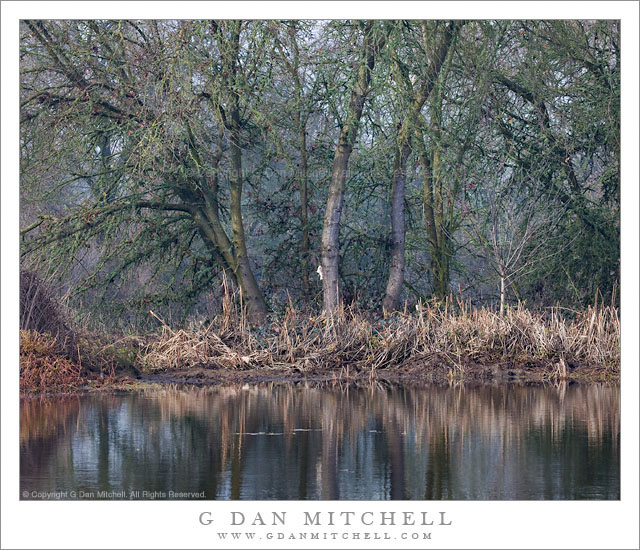
Weak sunlight breaks through Central Valley tule fog to illuminate trees and brush growing on a levee near the Cosumnes River.
This morning started out with extremely dense Central Valley tule fog – at first so thick that I more or less gave up photographing. But eventually, as usually happens, the upper layers of the fog began to thin, and some light began to filter down through the fog. By late in the morning the fog was thinning enough that very pale sunlight began to show through and softly light the dense vegetation on this levee along the edges of the Cosumnes River. This is an incredibly rich environment in the winter, especially with all of the water from winter rains and the nearby river, and the vegetation grows very thick here.
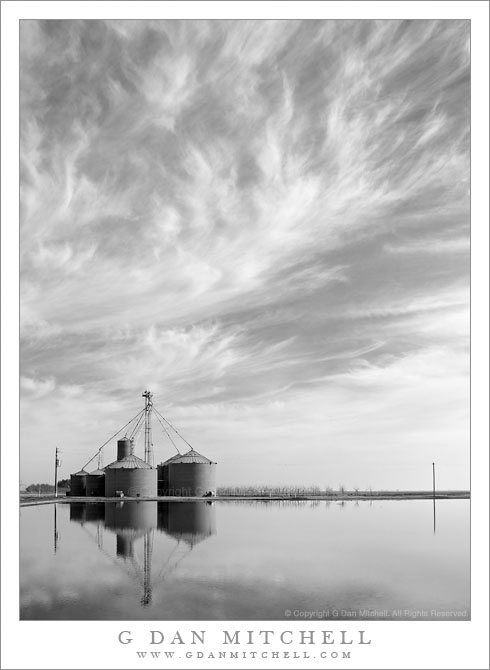
Thin winter clouds drift above farmland, Central Valley, California.
Photographing these beautiful winter clouds above the California Central Valley near the Cosumnes River between Stockton and Sacramento involved a certain amount of luck. For the most part it had been an extremely foggy morning – so foggy that at a few points early in the day I simply couldn’t find anything to shoot. Eventually the light began to filter down through the tule fog and I had some good luck shooting further up the valley at the Cosumnes River Wildlife Preserve.
At a certain point as the fog begins to thin it goes through a phase that is not so photographically compelling. The very thick fog can be quite interesting, and the light can be very special just as the sun starts to force its way through the fog as it starts to clear. But they there is a period when it is sort of sunny and sort of foggy, and but perhaps lacks the best aspects of each of the two conditions. That is how it was at about the time I left the Preserve and started back down the valley on my drive home.
Much earlier in the morning I had visited this side road near a bend in the Cosumnes River, so I decided to try it again since it was only slightly out of my way on the return drive. I drove slowly all the way to the end of the side road – to where it runs into the levee at the river – and then turned around to start back. I saw lots and lots of waterfowl, including impressive sandhill cranes and beautiful white egrets, but they were all too far from the road or in areas that didn’t provide the right kind of background. Near these flooded fields I stopped to consider trying to photograph some of the birds, changed my mind, and instead decided to see what I could do with these buildings, the flooded fields, and the sky. It was my luck that this final stop coincided with the near clearing of the fog and the appearance overhead of these wonderful clouds.
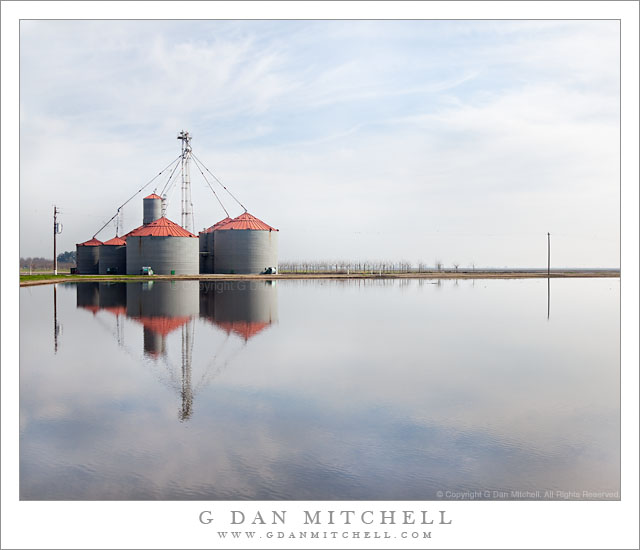
Agricultural facilities and Central Valley sky reflected in the surface of a flooded field.
This area turned out to be fun place to shoot. It is along a fairly nondescript road that branches off from Interstate 5 midway between Stockton and Sacramento and eventually dead-ends against a levee lining the Cosumnes River. I had been told that it is a good place to look for migratory birds – and, indeed, it is. Although it was hard to see them due to the very thick tule fog when I first arrived shortly after dawn, when I came back in the early afternoon the sky had cleared and the many fields, vineyards, and ponds along the road were filled with waterfowl.
I first saw this set of “structures” (silos? Being a “city boy,” I’m not certain of the right way to describe cylindrical storage facilities like this) as I drove out from Interstate 5 towards the river. They make for quite a striking sight – they are quite large, they are tall and the tower above is even taller, the brick colored roofs stand out against the other colors, and they are reflected in the still water of surrounding ponds. It was on my way back past them that I saw the view over this pond. I had just stopped to make another photograph of the ponds and I thought I was finished for the day – my thoughts were getting back to the highway and heading home. But I decided to walk down to a levee that let me place the structures and their reflections across the water and surround the image of the building and the thin horizon line with sky above and below.
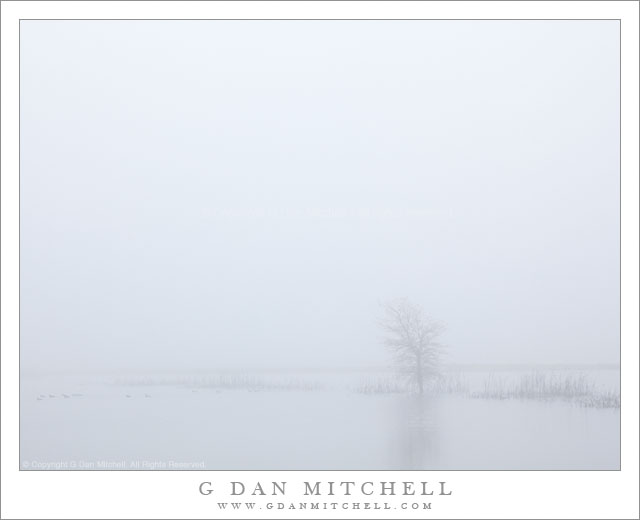
A solitary tree and a winter pond on a very foggy Central Valley morning, Cosumnes River Wildlife Preserve.
On my first visit to this wildlife preserve in California’s Central Valley (located between Stockton and Sacramento) I was thinking that I might have a chance to photograph wildlife, namely that incredible number of migrating birds that spend their winters in the rich, wet areas of this part of California. I knew it would be foggy, but I like that. (If you have followed my blog for even a short time you have perhaps seen some of my “barely there” photographs in which most details are nearly entirely obscured by clouds, rain, mist, or fog. )
I was not disappointed by a lack of fog! When I arrived it was so thick that I couldn’t see more than perhaps 100 or 200 feet! The Central Valley fog us tule fog which rises from the wet ground rather than blowing in from somewhere else. (The latter is the type of fog in, say, San Francisco, where it often blows in off the ocean.) Since tule fog starts at ground level, it often is not that thick. On a number of occasions I’ve been driving (slowly!) though terribly thick tule fog in the Central Valley, so thick that it seemed risky to drive at even 25 mph, only to look up and see stars in the sky overhead! On my way past Tracy on this morning, as I entered the fog I noted that it was perhaps only 30-50 feet deep. Because of this, the fog has a special quality that is not found as often in the ocean fog that is more common in the San Francisco Bay Area. The tule fog seems often to me to have a luminous quality that I attribute to the light that comes down from above even in the thickest fog.
That was somewhat the case here. I walked into the slough area across the road from the visitor center at the Preserve, and into an area that is mostly open fields in the summer, but mostly a giant pond in the winter. Everywhere around me I could hear the hundreds or thousands of waterfowl – ducks, geese, and who knows what else, and I later saw egrets and sandhill cranes – but I could see almost nothing. Eventually I could just barely make out his small tree standing on a shallow area where some grasses grew. I wondered if the photograph would have enough contrast to even be usable, but in the end there was just enough detail. (It is hard to see in the small jpg, but it is certainly there in the 12 x 18 test print I made.) At first I thought it would end up being a monochrome photograph, and I spent a lot of time taking it through my workflow with that in mind. But something just wasn’t quite working for me, so I decided to reconsider and try a color rendition. In the print, I think that this ends up looking better in color in several ways. First, the soft blue cast that I thought I’d want to avoid, more strongly evokes for me the feeling of actually being there, especially through that luminous quality of the tule fog light that I mentioned earlier. In addition, I think that some of the very subtle color variations turn out to be important.
Photographer and visual opportunist. Daily photos since 2005, plus articles, reviews, news, and ideas.
Manage Consent
To provide the best experiences, we use technologies like cookies to store and/or access device information. Consenting to these technologies will allow us to process data such as browsing behavior or unique IDs on this site. Not consenting or withdrawing consent, may adversely affect certain features and functions.
Functional
Always active
The technical storage or access is strictly necessary for the legitimate purpose of enabling the use of a specific service explicitly requested by the subscriber or user, or for the sole purpose of carrying out the transmission of a communication over an electronic communications network.
Preferences
The technical storage or access is necessary for the legitimate purpose of storing preferences that are not requested by the subscriber or user.
Statistics
The technical storage or access that is used exclusively for statistical purposes.The technical storage or access that is used exclusively for anonymous statistical purposes. Without a subpoena, voluntary compliance on the part of your Internet Service Provider, or additional records from a third party, information stored or retrieved for this purpose alone cannot usually be used to identify you.
Marketing
The technical storage or access is required to create user profiles to send advertising, or to track the user on a website or across several websites for similar marketing purposes.