
Fujifilm recently announced the X-E5, the latest camera in their X-E series. I think this model series is intriguing.. It is small and lightweight, well designed. has a lot of useful features, incorporates a high resolution sensor and IBIS (in body image stabilization) , and is compatible with Fujifilm’s excellent lenses. It has a few other features that may or may not appeal, along with one “elephant in the room” issue.

(Notes: I omit the hyphens between X and E in this article. I have rounded prices to the nearest dollar. Photographs of Fujifilm products used by permission from Fujifilm. Affiliate links in this article lead to B&H Photo — they return a small fee to this website if you use them to make a purchase — thanks in advance!.)
Right up front, let me be clear about one thing: I have not had my hands on the XE5 yet. I owned the XE1, my first Fujifilm camera, about a dozen years ago. Our photographic household has had the XE2, XE3, and XE4, and I have recommended all of them to various potential buyers over the years. While I cannot give a “hands on” review of the new camera at this point — hey Fujifilm, I’m here if you have one to loan! — I am qualified to comment on its features and who may find them appealing.
The XE Series
Let’s start with a bit of XE history. The original XE1 camera came out in 2012. At that time it was one of only two interchangeable lens x-trans* cameras from Fujifilm — the other was the more expensive “flagship model,” the XPro1. The XE1 was a smaller, less-expensive alternative for those who wanted a Fujifilm rangefinder-style camera with interchangeable lenses. Importantly, the XE1 (like later XE models) used the same sensor found in high-end Fujiflm APS-C cameras, which at that time was the 16MP sensor used in the “flagship” XPro1.)
(*”x-trans” refers to Fujifilm’s unique arrangement of the red, blue, and green photo sites on the sensor, a design that was said to help control aliasing/moire on cameras that do not use anti-aliasing filters, among other things.)
Several features distinguished the XE1 from the XPro1. The XPro1 had the Fujifilm’s innovative hybrid viewfinder, which let the photographer choose either an optical viewfinder (OVF) or an electronic viewfinder (EVF). The XE1 only had the EVF. The XPro1 had a more complete set of manual controls than the XE1. The XE1 was smaller than the XPro1 and also significantly less expensive at just under $1000 rather than $1700.
The XE1 appealed to photographers who wanted to try the Fujifilm x-trans system and who were attracted to its rangefinder-style design. It also was of interest to those looking for a very small interchangeable lens camera for things like street and travel photography.
Because it worked with Fujifilm’s expanding line of lenses and used the same sensor found in the flagship XPro1, this less-expensive camera was capable of producing equal image quality.
The original XE1 had some downsides, too. Given the state of EVF technology at that time, the display was slow and prone to “glitching,” unlike the real-time optical displays of DSRL cameras and the OVF in the XPro1. The autofocus (AF) performance was less than optimal. The small body and tightly spaced controls could seem awkward to users accustomed to larger cameras. As mentioned above, the controls were somewhat simplified by comparison to the XPro1.
The series continued with the XE2 (and XE2s update), XE3, and XE4. These cameras continued the legacy of using the same sensor (and other technology) found in more expensive Fujifilm cameras of their generation, of providing a much smaller ILC (interchangeable lens camera) body, of using somewhat simplified manual controls, and of providing a lower-cost option among Fujifilm’s expanding set of higher-end and more expensive cameras.
Notably, Fujifilm reduced the price of XE models after the XE1, to between approximately $800 (XE2) and $850 (XE3 and XE4) — thus positioning the XE series more firmly as a low cost alternative among other Fujifilm cameras.
My XE Experience
As mentioned, over a dozen years ago the XE1 was my first Fujifilm camera. I had seen other photographers using it and the XPro1, and I was intrigued. I was using (and still use) a large, full-frame Canon system for much of my photography, and I was looking for something smaller and lighter for street and travel photography.
While the camera had some performance limitations (mainly related to the EVF and the AF system), I found it to be a solid product and I got a lot of mileage out of it — I liked it a lot. Even though that was merely a 16MP camera, I could produce relatively large prints from it, including some that I sold and licensed.
At first I found the small XE body a bit awkward since I was used to larger DSLRs. But I soon adapted and developed instincts for its use. It was a fine tool for street and travel photography and other work done while walking about. I even carried it into the Sierra Nevada backcountry as a second camera on landscape photography expeditions. Overall I was impressed, and I gradually picked up a diverse set of Fujifilm lenses.
Although I did not personally own the XE2/XE2s, XE3, or XE4, my wife (also a photographer) has owned several of them and currently uses the XE4 alongside a full-frame system from another manufacturer. I have used each of these XE models at least a bit, and I’m familiar with the cameras and their features.
The XE5
The new XE5 was announced in June 2025, with first shipments anticipated in August.
Bottom line up front:
- Its features make it a worthy update and successor to the previous XE models. Like them, it uses the current best Fujifilm x-trans sensor, adds IBIS, and other features… and remains a small package that works with all Fujifilm lenses to produce excellent image quality.
- Its design language has been refined, making it visually similar to the popular Fujifilm X100vi.
- It has a few unusual features that some photographers will appreciate, but which others may view as a bit “gimmicky.”
- The price doubled by compared to previous models!
The Good Stuff
The XE5 has a number of attractive features and updates.
40 Megapixel Sensor — Over the past few years Fujifilm has been moving their APS-C x-seres cameras to a new, high-resolution 40MP sensor, and that sensor is found in the XE5. That is good news, though not unexpected — Fujifilm typically puts their most recent sensor into the XE cameras.
I currently use the Fujifilm XT5, which was one of the first cameras to get this sensor, and it is excellent. The added resolution is welcome, even if it isn’t strictly necessary for everyone’s photography. Fujifilm has managed to increase the photo site density without compromising high ISO performance or noise.
X-Processor 5 — The camera uses the newer X-Processor 5 “imaging engine” found in current high-end Fujifilm cameras. This plays out in a variety of ways, including updated power management and the promise of improved auto focus and more.
IBIS — Fujifilm added IBIS to the XE5. This is also not unexpected, as IBIS has become more or less a standard feature on most recent cameras. IBIS moves image stabilization from lenses to the sensor. This has benefits, including that it works with virtually any lens and does not require special image-stabilized lenses. It works especially well with the many Fujifilm prime lenses that lack stabilization. IBIS can be very useful for low-light handheld photography, something that many XE users are likely to do, but it is helpful in more typical situations, too. Fujifilm claims that XE5 IBIS can provide an extra 7 stops of stabilization in the center of the frame and 6 stops at the edge. (This may vary with different lenses.)
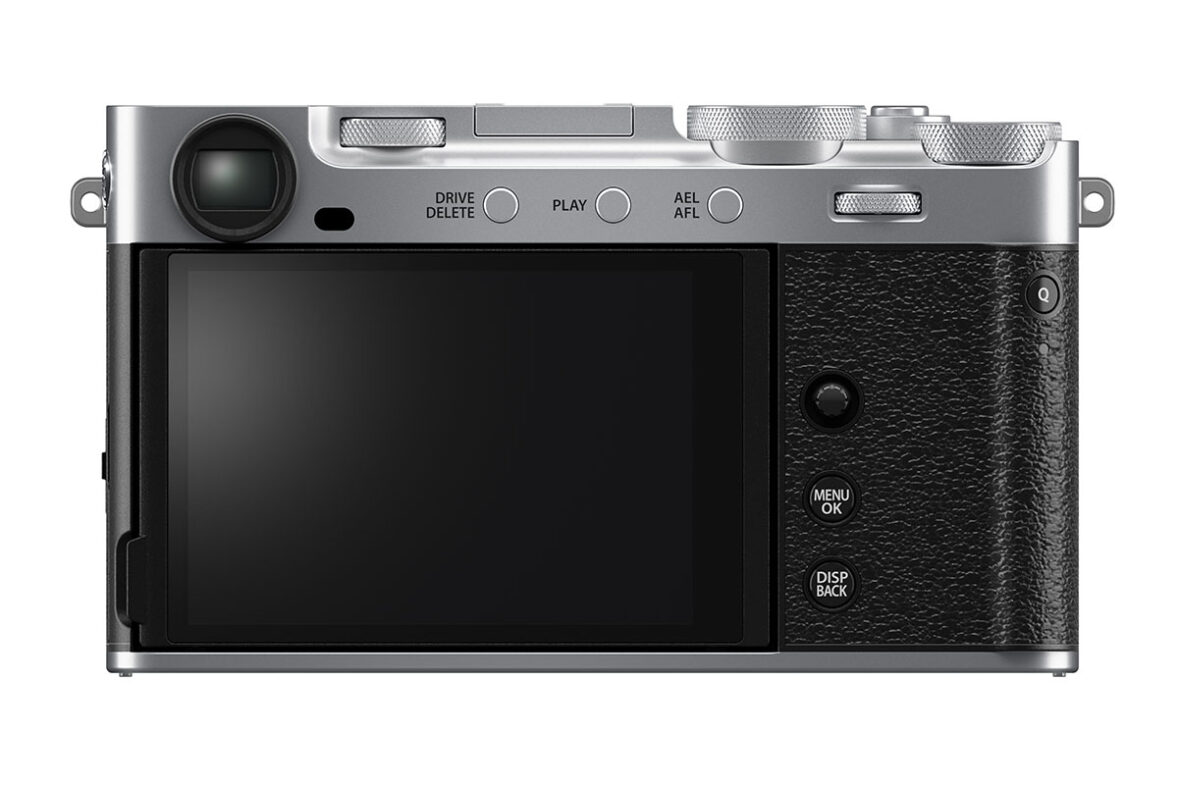
Tilting Rear Screen — Camera rear screen designs are quite varied, ranging from non-tilting fixed screens to screens that can flip out to the side or, face the front of the camera, or even be reversed to hide rear screen entirely. Some smaller cameras have eschewed movable screens, but the XE makes an effective compromise with a “tilt screen” that works well while retracted, can tilt up (for waist-level shooting), down (for holding the camera overhead), or even face forward (for selfie shooters and vloggers). This is my favorite rear screen design — I’m not a fan of screens that must be flipped out to the side. It is simple, efficient, compact, and provides a great deal of flexibility.

AF Mode Switch — The XE5 adds a physical switch to select either manual focus, single-shot autofocus, or continuous autofocus. Previously, changing this required a trip to the camera’s menus, so this placement will please those of us who switch among modes and between autofocus and manual focus.)

Control Points — Fujiflm cameras usually offer multiple user-definable buttons and knobs that can be assigned to control various camera functions. The XE5 adds to this collection, including with a new switch on the front of the camera.
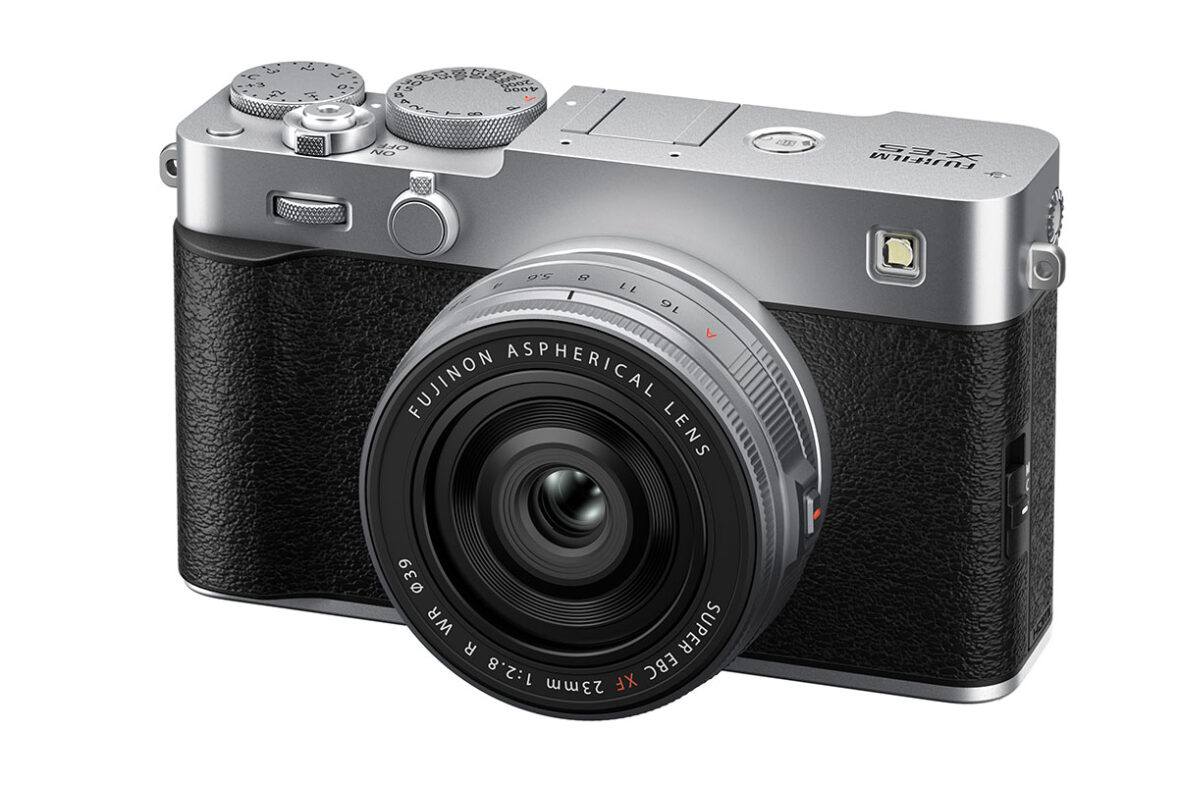
Camera Design/Appearance — The XE5 is, of course, quite small for an interchangeable lens camera with a high quality APS-C sensor and extensive manual controls. It makes for an especially small package when paired with the new 23mm f/2.8 or the older 27mm f/2.8 “pancake” lenses. Traveler photographers and street photographers, among others, will find this an unobtrusive camera that can be stashed in small places — small enough that you are likely to have it with you more often.

Although this is subjective, Fujifilm appears to have refined the design of the XE5 a bit. The design looks clean and tight to me, with a pleasing minimalist aesthetic. The company claims that it moves the design in the direction of the popular X100vi. That’s a good thing, and overall the camera presents a clean and functional design and layout that is consistent with its likely use. It comes in two visual schemes — an all-black model and one that combines black and silver components.
Other Features
Fujifilm includes some other features whose utility might be debatable — some will love them while others may wonder why they are there… or even regard them as gimmicks. In general, they don’t do any harm, though whether or not they add value will be an individual decision.
Surround View Mode — Some cameras with optical viewfinders (like the XPro series) can display a larger area in the viewfinder than what will be captured in the photo, letting you see things outside the frame as you shoot. The XE5 digital surround view mode simulates this in the electronic display. When using a cropped mode (like digital telephoto or a different aspect ratio than 3:2) the viewfinder shows the “extra” unused space around the reduced image capture area. While potentially useful in some situations, this digital mode comes with a downside: it works only when you crop the image area, resulting in decreased resolution. (Truth be told, this is essentially the “sports finder mode” found on several other Fujifilm cameras.)
Film Simulations — Film simulations are just that — presets designed to simulate the appearance of various types of old-school film. The availability of simulations is a general feature of Fujifilm cameras and not unique to the XE5. They work with .jpg images in-camera, so simulations are more likely to interest those willing to accept the somewhat compromised quality of the .jpg format, and who may be less enthusiastic about post-processing. Some people love the “sims,” while others prefer to shoot the higher quality raw format and post-process to their own taste. (Those shooting raw can still apply simulations — and other presets — using post-processing software from companies like Adobe.)
Film simulation dial — Fujifilm has added a hardware dial for selecting film simulations. The dial is unobtrusively embedded in the top plate of the camera. Some feel this is a useful feature, but I have my doubts. While I like the idea of having hardware controllers (buttons, knobs, etc.) to access settings that we use frequently, this feels a bit gimmicky. Those who like the simulations most often choose one and shoot with it, perhaps only changing to a different one occasionally. This hardly seems to warrant adding a hardware control — especially when hardware controls for other important features like ISO are omitted. (You can see the round film sim dial and display between the “Fujifilm X-E5” lettering and the flash hot shoe area in the photo below.)
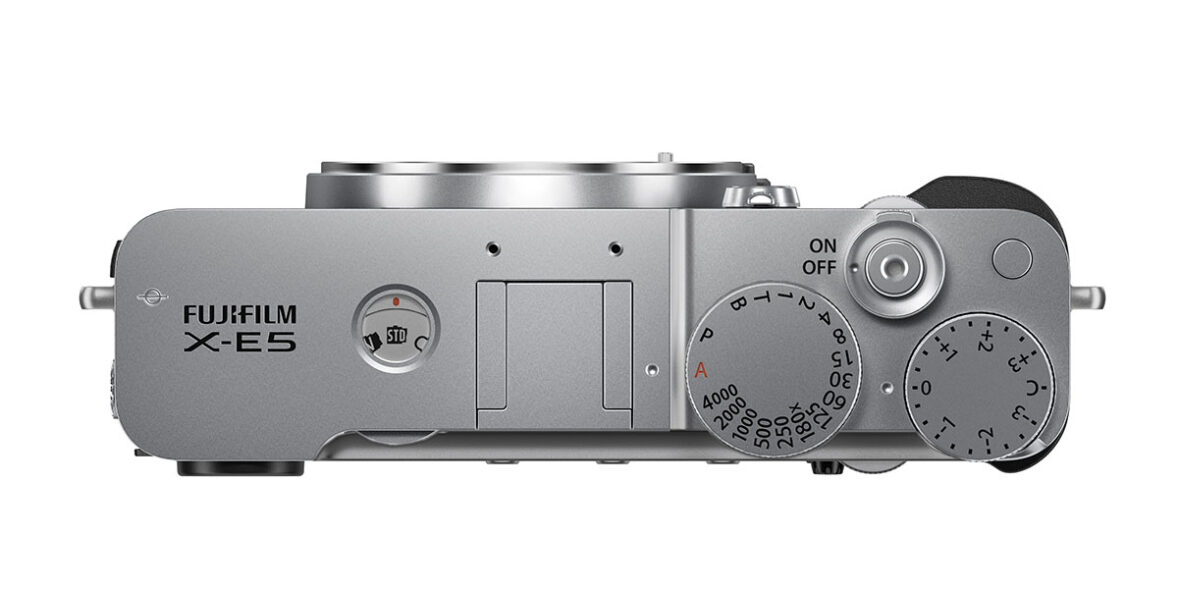
Custom Film Simulations (or “recipes”) — If you are really a film simulation fan you may create three of your own custom “recipes” and call them up using three custom setting positions on the simulation selection dial. I’m sure someone will like this, so no harm done — but it seems like something that few users of this camera are likely to use a whole lot.
Classic viewfinder mode — This EVF display mode will evoke nostalgia among those of us who used real film cameras decades ago. It optionally replaces the typical modern digital data display in the viewfinder with minimal information that looks like what we saw in those old film cameras, even going so far as to add a virtual match-needle-style display on the right side to show exposure compensation. Again, no harm done, but I have to wonder how useful it will actually be.
Battery — The XE5 continues to use the old W126s battery from the earlier generation of x-trans cameras. (The X100vi also continues to use this battery.) Newer high-end Fujifilm cameras have moved to the higher capacity NP-W235 battery, which can make more exposures before it needs to be recharged. Is this a good thing or a bad thing? That depends on your perspective. Fujifilm may have kept the camera size a bit smaller and lighter by using the smaller battery. On the other hand, making the camera a little bit larger to accommodate the newer battery would have made it more compatible with other Fujifilm cameras and would provide longer shooting times per charge. Those pairing the XE5 (or the X100vi) with other newer Fujifilm cameras will need to carry two types of batteries. (When I used cameras with the old battery I always carried a spare. I rarely do that with my XT5, which uses the newer high-capacity battery.)
Aspect Ratio control — Like its larger and recently introduced miniMF cousin, the Fujifilm GFX100RF, the XE5 adds a dedicated control for selecting different aspect ratios, in this case a via a front lever. (“Aspect ratio” refers to the relationship between the width and height of the picture.) How important is this? It may be useful to some .jpg shooters who know that they prefer something other than the usual 3:2 ratio on APS-C cameras — though there is an argument that it might make more sense to capture the full frame and make final cropping adjustments during post-processing. (Note that this is “hard cropping” in .jpg mode — the final image file includes only the cropped section, and you cannot “un-crop’ it. On the other hand, the full image still remains available in post-processing if you shoot in the raw file format.)
There’s a pattern to the features I mention here — we could debate the utility of these functions, but their inclusion doesn’t really affect the camera negatively. If you like these design features you’ll welcome them on the XE5. If you think that some of them are less-than-useful and/or gimmicks, you can mostly ignore them and they will hardly have any negative effect on your experience with the camera — with the possible exception of the smaller battery.
What’s Missing?
It is no surprise that a few features are missing from a camera like the XE5 that is (or used to be?) priced well below the most expensive models in a company’s line-up, not to mention a camera designed specifically to be extra small and light. Some of them include:
- No dedicated ISO control — Many Fujifilm cameras using “retro” knobs and dials include a dedicated top-panel control wheel to set the ISO. This is very useful for photographers who deal with complex and changing light levels, since it gives quick and direct control of ISO without a trip to the camera’s menus. The XE5 does not provide an ISO control knob on the top plate — just shutter speed and exposure compensation (EC) knobs. (For my part, I’d rather have and ISO knob than a “sims” knob.)
- Only one card slot — As is typical on less expensive and/or smaller cameras, the XE5 has only one memory card slot which uses the small SD cards. A second slot isn’t really expected on this camera and it would make the camera bigger, although it would add redundancy.
- Very small “grip” — The XE camera bodies are rather flat and squared-off. You won’t find a large, comfortable grip like on the XT5 or XH2. But to be fair, you should not expect a large grip on a camera designed to be this small either. The body shape does project forward a little more on the right side, producing a shallow grip-like surface that can help users hold it a little more securely. (You can add third-party “grip” equivalents, but if you really want/need a larger grip… perhaps the little XE5 isn’t really the camera for you, and you should consider a slightly larger camera with a built-in grip like the XT5..)
- No rear “D-Pad” controller — While there is a “joystick” control for navigating menus and other controls, there is no d-pad controller.
How important are these omissions? For most users in the camera’s target market, probably not very. That being said, with the new and much higher price for the XE5 (see more below), some of these choices might feel a bit like short-cutting the design, since they do appear on the XT5, which had the same list price at the time of introduction. (But see a pricing update below.)
The Elephant in the Room
Comparing the XE5 to its predecessors, especially the most-recent XE4, there is a lot to like about this new camera: the updated high-resolution sensor, the addition of IBIS, and more — even including the “Other Features” mentioned above if they appeal to you. They make for a small yet powerful camera, which is the lineage of the XE line. Judged purely on its merits, the XE5 is a fine product.
But the price of the XE5 is , to put it mildly, a bit of a shock.
As mentioned earlier, the original XE1 (when it was the only Fujifilm ILC alternative to the XPro1) was priced at $1000 . More recent models ranged from $800 for the XE2 to $850 for the XE3 and XE4.
The price of the XE5 is double that of the previous model, the XE4. That’s right, it costs twice as much as its predecessor! It is listed at $1700 for the body only. (The list price when bundled with the new 23mm f/2.8 “pancake” lens is $1900.)
Somewhat astoundingly, at its introduction the list price of the XE5 was the same as the list price of the XT5! (Update: as of late-summer 2025 Fujifilm has raised the price of the XT5 to $1999.) The XT5 is a full-featured camera with full manual controls, a beefier body, dual card slots and so forth. Putting the XE5 and the XT5 side-by-side, it becomes difficult to make sense of the former’s high price. Alternatively, it makes the XT5 look like an extremely good deal!
The price is going to be a hard pill to swallow for a lot of fans of the XE series, who are used to a much lower price point.
What explains the price change? We don’t now for sure, but we can speculate that the increase may be the result of several factors.
- New features increase the price. Maybe, but that’s not as much of a reason as you might think. For example, putting the 40MP sensor in the camera is simply what we would expect since XE models have always used the then-current high-MP sensor. Perhaps the addition of IBIS warrants a price increase — but IBIS is now virtually ubiquitous in the Fujifilm line-up, and in any case it would not double the price.
- Inflation. Inflation has raised the cost of many products, photographic and otherwise. Based on US inflation rates between 2021 (the introduction of the XE3) and 2025, it would not be unreasonable to see the price rise by almost 20%. So the $850 price for the XE4 in 2021 might rise to the $1000-$1050 range for a 2025 equivalent product, the XE5.
- Tariffs/Import Tax — Though they continue to fluctuate wildly and unpredictably (10% one week, and over 100% the next!) the Trump administration’s import taxes (known as “tariffs”) paid by Americans when they purchase imported products might add as much as several hundred dollars to the cost. It is hard to quantify the exact cost to consumers attributable to the import taxes, but one thing is certain: they increase retail prices significantly.
- Market positioning closer to the X100vi. Given the visual and other similarities between the X100vi and the XE5, some suggest that Fujilm wants to make the price-point for the XE5 be more in line with the $1600 (now higher) X100vi. That is a bit of a stretch since the X100vi includes a built-in lens, adds some features not found on the XE5, and listed for $100 less that the body-only XE5 when the latter was announced. Adding the 23mm f/2.8 pancake lens makes the XE5 more comparable… and $300 more expensive. (Update: Indeed, Fujifilm has now raised the list price of the X100vi, too, making the difference smaller.)
If you add all of those together it starts to almost make sense. Maybe. There’s no question that the XE5 is an appealing and functional camera, and there are factors that make a price increase unavoidable. However, whatever you think of the new price, this has to have an effect on the market for a camera model that previously cost literally half as much.
To put it simply, the XE line traditionally appealed for three main reasons:
- It is smaller than other Fujifilm x-trans cameras.
- Its image quality equals that of more expensive models since it has the same sensor and some other features as more expensive Fujiflm cameras, and it can use all Fujiflm lenses.
- It was priced considerably lower than the high end Fujifilm cameras.
The first two are still true — it remains a very small camera that can produce great results. But the third attribute is now gone — the new pricing is roughly in the same price range as the X100vi, XT5 and arguably the XH2. (Subsequent price increases on those cameras have altered the math a bit.)
What does this mean for potential buyers? The answer is complicated. Many reviewers have accurately pointed out that the features of the XE5 make it a very attractive camera, and I agree. It is small and light, works with all of the excellent Fujifilm lenses, has the same sensor and IBIS found in high-end Fujifilm x-trans cameras, and it looks great. It is a good camera, and its design makes it ideal for some photographers — notably travel and street photographers looking for a small and light rangefinder-style interchangeable lens body.
However, some buyers who would have considered the $850 XE4 may look at that $1700 XE5 price and hesitate. There are viable lower cost alternatives from Fujifilm competitors, though none are exactly like the XE5. But even within the Fujifilm line there are interesting alternatives. Those who are mainly attracted to the XE5/23mm lens combo could decide to save a little money (and get things like the hybrid viewfinder, the ISO dial, and the f/2 lens) and buy the fixed-lens Fujifilm X100vi. Others may settle on the (less capable, but still interesting) little Fujifilm XM5 for approximately $1000 less. There is also the Fujifilm XT50 at a slightly lower price point. Some will look at the more advanced feature set of the Fujifilm XT5 at the same list price (Update: Now a few hundred dollars more) and choose that camera instead. While the XT5 isn’t quite as small and light as the XE5, it isn’t a big camera either. While it is a rather different camera, the flagship Fujifilm XH2 is only a few hundred dollars more.
A new lens
Those who decide to get the XE5 can blunt the price pain by purchasing it bundled with the new 23mm f/2.8 “pancake” lens. I use its sibling, the 27mm f/2.8 pancake lens, a lot, and it is a fine and useful lens. I suspect that the 23mm f/2.8 will be just as good— a recent uwer reports tend to verify that. It provides the same focal length as the fixed lens X100vi, though with a maximum aperture that is not quite as large.
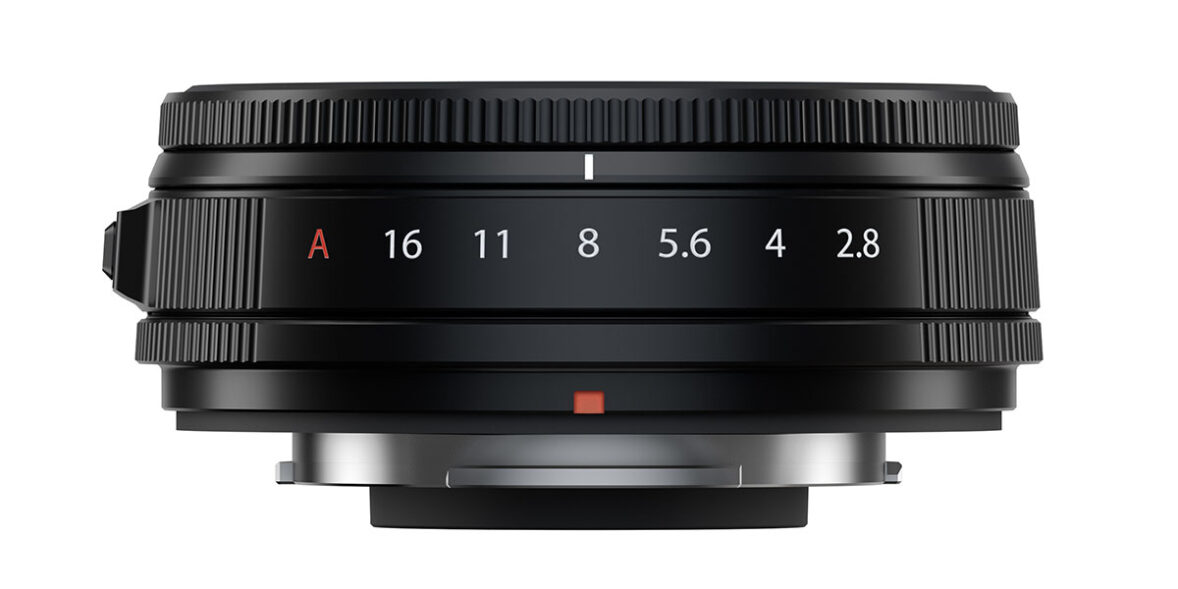
This lens is expected to retail for about $500 (article originally misstated this as $400), but when purchased as a bundle with the XE5 it only adds $200 above the price of the body alone. It looks like a good option for those who want a X100vi-like experience from the XE5. Alternatively, one could buy the bundle, potentially resell the lens for at least the $300 differential, get a different lens that they prefer or use one they already own.
Summary
The Fujifilm XE5 is an attractive and competent camera that is a worthy update to the XE line in useful and interesting ways: a 40MP sensor, IBIS, an updated design that suggests the legacy of the X100vi, especially when outfitted with one of the Fujifilm “pancake” lenses like the new Fujifilm 23mm f/2.8 lens or the older Fujifilm 27mm f/2.8 lens. The camera also comes with a other features, such as the film sim knob and the smaller old-model battery and more — which individual buyers might regard as pluses, minuses. or even as irrelevant. The price increase for this new XE model is going to give some buyers pause, and they may wish to compare other options before laying down their credit cards. Others will look at the XE5 features, like what they see, and be willing to pay the new price.
Bottom line: The price issue aside, the Fujifilm X-E5 looks like a very useful tool — a fine small camera with a great sensor that will work with the fleet of excellent Fujifilm lenses.
Products mentioned in this article.
These are affiliate links to products at B&H Photo/Video. Your purchase via these links earns me a small sales commission and helps support my work at this website.
- Fujifilm X-E5
- Fujifilm 23mm f/2.8 lens
- Fujifilm 27mm f/2.8 lens
- Fujifilm X100vi
- Fujifilm XM5
- Fujifilm XT50
- Fujifilm XT5
- Fujifilm XH2
- Fujifilm GFX100RF
Note: This article has been edited since it was first posted.
G Dan Mitchell is a California photographer and visual opportunist. His book, “California’s Fall Color: A Photographer’s Guide to Autumn in the Sierra” (Heyday Books) is available directly from him. Blog | Bluesky | Mastodon | Substack Notes | Flickr | Email
4 responses to “Considering the Fujifilm X-E5”
-
AT THAT PRICE – might as well go full frame Sony’s A7C mk2.
-
Maybe, but there’s a bit more to the question than that.
First, the XE5 price is — as I wrote — a shock by comparison to the traditional pricing on XE models. All camera prices have risen in the USA, largely as a result of the federal import tax (aka “tariff”) on photography gear. Some companies have minimized the increases or shifted them to other products, but price increases have recently been announced by all companies.
I just looked up that Sony A7C ii that you mention, and its price is $1000 more than the XE5 price. Yes, it is full frame, but it also has a lower resolution 33MP sensor. In addition, the Fujifilm cameras has the company’s well-known “knobs and dials” interface rather than the alternative PASM interface on Sony cameras. And Fujifilm has a complete ecosystem of APS-C-specific lenses, so users who want additional lenses won’t have to use larger lenses designed for full frame.
As to the full frame versus APS-C question, it isn’t as simple as “full frame is always better.” Yes, contemporary full frame systems offer some potential image quality advantages over cameras with smaller sensors. But those advantages are largely meaningless to typical users of these cameras — say for people who are mostly or entirely sharing pictures electronically on the web, in social media apps, and in emails. For them, the pluses of larger sensors are largely insignificant and irrelevant.
And that XE5 really is tiny, especially when outfitted with the 23mm f/2.8 or 27mm f/2.8 pancakes lenses.
I’m sure that the the A7C ii is a fine camera, and I know that Sony is a fine manufacturer. And the A7C ii might be the ideal choice for some buyers… just as the XE5 will be for others.
Dan
-
-
I’m also looking for a small camera for my wife. The XE5 price certainly takes it out of consideration. Thanks for the informative review.
-
Great camera and perhaps ideal for her… but the price is a shocker.
-


(All media © Copyright G Dan Mitchell and others.)
Discover more from G Dan Mitchell Photography
Subscribe to get the latest posts sent to your email.
Leave a Reply to Bill PelzmannCancel reply