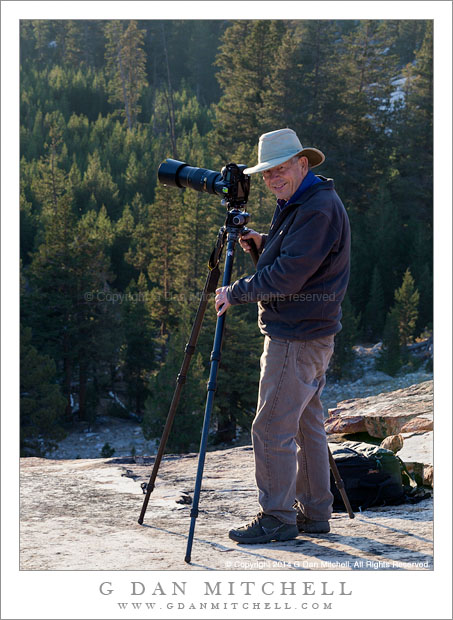
Category Archives: Commentary

Sierra Nevada Fall Color (Morning Musings 8/25/14)

For various reasons — projects I’m working on, clear signs of the changing seasons, photographs I’ve recently seen — I have been getting into that autumn frame of mind that comes at about this time every year. With that in mind, today’s “morning musings” post is about finding and photographing fall color in the Sierra Nevada. Rather than re-writing the whole thing, I’ll start by pointing you to an extensive guide that I wrote a few years ago and have updated every year since that time — if you are thinking of chasing aspen color this fall you may want to take a look: “Sierra Nevada Fall Color — Coming Sooner Than You Think”

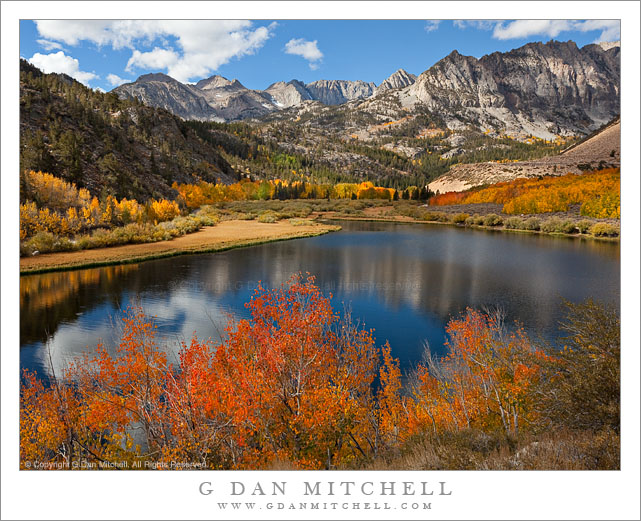
If things evolve on a relatively typical schedule, eastern Sierra aspen color is perhaps about six weeks away. I have been photographing this subject for a while now, and it is one of my favorites. I intend to be out there again this fall.

Aspen Color, North Lake

One popular game at this time of year is to predict/guess when the colors will arrive and how good they will be. I’m fully aware that I’ve been wrong quite a few times, and my increasing knowledge of this subject has perhaps only made me more aware of how unpredictable this can be. However, this year I have to wonder about the effects on the trees from our three-year California drought, which has reached an extreme level all across the state this year. I don’t know what the results will be, but I’m considering some possibilities:

  • During the last two years it seemed to me that I was seeing the onset of color move a bit earlier in the season. I have to wonder if we may see stressed trees go into fall mode a bit on the early side this year.
  • Some people say that they are seeing a few aspen groves turning brownish-yellow already and looking like they are drying out.
  • Also during the last few dry years we have seen some anomalous early season storms, and I wonder if that pattern will continue. This can affect the season in various ways if it happens. On the negative side, leaves can blow down early. On the positive side, snow and aspens can make a beautiful pair.

As always, to the extent possible, I like to remain flexible about when and where I’ll photograph the aspens, and I watch the evolving conditions to see what this season may bring. How about you? What are your fall color plans?

G Dan Mitchell is a California photographer and visual opportunist whose subjects include the Pacific coast, redwood forests, central California oak/grasslands, the Sierra Nevada, California deserts, urban landscapes, night photography, and more.
Blog | About | Flickr | Twitter | FacebookGoogle+ | 500px.com | LinkedIn | Email

Text, photographs, and other media are © Copyright G Dan Mitchell (or others when indicated) and are not in the public domain and may not be used on websites, blogs, or in other media without advance permission from G Dan Mitchell.
Concerning Megapixels

(This is another in a series of articles based on posts I shared elsewhere. This one is based on a reply to a post concerning how important it is to move to a newer, improved sensor with higher photo site density. The immediate question had to do with how often the improvements would be significant enough to be seen, and the writer had correctly pointed out that there can be advantages to higher “MP count” when making very large, high quality prints.)

It is useful to try for a realistic understanding of how and when a higher MP sensor may show its advantages. This post tries to not take a position on brands and models, but rather to lay out a comparison of some relevant technical stuff — from which we can all draw our own individual conclusions.

There is a point below which you would be hard pressed to tell the difference between prints made from 22MP and 36MP cameras and above which you might be able to.(1) For example, virtually everyone would agree that the difference is typically completely invisible in small web images, and virtually everyone would agree that it could be visible if you closely inspect a print that is six feet wide. Since we could debate just where the boundary is — and, frankly, it is somewhat subjective — you could pick any point on the print size scale that you want and the principles will be the same.

Some Comparisons

Just for fun, let me use completely arbitrarily use two print sizes and base the comparisons on the 22MP Canon 5D Mark III and the Sony/Canon 36MP sensor cameras. Continue reading Concerning Megapixels

Print Review (Morning Musings for 8/19/14)

We are very fortunate to be part of a small group of photographers and friends who gather every six weeks or so in one of our homes for an informal print review. Each of the photographers is talented and expressive, and while our stylistic and subject preferences overlap, each has a unique style and photographic “voice.”

Print reviews, especially when the participants comprise a group of very talented and perceptive photographers who are also friends, are very, very useful. They tend to force me to switch out of the regular ongoing “flow” of making a lot of photographs, and towards a more directed task of choosing work worthy of showing and then making decent prints of the work. This switch is another element of the “discipline” component of photography. Even more important, I hear diverse responses to the work, which range from the purely emotional (very important) to technical observations (also important).

It is interesting to see the range of responses — sometimes they are pretty much what I expected based on my own relationship to the images, but at other times I’m surprised. I had two of those surprises last night, and each of them came in the case of sets of related prints that I shared. One was a small group of three street photographs from my recent visit to New York City, photographs of dense and busy spaces that feature intense and wild color palettes. I had originally preferred one of the images to the others, but was beginning to gravitate to a second one in the set that included many more people. To my surprise, the group responded most strongly to the third, and their reactions to it made me reconsider my own feelings about the images in several ways.

The second group of photographs included five high-key black and white photographs, all of which belong to minimalist thread in my work that is about luminous atmosphere, usually from fog, that is so brightly lit by sun that it almost hurts to look into the scene. In order to get prints to somehow suggest that quality, I push the luminosity levels up about as far as possible, and the resulting images are somewhat minimal and often contain large areas of gentle tonal gradation. Among the five I shared were four that I made in California’s Central Valley. One of these is truly minimal, with a nearly invisible and diffuse horizon dividing an extremely luminous foggy sky from its reflection in still water below, and the only clear details are a few scattered birds in the water. I had almost chosen to not include this print, thinking that it might just be too minimal for other viewers. Much to my surprise, and without any prodding from me, the group preferred this image over the others. Live and learn!

Finally, it is a wonderful and useful discipline to hear my work critiqued and mostly adopt a learner’s attitude about what I hear. It is in my nature to try to persuade others of my point of view, but that is usually (but not quite always) the least useful way to deal with critique. The best and most useful thing is to hear and understand what others are seeing in the work, and to a consider it even if it doesn’t mesh with my own perspective. In the end, I can choose to accept or not what I hear, but hearing it is incredibly useful and important.

If you are fortunate enough to have perceptive, knowledgable, sympathetic photographer friends, I urge you to try to get together and try this, and to stick with it long enough to allow the process and the relationships to grow. (And thanks to any of you in the group who are reading this!)

G Dan Mitchell is a California photographer and visual opportunist whose subjects include the Pacific coast, redwood forests, central California oak/grasslands, the Sierra Nevada, California deserts, urban landscapes, night photography, and more.
Blog | About | Flickr | Twitter | FacebookGoogle+ | 500px.com | LinkedIn | Email

Text, photographs, and other media are © Copyright G Dan Mitchell (or others when indicated) and are not in the public domain and may not be used on websites, blogs, or in other media without advance permission from G Dan Mitchell.

Is It Ever Too Early To Dream of Aspen Color?

Aspens and Talus, Autumn

Aspens and Talus, Autumn. Eastern Sierra Nevada, California. © Copyright 2013 G Dan Mitchell – all rights reserved.

Small stands of aspens with autumn leaves stand in front of a talus slope, eastern Sierra Nevada.

Is it ever too early to dream of aspen color? In a word, no.

Every summer around this time I start to think about fall color, and for me that primarily means eastern Sierra Nevada aspen color. I’m not quite sure what triggers the thoughts. Sometimes when I’m in the Sierra — and I am not there right now — it can be some nearly imperceptible changes in the light, the atmosphere, the patterns of annual growth, or even the sound of the wind. It might also be something as simple as my now innate “tuning in” to annual cycles, something that I think we are all more able to do than we might imagine.

On hot northern California days like this one, it certainly does not feel at all like autumn. Yet, I know that the first real signs of the seasonally change will appear high in the Sierra in barely 8 weeks, and the aspen color will arrive only a few weeks after that.

G Dan Mitchell is a California photographer and visual opportunist whose subjects include the Pacific coast, redwood forests, central California oak/grasslands, the Sierra Nevada, California deserts, urban landscapes, night photography, and more.
Blog | About | Flickr | Twitter | FacebookGoogle+ | 500px.com | LinkedIn | Email

Text, photographs, and other media are © Copyright G Dan Mitchell (or others when indicated) and are not in the public domain and may not be used on websites, blogs, or in other media without advance permission from G Dan Mitchell.