Category Archives: Equipment

Canon EOS 5D II: Early Observations on Image Quality

I posted earlier today about increasing availability of the Canon EOS 5D II at places like B&H, so I thought it might be useful to begin posting on some of my experiences with the camera during the couple of weeks (and perhaps a thousand frames) that I’ve had it. Here is a copy of something I posted elsewhere earlier this week, in response to a post concerning image quality from this camera:

I’ve shot with cropped sensor bodies extensively in the past. I have shot with a full-frame 5D for the past two years. I recently began shooting with a 5DII and have done a thousand or so frames with it.

I cannot see image quality problems in my images, even in those that stress the ability of the camera in ways that should produce them if they are there: shooting wide dynamic range scenes, using high ISOs (up to 1600), inspecting at large on-screen magnifications, and making careful prints.

My photos have very low noise all the way through the shadows to pure black, even in some photographs where I’ve pushed the shadows either during RAW conversion and/or via the shadow/highlight tool in post. I’m seeing very highly detailed images with smooth tonal transitions. As far as I’ve seen the 5D II has a rather substantial dynamic range – as reported in a number of tests – and it is at least as great as that of the 5D.

Let me repost a couple of 100% magnification crops that I posted elsewhere from the 5DII.

The first was shot at ISO 100 at, IIRC, f/16 using a 35mm prime with the camera on tripod. The crop is a 100% magnification section from the very far lower right corner of the shot. The dark areas were pushed slightly, too, so if there were noise anywhere it would certainly appear here – but I don’t see it even at this resolution, which would be equivalent to a print width of five or six FEET wide. Seems like pretty good resolution to me! (It also speaks well for the EF 35mm f/2 lens.)

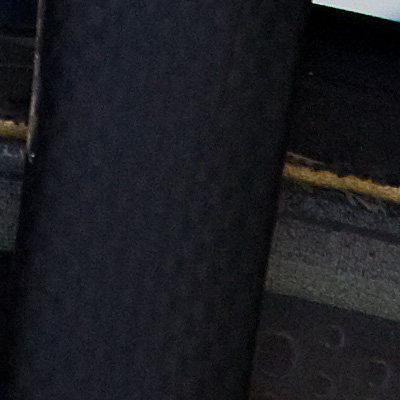
The second example is pretty much a noise “torture test” – it is a very dark section of a much larger image. (Again a 100% crop). It was shot using a 100-400mm zoom handheld at ISO 400 in cloudy conditions. There is some noise in the shot, but that is entirely normal – and this noise would be completely invisible even in a very large print. (The pattern on the lighter fabric near the left side of the frame is that of the fabric itself.)

My observations from 100% on-screen pixel peeping are confirmed by the more important test of printing.


(If my post has helped you with a purchase decision, making your purchase from B&H through this link will help support the blog. Thanks!

A Test: Correcting Perspective in Post-Processing

Earlier today I saw a post in which the author stated that correcting for perspective in post-processing would lead to serious problems:

There is quite a bit of loss in image definition if you do a significant amount of correction for converging verticals in an image editor. You can get far better results with a view camera or a tilt/shift lens. If you only photograph for the web, then maybe the image editor approach is ok, but for reasonably large prints?

While that point of view is widely held and often repeated, in my experience a blanket statement like this is not totally correct – it may come down to the definition of “significant.” I find that in many cases the degradation of the image is so small as to be insignificant or even invisible at 100% magnification, and it is most often completely invisible even in fairly good size prints. (This is not to suggest that those making severe corrections, in architectural photography for example, would not be better served by using a tilt/shift DSLR lens or a MF or LF system.)

Rather than just accepting statements like this, I like to test them. In the past I’ve tested and written about the option of correcting for lens distortions in post- processing: A Test: Correcting Lens Distortion in Post Processing. Here I want to extend this concept to using post-processing techniques for the correction of perspective distortion and for leveling the image.

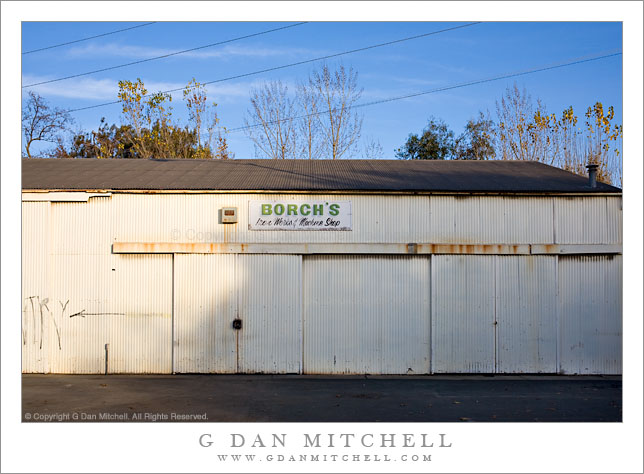
The photograph I’ll use was shot handheld using a full-frame Canon 5D with the EF 35mm f/2 lens, one of my favorites for street photography. First a small version of the final photograph:


Borch’s Iron Works and Machine Shop – old metal shop building in the downtown area of San Jose, California. © Copyright G Dan Mitchell – all rights reserved.

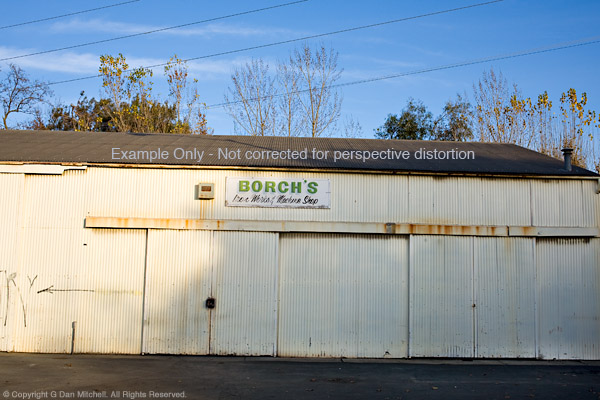
Next is the same image with the same post-processing, except that the corrections to horizontal alignment and perspective have been left out:


Borch’s Iron Works and Machine Shop – old metal shop building in the downtown area of San Jose, California. Uncorrected version. © Copyright G Dan Mitchell – all rights reserved.

Yup, that’s what happens when you shoot street and shoot handheld. ;-)

In this example we can clearly see several problems that need fixing. First, the image is not level – it tilts down to the right. Second, the vertical lines begin to converge toward the top of the image. Third, since the camera’s sensor was not perfectly parallel to the building wall, the right side of the building recedes and gets smaller as the horizontal lines become closer together toward the right edge.

In my view, the uncorrected version of this photograph is not usable. On the other hand, I’m not likely to start doing street photography with a tripod and a tilt shift lens any time soon! Correction in post seems to be a reasonable option. (And, to cut to the chase, the corrected version seen above really does make a nice print.)

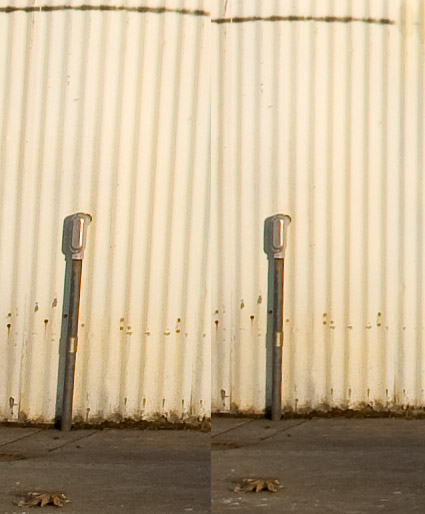
The next image includes two versions of roughly the same section of the photograph at 100% magnification. The crops come from the lower left area of the full image and include the conduit on the wall in the area in full sun. I could have used a section from all the way in the corner, but given the low contrast in that area the difference between the samples would be even harder to see – so I’ll stick with the section where the conduit provides a more visible contrast and frame of reference. Depending on your monitor, this resolution is equivalent to looking at a small section from a print that would be perhaps 50″ or 60″ wide. (Hint: that would be a very big print for a DSLR original – significantly larger than almost anyone ever produces! Made many 60″ x 40″ prints recently?)


100% magnification from lower left area of ‘Borch’s Iron Works and Machine Shop’ – two versions. © Copyright G Dan Mitchell – all rights reserved.

I believe that if you know what to look for and you  inspect this 100% crop very closely you can detect a small difference in the “sharpness” of the two photographs – but it is quite subtle even when viewed at 100%. In practical terms, however, this tiny effect that is just barely visible under close inspection at 100% in side-by-side comparisons on the screen is entirely insignificant in a print. Even with a very close inspection it would be quite invisible in a print of, say, 18″ x 24″ and probably even larger. Bottom line: Both would produce very sharp prints at very large sizes and essentially no one would comment that one is sharper than the other… though quite a few might notice that the corrected image looks a whole lot less distorted in the spatial sense.

Note: Article text edited/updated for clarity on 4/27/13.

This reinforces my belief that any degradation to the image quality that occurs when lens distortion, perspective, and/or horizontal level are corrected carefully during the post-processing stage can be very minimal and in the majority of situations will be invisible in prints.


G Dan Mitchell is a California photographer and visual opportunist. His book, “California’s Fall Color: A Photographer’s Guide to Autumn in the Sierra” is available from Heyday Books and Amazon.

Blog | About | Flickr | FacebookEmail

Links to Articles, Sales and Licensing, my Sierra Nevada Fall Color book, Contact Information.


All media © Copyright G Dan Mitchell and others as indicated. Any use requires advance permission from G Dan Mitchell.



Aarrgg! Broken Camera!

Last night I joined The Nocturnes for night photography at Mare Island Naval Shipyard. Things began in the usual uneventful way – perhaps 40 photographers assembled as Tim Baskerville went over the “rules” of the game, I shot a few photos of the group, and then I headed off to start photographing the interesting shipyard structures under the light of a nearly full moon.

I began by working on improving a shot that I had attempted on another visit, a scene of a brick building with an attached green building in front of a metal roof structure with the power plant smokestack in the background, this time with some very interesting shadows cast by the overhead shipyard structures. Finishing this shot, I set up another of an overhead truss structure illuminated by moonlight with star trails behind. So far so good – and I felt like I was getting in the groove for a productive evening.

I composed a third shot, again with that shadowed wall of the brick building but this time with the base of a giant steel tower in front of it. I pressed the shutter release… and something didn’t sound right. Tried again, and still no go. I took the camera off the tripod and saw the dreaded Canon “err 99” message in the display. No panic, though; I’ve seen this before and know enough to remove the battery, card, and lens and give it another try. Ah, still no go. After removing the lens and jumping through a few other hoops I figured out that the mirror was in the “up” position, more or less waiting for the shutter to open… which it didn’t do.

So, perhaps 15 minutes into this night photography session I had an inoperable camera. I packed up and headed home, where I did a bit of Internet searching and found other descriptions of exactly this issue. It looks like I need to have Canon replace the shutter mechanism.

(I’m going to bring up one odd factor with Canon. It seems that a good percentage of the people who encountered this problem did so after exactly the same sequence of events that I followed in shooting long exposures with mirror lockup engaged. A number had even been using the 24-105 beforehand, as I had been. Hmmm… Later: I’ve been contacted by another photographer who had precisely the same situation and had some dialog with Canon about the situation…)

So, at the moment I’m without a camera. I’m giving some thought to picking up a 5D II a bit ahead of my planned schedule and either keeping the repaired 5D as a backup or selling it. (It would be a good deal for someone, especially with a brand new shutter.) Of course, as luck would have it, it appears that all of the body-only versions of the 5D II that were available last week are now out of stock…

Seems like a good day to take a hike. Without a camera. :-)


G Dan Mitchell is a California photographer and visual opportunist. His book, “California’s Fall Color: A Photographer’s Guide to Autumn in the Sierra” (Heyday Books) is available directly from him.

G Dan Mitchell: Blog | Bluesky | Mastodon | Substack Notes | Flickr | Email


All media © Copyright G Dan Mitchell and others as indicated. Any use requires advance permission from G Dan Mitchell.
Resisting Temptation: Canon 5D2

I shoot with a Canon 5D. It is a really fine camera for my purposes, and after a couple of years of fairly substantial usage it is still working quite well.

Canon recently introduced the 5D2, which appears to be a very fine upgrade to the 5D line in pretty much every important way that we could expect in a camera sold at this price point: 21 MP sensor, a high quality video mode, dust reduction features, bigger and better monitor, and so on.

I’ll almost certainly get one… in due time. I resolved to not be an early adopter of the new camera, for several reasons. Early adopters typically pay list price of more for their cameras. To the extent that some glitches are not always discovered in pre-release testing, it is not uncommon for the first production run to have a few “issues.” And, most important, my current camera works really, really well. The 5D2 could, indeed, be “better” in some ways, but not so much better that I must rush out and replace it immediately.

But now that the 5D2 seems to be reaching the retailers in larger numbers, I’m starting to see interesting deals. For example I saw a couple for $2700 that included immediate availability and free shipping. I saw another legitimate price that was even lower. There have been a couple of deals on the 5D2 bundled with the EF 24-105mm f/4 L. (Those won’t appeal to me since I already own that lens.)

Note to self: Be strong, Dan. :-)


If  you are ready to buy your 5D2, you can purchase this product from B&H Photo via this link and help support this web site – thanks!


G Dan Mitchell is a California photographer and visual opportunist. His book, “California’s Fall Color: A Photographer’s Guide to Autumn in the Sierra” (Heyday Books) is available directly from him.

G Dan Mitchell: Blog | Bluesky | Mastodon | Substack Notes | Flickr | Email


All media © Copyright G Dan Mitchell and others as indicated. Any use requires advance permission from G Dan Mitchell.