
Tag Archives: 2

Testing? Testing? (Morning Musings 12/8/14)

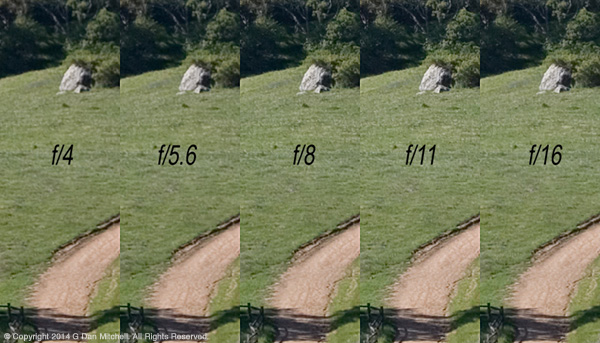
Aperture Test Image
Aperture Test Image (1)

This morning I saw an article over at The Online Photographer (which you should be following) about a particular camera/lens combination and the process of doing a quick and informal test of that gear… right there in the kitchen.

I read a lot of photography questions about how this or that thing works, which setting is “best” for a particular result, what shutter speed range works for hand-held photography, how much the shadows can be pushed, whether a lens is sharp enough for some particular usage, and much more. Folks are often looking for quick answers — and who wouldn’t in most cases. However, the quick answers often turn out to be less clear than they might like, and sometimes the simplest questions can end up in controversy.

A simple answer is to simply try it out yourself!

The answers to many of the questions that we ask are too complex to lend themselves to absolute answers. Yet, we can often get a very good and quite accurate feeling for these things by just giving them a try. In some cases the “testing” can be very informal, while in others it might require just a bit more care and organization. But in our modern photographic world of digital cameras and computer post-processing and display the testing is much easier than it might have been in the past, and it is well within our grasp to do it ourselves.

I recall one of the first times I put this to good use with a digital camera. Continue reading Testing? Testing? (Morning Musings 12/8/14)
Post-Processing: A Shadow Recovery Example

(In another forum someone asked a question – actually, more like posed a challenge – related to how much usable detail and quality could be extracted from a raw file that contained areas of very low luminosity, as could happen with a badly underexposed image or with an image of a scene with a very large dynamic range. Since I went to the work of responding and illustrating my response, I figured that I might as well share it here, too. With minor revisions, here it is.)

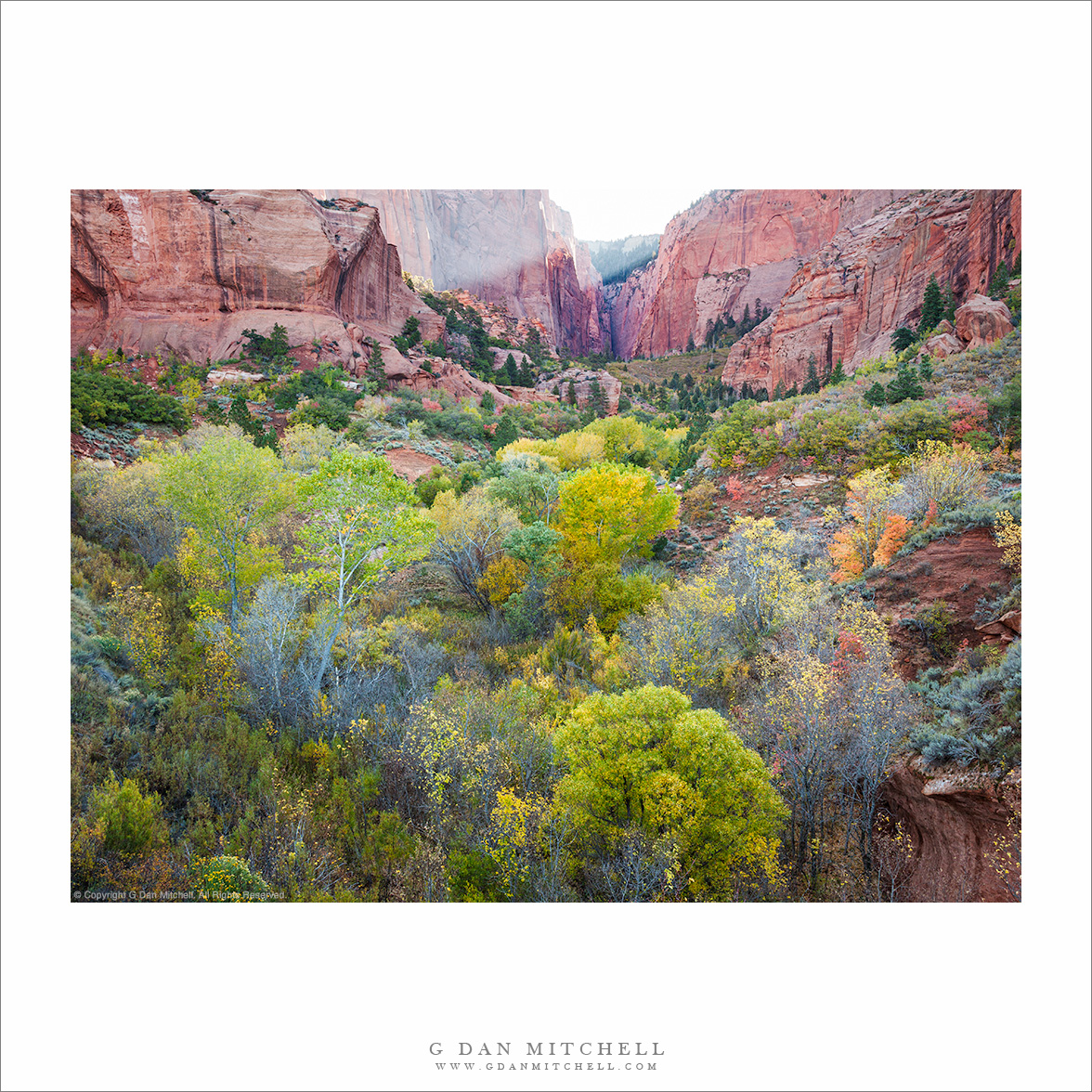
First, I actually have a “real” version of this photograph in which highlights were slightly blown, but which I preferred to use since I could bring them back in post and get a bit more shadow detail to start with. (It looks a bit bright to me as an on-screen jpg, but it makes a fine print.) That photograph ended up looking like this:

Morning light slants over the top of sandstone cliffs above early autumn foliage in Kolob Canyon, Zion National Park

This photograph and the other I’ll move to below were both shot from a tripod with a Canon EOS 5D Mark II at ISO 100 using the Canon EF 24-105mm f/4L IS at f/16. While the “keeper” used for the photograph above had a 1/4 second exposure, the example I’ll use below was shot at 1/30 second.

The exposure challenge in this scene was the very large dynamic range between the bright spot of sky at the head of the canyon and the much darker colorful foliage in relatively deep shadow in the foreground. Exposing for optimal quality in the foreground would completely blow out the sky, while exposing for the sky would necessarily grossly underexpose the foreground.

I originally thought that I might like to have four bracketed exposures in case that would let me produce a better final image via layer blending, but it turned out to be unnecessary and the final image (as shown above) has a single source file with no blending. However, this means that I still happen to have one very badly underexposed (by three stops) version at 1/30 second which I’ll use here as the starting point for what I plan to illustrate in this post. Follow along with me and see what I can do with the very underexposed version of the file…

Continue reading Post-Processing: A Shadow Recovery Example

B&H: Holiday Deals Update and Last Day for Holiday Standard Shipping

See the Deals Page for updates on the following and more:

  • Today is the last day to order from B&H with “guaranteed” holiday delivery via standard shipping. (You can still procrastinate a bit and pay more for expedited shipping if you want! ;-)
  • The special price in the Canon 5D Mark II body is still available.
  • I have added an updated listing of this weeks holiday specials at B&H – they include a wide range of camera bodies, lenses, and more from Canon, Nikon, and other manufacturers.

G Dan Mitchell is a California photographer and visual opportunist whose subjects include the Pacific coast, redwood forests, central California oak/grasslands, the Sierra Nevada, California deserts, urban landscapes, night photography, and more.
Blog | About | Flickr | Twitter | FacebookGoogle+ | 500px.com | LinkedIn | Email

Text, photographs, and other media are © Copyright G Dan Mitchell (or others when indicated) and are not in the public domain and may not be used on websites, blogs, or in other media without advance permission from G Dan Mitchell.

Canon 6D is Arriving – With Price Reductions

Shortly after releasing the Canon EOS 5D Mark III (and the Canon EOS-1DX and assorted other goodies), Canon announced a forthcoming less-expensive full-frame DSLR, the EOS 6D, a 20+ MP with a range of attractive features and a price barely above $2000. Right now site-sponsor B&H is offering a $200 “instant savings” on the Canon EOS 6D Digital Camera with Canon 24-105mm f/4.0L IS Lens bundle that lowers the cost of the lens and camera to only $2,699. The product is also eligible for the B&H “2% reward” – read more about that at the link.

Where does the 6D fit into the Canon eco-system? I think that for many people looking for a first full-frame body, and for many whose primary consideration is purely image quality, the 6D is going to hit the sweet spot. A 20 MP full frame image, assuming you shoot with skill and understand how to post-process, can produce an outstanding print in sizes much larger than the typical user will ever produce. There is every reason to think that the image quality produced by this camera will be essentially indistinguishable from that produced by the fine Canon EOS 5D Mark III. I have not used the camera, but from many reports I have read from those who have had their hands on a copy, it sounds like it will be a fine performer.

G Dan Mitchell is a California photographer and visual opportunist whose subjects include the Pacific coast, redwood forests, central California oak/grasslands, the Sierra Nevada, California deserts, urban landscapes, night photography, and more.
Blog | About | Flickr | Twitter | FacebookGoogle+ | 500px.com | LinkedIn | Email

Text, photographs, and other media are © Copyright G Dan Mitchell (or others when indicated) and are not in the public domain and may not be used on websites, blogs, or in other media without advance permission from G Dan Mitchell.