
Tag Archives: artist

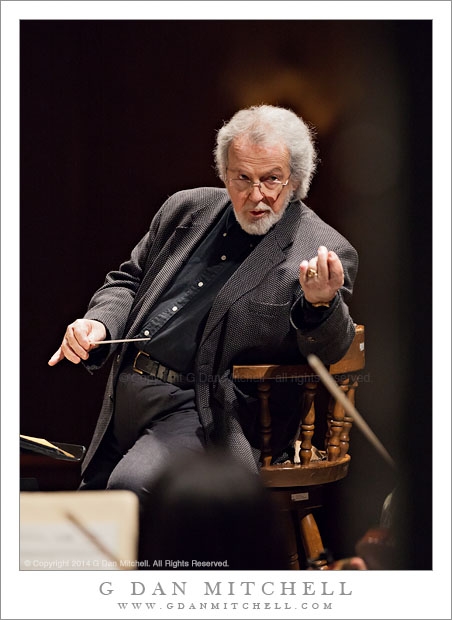
Conductor George Cleve

Conductor George Cleve

Conductor George Cleve. San Jose, California. June 5, 2014. © Copyright 2014 G Dan Mitchell – all rights reserved.

George Cleve conducts the Symphony Silicon Valley in rehearsal

Bear with me. This may be a long story. I’ll start with some basic facts concerning this photograph. As some of you may know, I have been working on a long-term project to photograph classical musicians. This is related to a sabbatical project at my college, and one goal is to document aspects of the lives and works of classical musicians that might not typically be seen by those who only get to come to see performances. For this purpose, I have been “embedded” with a couple of groups for over a year. It has been a great opportunity, and I’m grateful to the musicians and others who work with them for allowing me a kind of access to their lives and work that they might not afford to just anyone. It helps that I know many of them, that I’m married to one of these musicians, that my academic training is in music, and that I used to perform with people like these. All of that also helps me be sensitive to things that other photographers might not as easily see. (This is a long story in and of itself, and I’ll save that for later.)

The conductor of this concert “set” is George Cleve. His name is not exactly a household word, but his experience and skill and musical sensitivity is of the highest level. My experience with George goes back many years, to a time when he conducted orchestras in which I occasionally played (San Jose Symphony and the Midsummer Mozart Festival Orchestra) and one for which I served as orchestra stage director for a few years. In a surprising coincidence I even took a conducting class from him when I was an under-graduate music major “back in the day.”

Conductors are not always patient people, and there are many reasons that this can be the case. The work they do is unlike almost any other work that I can imagine. Even though I’ve been around music for many years, I still find it difficult to offer a really good description of the complexity of the role—which includes elements of ring-master, leader, coordinator, passionate interpreter, analytical listener and teacher, and much more. Truly watching a skillful conductor—and preferably not while performing, but instead while your full attention can be on the watching—is an illuminating experience. From the visual perspective of a photographer, the appearance of the conductor is in a continuous state of flux. His or her facial expressions change faster than you can follow, and subtle movements—a quick glance, a hint of a smile, a momentary intensity, a curving motion of the hand—convey things in a fluid way.

But I have one more story about George, and it involves that conducting class. His was an intimidating presence for young music students. I recall him at one of the first classes asking, “You do all have the nine symphonies of Beethoven committed to memory, right?” Wrong! Though we quickly set about trying. (That task takes far longer than a college term!) I recall a day when we were to individually conduct the second movement of the 6th symphony for him. As I remember it, we entered the room alone to face him and conduct as a pianist played a reduction of the score. One after another nervous students entered and soon emerged from the room, often seemingly crushed by the realization of how little they understood what they had to do. It was my turn. I entered and faced him and began to conduct. In my recollection, which is probably no longer completely accurate, he quickly stopped me and said something along the lines of, “No, no, no!” But then, for reasons I never quite understood, he gave me a musical gift that I did not expect and which has remained with me since then. Instead of telling me I was done, he said, “Watch me.” Standing a few feet in front of me and conducting as if the full symphony was where I stood, he put on the full show for me, intensity of expression, cues to all, the perfect physical expression of what did and could happen in the music, and I saw what it actually might mean to understand and lead such a performance of such a piece… even if I never learned to do so even close to his level.

This week, at the rehearsals that included a different Beethoven symphony, I finally had the opportunity, decades later, to thank him for that gift.

G Dan Mitchell is a California photographer and visual opportunist whose subjects include the Pacific coast, redwood forests, central California oak/grasslands, the Sierra Nevada, California deserts, urban landscapes, night photography, and more.
Blog | About | Flickr | Twitter | FacebookGoogle+ | 500px.com | LinkedIn | Email

Text, photographs, and other media are © Copyright G Dan Mitchell (or others when indicated) and are not in the public domain and may not be used on websites, blogs, or in other media without advance permission from G Dan Mitchell.
Double Bass, Backstage

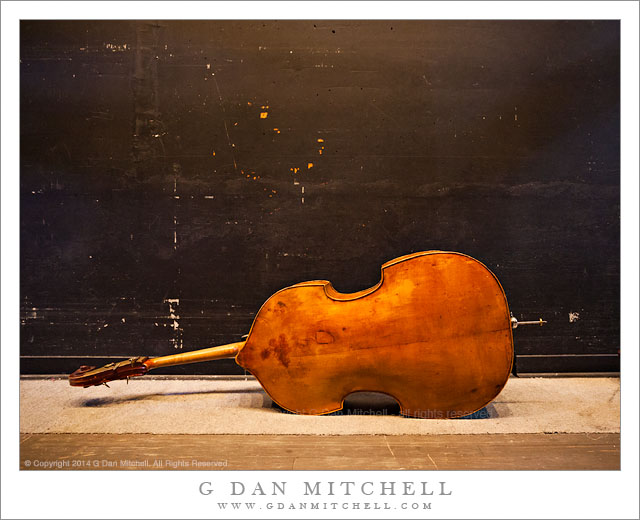
Double Bass, Backstage

Double Bass, Backstage. San Jose, California. May 14, 2014. © Copyright 2014 G Dan Mitchell – all rights reserved.

A double bass rests back stage during a break in a rehearsal of Symphony Silicon Valley

This is a photograph from my ongoing project related to classical music performing groups and the musicians who belong to them. It falls into a category I have mentioned before, namely photographs of people and things that happen to turn up in the small areas of interesting backstage light that I have discovered. As I have worked several venues over the past two years I have gotten to know many things about them intimately, and one of those things is the location of the many little unexpected pools of interesting light. Sometimes I “stalk” those spots, just waiting for someone or something to happen there, and I always check them as I walk around the theater with my camera.

This is, obviously, a visually simple image—just a double bass lying on its side during a break in a rehearsal. (I was attracted by the contrast between the warm colors and interesting textures of the instrument and the “industrial” surroundings with their signs of heavy use and even minor damage.) From my point of view, however, it could lead to thoughts of a whole range of other things. I’m fascinated by what an instrument is and what it isn’t. Instruments, musical and otherwise, are often remarkable things in that they allow us to do things that we can’t otherwise do with our minds and bodies alone. The instruments of classical (and many other types of) music are fundamentally pretty simple things and often the result of some really “primitive” technologies, yet they are remarkably adapted to the purposes for which they are intended, generally as a result of a long and complex evolutionary process. But in the end, I would argue that even the most beautiful and sophisticated instrument is no more than a tool, and the really interesting things are how the tool is used by a person or persons to produce something far more meaningful and interesting than the instrument itself.

G Dan Mitchell is a California photographer and visual opportunist whose subjects include the Pacific coast, redwood forests, central California oak/grasslands, the Sierra Nevada, California deserts, urban landscapes, night photography, and more.
Blog | About | Flickr | Twitter | FacebookGoogle+ | 500px.com | LinkedIn | Email

Text, photographs, and other media are © Copyright G Dan Mitchell (or others when indicated) and are not in the public domain and may not be used on websites, blogs, or in other media without advance permission from G Dan Mitchell.
Cymbals

Cymbals
Cymbals

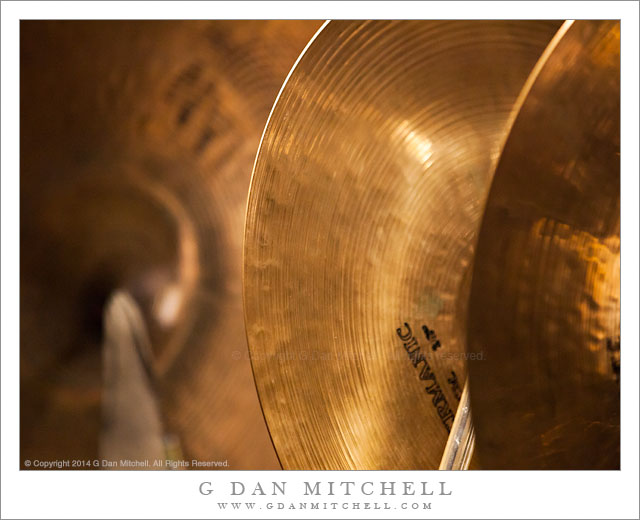
Cymbals. San Jose, California. May 14, 2014. © Copyright 2014 G Dan Mitchell – all rights reserved.

Cymbals on a rack, ready for use at a Symphony Silicon Valley rehearsal

The percussion section of a classical symphony orchestra, especially when somewhat modern music is performed, can be a rich source of photographable objects, shapes, colors, texture, and reflections. Between pieces, or during breaks, I get to stalk the stage and have free rein to wander around that find and photograph these interesting objects.

The subject here is pretty straightforward. When not being played, cymbals are kept safely (and quietly!) stashed on covered tables or in holders. Here a line-up of multiple cymbals was in racks, waiting to be picked up and played.

G Dan Mitchell is a California photographer and visual opportunist whose subjects include the Pacific coast, redwood forests, central California oak/grasslands, the Sierra Nevada, California deserts, urban landscapes, night photography, and more.
Blog | About | Flickr | Twitter | FacebookGoogle+ | 500px.com | LinkedIn | Email

Text, photographs, and other media are © Copyright G Dan Mitchell (or others when indicated) and are not in the public domain and may not be used on websites, blogs, or in other media without advance permission from G Dan Mitchell.

Low Strings, Rehearsal

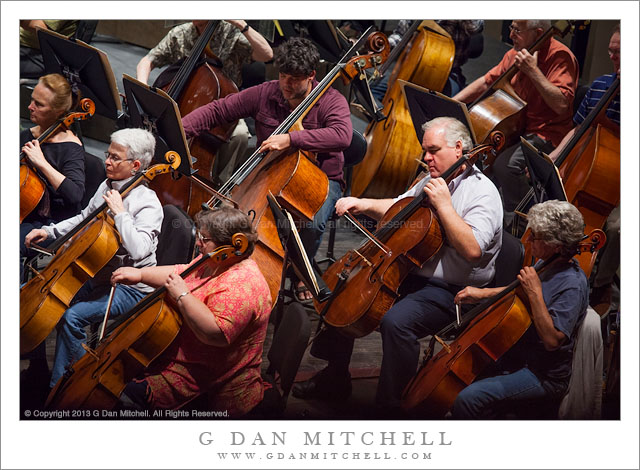
Low Strings, Rehearsal

Low Strings, Rehearsal. San Jose, California. September 27 ,2013. © Copyright 2013 G Dan Mitchell – all rights reserved.

Members of the cello and double bass sections of Symphony Silicon Valley at a September 27, 2013 rehearsal

And now, as they say, something entirely different. I am midway into a three-year project that has me photographing classical musicians in San Jose, California – primarily the Symphony Silicon Valley and the San Jose Chamber Orchestra. Symphony Silicon Valley is the direct descendant of the San Jose Symphony, a group that has been described as the longest running symphony orchestra in the western United States. The San Jose Chamber Orchestra is a smaller group that has a reputation for exciting and high quality performances and for promoting new works by living composers.

Since many of my usual photographic subjects are inanimate objects – as we like to say, “Rocks. Trees. Water.” – photographing performing artists is, in many ways, a very big change for me. This work is all about the people and, in fact, the point of the project is to tell the stories of these artists in a more complete way, showing and telling aspects of what they do that are not usually seen by the public and concert-goers. It was a bit of a stretch for me at first, walking around among performing artists and finding ways to see what they do photographically and record what they do and show who they are. However, I may have an advantage or two over some who might try to photograph such subjects. I have a lot of background in music, having taught it at the college level for many years, having been a performer myself at one time, and being married to a fine musician. There is as much music as photography in my life, and for this reason I believe that I am sensitive to aspects of the musical life that might not be apparent to other photographers who don’t have this background. Related to this, I have personal friendships among many in this world, which gives me a bit of an entre that has helped a lot.

I’ll likely share more of this work from time to time – from among the 2000 or more photographs that I have made so far. This photograph was made at a rehearsal of Symphony Silicon Vally in late September, 2013. Here the orchestra is preparing their performance of Prokofiev’s Lieutenant Kije Suite. (Folks who know the music might even be able to figure out where they are in the work – there is a hint in the photo.) For this shot I photographed from the balcony with a long lens in order to compress the perspective of this part of the stage occupied by some of the orchestra’s low string players.

G Dan Mitchell is a California photographer and visual opportunist whose subjects include the Pacific coast, redwood forests, central California oak/grasslands, the Sierra Nevada, California deserts, urban landscapes, night photography, and more.
Blog | About | Flickr | Twitter | FacebookGoogle+ | 500px.com | LinkedIn | Email

Text, photographs, and other media are © Copyright G Dan Mitchell (or others when indicated) and are not in the public domain and may not be used on websites, blogs, or in other media without advance permission from G Dan Mitchell.