
Tag Archives: camera

Comparing 33 x 44mm “miniMF” and 24 x 36mm Full Frame Sensors

Comparing Full Frame and miniMF Sensors
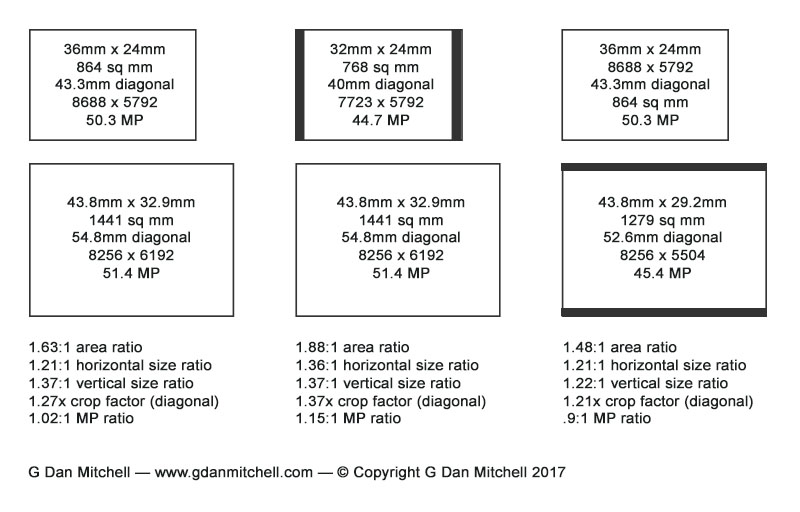
Comparing full frame 24mm x 36mm and Fujifilm mini-MF 33.8mm x 43.8mm sensors

Starting a few years ago with cameras like the Pentax 645d and then 645z and continuing with new cameras from Hasselblad and Fujifilm, systems using  the “miniMF” 33mm x 44mm sensors have become more readily available and less expensive.

In preparation for writing something about the merits of the two types of systems I created this image that holds quite a bit of technical comparison data based on pixel counts (e.g. — “megapixels”), sensor size, and ways of comparing them.

For now I won’t try to analyze this too much, except to say that comparisons between the two formats are more complicated than you might think and they are somewhat subjective — it matters how you plan to use them. For example, do you prefer to use the 3:2 aspect ratio of full frame,  or the 4:3 ratio of miniMF, or will you adapt to whichever you are using? This chart shows you how that affects your comparisons.

NOTE: The graphic is a first attempt at including a lot of information in a single chart. It has some problems, especially with the numbers representing crop factor. I’ll update the image to correct the errors before long, and at that point I’ll use it in a more substantive post about comparing the formats.

© Copyright 2016 G Dan Mitchell – all rights reserved.


G Dan Mitchell is a California photographer and visual opportunist. His book, “California’s Fall Color: A Photographer’s Guide to Autumn in the Sierra” is available from Heyday Books and Amazon.
Blog | About | Flickr | Twitter | FacebookGoogle+ | LinkedIn | Email


All media © Copyright G Dan Mitchell and others as indicated. Any use requires advance permission from G Dan Mitchell.

Fujifilm Camera/Lens Promotion

FUJIFILM PROMOTION

I’m a big fan of the Fujifilm x-trans cameras and the Fujifilm lenses. (I use the XPro2 and several of the lenses for my street and travel photography. Fujifilm has one of their periodic promotions going on up until close to Christmas, and it reduces prices on cameras and lenses by as much as $400. Here is a list the items from site-affiliate Adorama. (You can also fine many of them at site-affiliate B&H via their link in the sidebar, and their Black Friday link at the end of this post.)

(Link to all.)

Cameras

Some of the best bargains here are on older 16MP cameras such as the XT10, XT1, and X100T, but there is good pricing right now on the newer 24MP XPro2, the camera I currently use.

Lenses

The Fujifilm lenses are excellent, and they cover most photographers’ needs. The primes are excellent — I rely on the 14mm f/2.8, 23mm f/1.4, 35mm f/1.4, and 60mm f/2.4 macro. I’ve used the 18-55mm kit lens and the 55-200mm tele-zoom, which is a very nice lens in a compact, light and affordable package.  Recently I have also been using the 50-140mm f/2.8, which is the equivalent of the high end 70-200mm f/2.8 lenses from major DSLR manufacturers. I’m likely to acquire the 16-55mm f/2.8 before long.

(Note: the numbers in parentheses are “angle of view equivalent focal lengths” on full frame cameras.)

A Small Test: Fujifilm X-Pro2 Mirrorless and Active Subjects

I want to share the results of a little informal test I did today using my Fujifilm X-Pro2 (B&H | Adorama) mirrorless interchangeable lens camera and a Fujifilm zoom lens to photograph an active subject. First, here is an unremarkable photograph, aside from the fact that I would probably not have used my previous mirrorless camera to photograph this subject.

Fujifilm X-Pro2, ISO 400, f/8, 50-140mm lens at 140mm, handheld

Read on to find out why I photographed this and what I learned from it.

Background

I first used a mirrorless digital camera way back before the 21st century began — before there were DSLRs there were a number of early digital cameras, and my first was an Apple QuickTake! I used several others from a range of manufacturers before I acquired my first DSLR in about 2003.

As a group, mirrorless cameras have had some problems. One of the most glaring has long been slow autofocus (AF) speeds. Those very early cameras were often just plain awful in this regard, but they got better over the years.

Until recently I used a Fujifilm X-E1 mirrorless interchangeable lens camera, and it was my primary camera for travel and street photography for about 3 1/2 years. Its AF was fine for most things, but I also had to learn to adapt to slow AF in low light and with low contrast subjects — and the issue was more acute with some lenses than with others. For this reason — and a few others, including electronic viewfinder (EVF) display latency — I would never have thought to use that camera for photograph active subjects.

Continue reading A Small Test: Fujifilm X-Pro2 Mirrorless and Active Subjects

Fujifilm Announces XT2 Mirrorless Digital Camera

Everyone knew it was coming — and knew most of the specifications — but Fujifilm has announced the new X-T2 mirrorless digital camera.

X-T2 Mirrorless Digital Camera

The X-T2 takes its place alongside the X-Pro2 as the second of Fujifilm’s two “flagship” camera bodies. Both  use a 24.3MP X-trans 1.5x cropped sensor and both work with the excellent selection of Fujifilm lenses. Like its predecessor,  the popular X-T1, the X-T2 has a DSLR-like design with an electronic viewfinder (EVF). Fujifilm says that it improves on the autofocus system of the X-T1. The camera also can make 4k video, a first for Fujifilm, it has impressive burst mode speeds, and a flip out view screen on the back of the camera. There are rumors that the X-T2 can be charged directly using USB.

If you are ready to go out and buy one… you’d better be patient. First deliveries are scheduled for around September 8, 2016.

Preorders are available now:

  • Fujifilm X-T2 Mirrorless Digital Camera (body only) $1599: B&H | Adorama
  • Fujifilm X-T2 Mirrorless Digital Camera with 18-55mm lens $1899 B&H | Adorama

X-T2 Vertical Power Booster Grip

Fujifilm has also announced the X-T2 Vertical Power Booster Grip, a long-rumored vertical grip for the X-T2. The grip holds two extra batteries (for a total of three in the camera), which extends shooting time without a battery change and also enables higher speed shooting and 4k video recordings of up to a half hour. Price is $329.99.

The XT-2 Vertical Power Booster Grip is expected to be available in September 2016. Preorders are available now: B&H | Adorama

EF-X500 Electronic Flash

One weakness of the Fujifilm system for some photographer has been the lack of support for electronic flash. Despite periodic rumors nothing has been released… until now. Fujifilm also announced a new EF-X500 electronic flash unit. List price is $499.99.

Expected availability for shipping is September 2016. Preorders are available now: B&H | Adorama

Updated “Lens Roadmap”

Fujifilm, unlike some other manufacturers, has provided a “lens roadmap” describing their overall system of lenses, including both current and planned future products. The roadmap was updated at the time of the X-T2 announcement to include three new lenses and planned introduction timelines.

Continue reading Fujifilm Announces XT2 Mirrorless Digital Camera