
Tag Archives: Equipment

DSLR & Mirrorless: Flexibility and Adaptability

(Note: This is one of those occasional posts adapted from something I originally wrote elsewhere. This one came from an online discussion of the relative merits of DSLRs and mirrorless cameras and their abilities to work with various lenses and photographic subjects. I have edited the original slightly for its re-use here.)

With all of the recent (justifiable!) interest in new mirrorless camera developments from Sony, there are factors that may persuade some photographers to go slow on giving up DSLRs for mirrorless. (It may also convince them to do what I did — I augmented my DSLR system with a second mirrorless system.) As good as mirrorless cameras are becoming, in particular the full frame Sony A7r and newer A7rII, they have their pluses and minuses when it comes to real-world photography. They can do some things quite well – there are advantages in some cases to the electronic viewfinders, Sony sensors provide state-of-the-art dynamic range, the bodies are compact, and more. They do some things less well — native lenses are few, other lenses require adapters, the autofocus systems are slower than DSLRs, there are still latency issues with the viewfinders, and so on.)

In this context, I recently realized that one of the nice things about the new Canon EF 100-400mm f/4.5-5.6L IS II Lens and the newer Canon bodies (like my 5Ds R, which is very similar to the 5Ds)  is that they now autofocus (AF) quite well at f/8. The 100-400 len’s maximum f/5.6 aperture at the long end is no longer a barrier to getting 560mm out of the lens by adding the TC.

I’ve only tried the combination on one occasion so far, when the opportunity to photograph wildlife came up on a recent photography venture along the California coast. I put the 100-400 version II and the Canon 1.4x TC on my 5DsR and photographed two wildlife subjects, elephant seals lounging on a beach and pelicans doing everything from flying past to landing to sitting still. (For those who want more information than I can provide here, I wrote about the initial results in a another article.)

While I do not recommend that people whose primary photographic focus is birds in flight rush out and get a 5Ds or 5Ds R, a 100-400 v2, and a 1.4x TC as their primary setup, it does work decently and in some cases extremely well.  Most importantly, it means that my primary landscape photography setup and can also work very effectively with non-landscape subjects, including wildlife — a task that will severely challenge the best current mirrorless options.
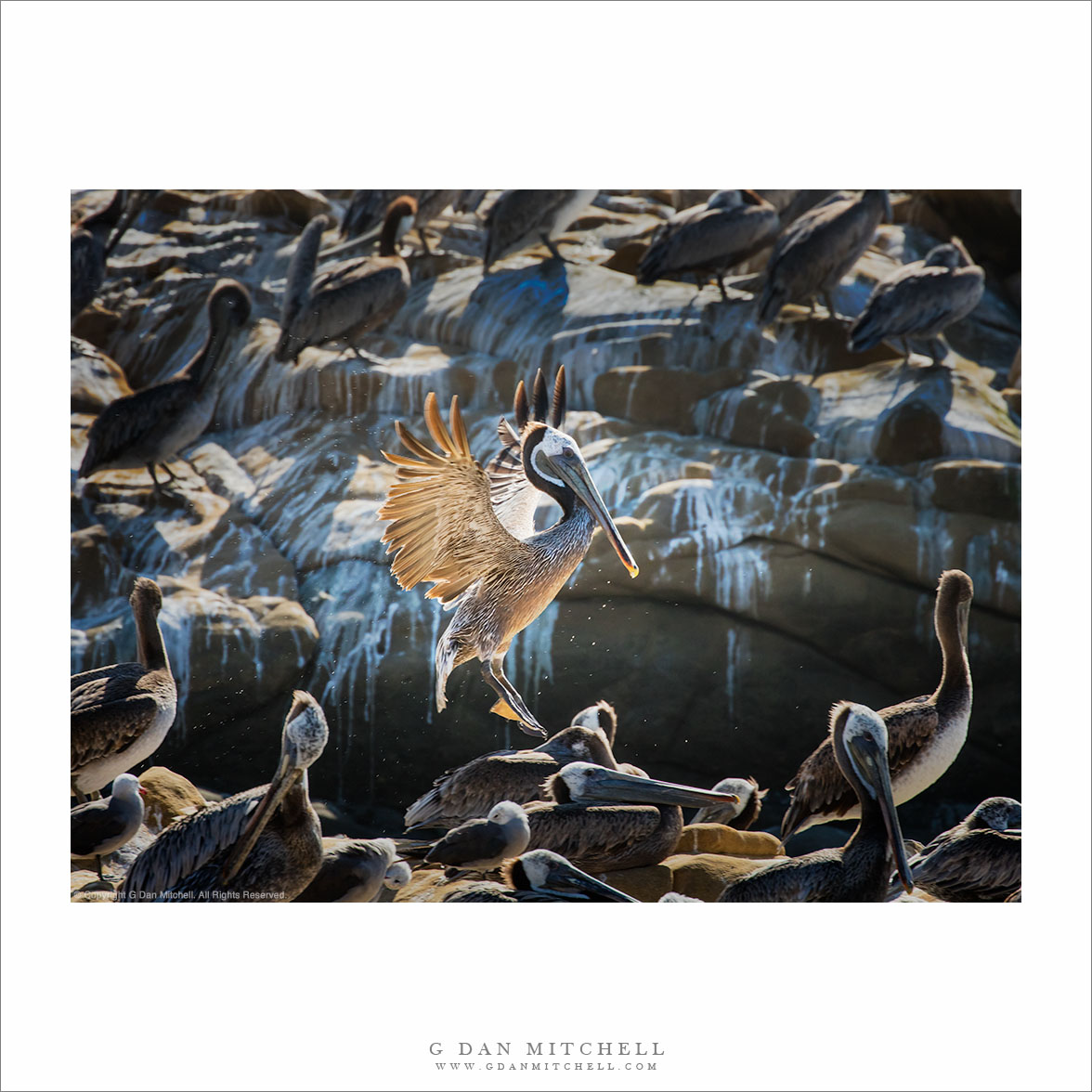
The Landing
“The Landing” — A brown pelican joins the flock on a rock along the Pacific coast of California

The combination focuses well and provides good resolution, even with moving subjects — though, obviously, not as well as using something like a 1Dx with a 300mm f/2.8 prime. It is good enough that I can track birds in flight and catch sharp photographs of them in motion.

Continue reading DSLR & Mirrorless: Flexibility and Adaptability
Reader Questions: Landscape Lenses

From time to time I get questions from readers, and I usually like to share the answers so that other might learn something, too.

Recently “Gregory” wrote:

I just read one of your articles on appropriate lenses to use for landscape photography. I’m a hobbyist photographer in California that has a passion for landscape photography. I sold my Canon equipment and will be purchasing some Nikon lenses and camera body. I wanted to get your input as to what the majority of landscape photographers use – prime lenses or zoom lenses? Based on my limited budget, here is what I am thinking of:

Option A — Primes: 20mm, 28mm, 50mm, 85mm
Option B — Zooms: 24-70mm, 70-200mm
Option C — Zooms: 16-35mm, 24-70mm

I don’t have the budget to purchase both a super wide zoom AND a telephoto. I’ll have to settle for one of these and then acquire an additional zoom later on. I’m thinking the primes maybe slightly sharper in the borders and lighter to carry, but what about the hassle of constantly switching lenses back and forth? Not sure I want to do this. I would appreciate any recommendations/suggestion you might have.

Before I reply here, let me share a couple of articles that I wrote about more or less this topic:

By the end of this article… I probably will not tell you which lenses to select! But perhaps I’ll help you consider factors that will assist in making a good personal decision that is right for your photography.

To a great extent, many of these decisions are personal and they come down to your own personal preferences and the ways in which you approach your subjects. Some people have reasons for preferring prime lenses, some have reasons for preferring zooms, and others have good reasons for wanting both. Some are comfortable working with a relatively narrow range of focal lengths, while other feel the need for a wider range. Some have a predilection for wide-angle lenses, while others are drawn to longer focal lengths. And this doesn’t even get into the questions about tilt/shift lenses and other variables.

I mention this for a couple of reasons. First, there are going to be people who disagree with my preferences — listen to their perspectives, too, and then use your own judgment. Second, consider your own preferences at least as much. Continue reading Reader Questions: Landscape Lenses

Misplaced Focus (Morning Musings 12/3/14)

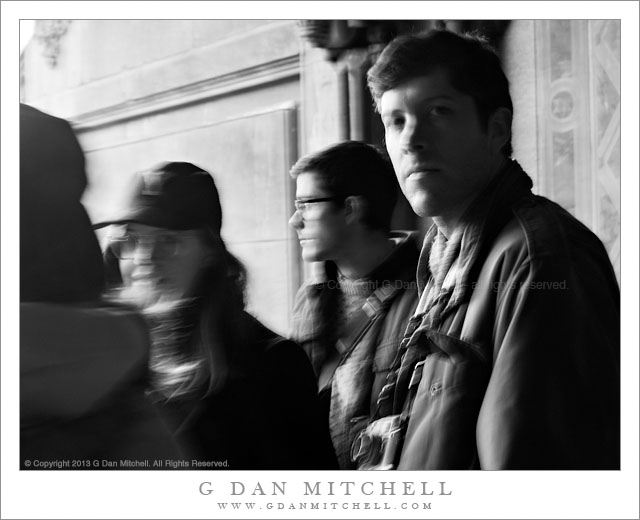
Family Portrait
Family Portrait

From time to time I adapt things that I wrote elsewhere and re-share them on the blog. The following is something I contributed to a discussion about a question from a newish photographer who wondered how important it would be to upgrade his camera. 

I’m all for better image quality — which contemporary cameras, software, and printing processes provide in spades. And there is no question that, all else being equal, a photograph captured on a larger film or sensor format can potentially resolve more detail, and may improve other image parameters including dynamic range and noise.

As they say, “So stipulated.”

But the question (which was about choosing a sensor format) deserves a more nuanced and contextual answer than that. Fortunately, the most accurate and useful answer involves quite a bit of that nuance. I think it really comes down to something like, “Will replacing my cropped sensor camera with a full frame camera make my photographs look better?”. The best answer begins with, “It depends.”

As to the question (which also came up in the original discussion) of what is important in a photograph, image sharpness is not unimportant in many cases. (Though there certainly are photographs whose “goodness” is perhaps at least partially because they are blurred — softness and blur are not always things to be avoided.)

I think the issue in photography discussions is frequently about the balance among issues that affect the quality and effectiveness of a photograph. Here, it is not uncommon for some folks to exhibit a misplaced focus on the technical stuff, accompanied by insufficient attention to other things that are more important to their success as photographers. Continue reading Misplaced Focus (Morning Musings 12/3/14)

Switching. And Patience. (Morning Musings 9/18/14)

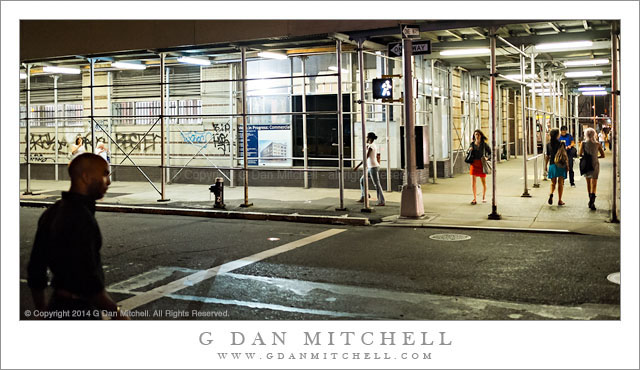
Friday Night, Manhattan
Friday Night, Manhattan*

Today I’m going to muse about equipment, and how to respond to the ongoing and inevitable continuing improvements in the capabilities of photography gear. My primary context is the Canon DSLR gear that I use, though the issue that I’m “musing” about is a more general one.

I shoot mostly with a Canon 5D Mark II camera body, typically using four or fewer lenses. (I also use a Fujifilm X-trans camera for situations where small and light gear is more important than having a full frame sensor.) The 5DII is a 21MP full frame DSLR camera and can produce marvelous photographic results, including quite large high quality prints.

Recently Canon-using photographers have become acutely aware that full frame cameras from Sony (such as the A7r) and Nikon (the D800 and D810 models) incorporate important advances in digital sensor technology. These include greater photo site density (36MP sensors) and increased dynamic range (or “DR” in photospeak), and these cameras have gotten the attention of many serious photographers. (Today the issue came up in the context of a forum discussion of a vague and unsubstantiated rumor of a new Canon camera.)

Since photography relies on the technology of cameras and lenses, photographers are almost always interested in technological improvements. In fact, some folks can become so interested in this that the technology becomes more important to them than the photographs, and it be a challenge to keep things in perspective. Continue reading Switching. And Patience. (Morning Musings 9/18/14)