This is the time of year when people plan their summer travels. Recently I’ve noted people trying to figure out what gear will work for photography while traveling, what kind of camera and what lenses to take. What is the best approach? Take the whole kit? Just use your smartphone? Get something special just for travel photography?
I do a fair amount of travel photography, and I wrote an article sharing some of my ideas: Travel Photography Gear. Click the link and take a look!
“Je Suis Bleu” — Sidewalk, graffiti covered wall, and women (virtual and real) on a Paris street
A starting assumption: There is no one “right” or “best” approach to photography while traveling, and what works for me may be far from ideal for you. It depends a lot on your goals and the role photography plays in your travels. The article explores some of the options and variables.
I’m hopeful that this article may help you figure out what will work for you.
COMMENT OR QUESTION? Scroll down to the comment form.
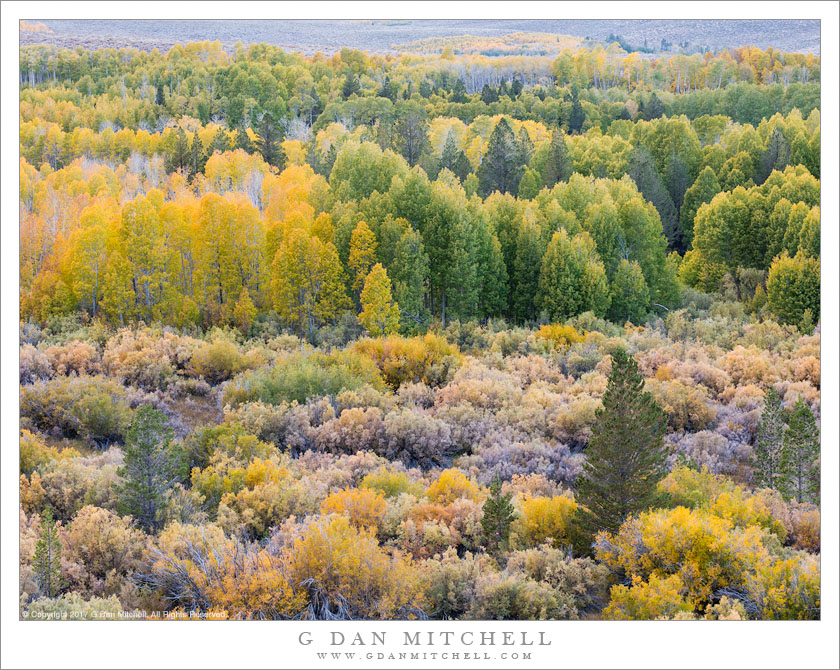
Brush and aspens undergoing the autumn color transition in the eastern Sierra Nevada
Excerpt:
“California-based G. Dan Mitchell notes that the color season can last months in California’s Eastern Sierra, given the large variations in elevation, precipitation, range of north/south latitude, and other factors. He explains, “When color is absent in one location, it may be great not far away. In the Eastern Sierra, this often means going to a higher or lower elevation. While aspens can start changing color at higher elevations in the second half of September, some trees at lower elevations may be colorful a full month later.”
(About the “color season can last months…” comment. I can often find the first hints of coming autumn color early in September, and even in late August sometimes. I can still find low elevation color in the last half of October.)
Some end-of-year special promotional prices on Canon DSLR/lens bundles, Canon lenses and Speedlites, and Nikon DSLR/lens bundles are valid at B&H only through 4:00PM EST time today!
Canon DSLRs and DSLR/lens bundles — Savings of up to $650 on many products including 5DIII, 5Ds, 5DsR, 6D, 70D, 7DII, several Rebels
Canon lenses and Speedlites — Savings of up to $200 on over 30 lenses, including many excellent and popular models, along with four Speedlite/flash units
Nikon DSLR/lens bundles — “Instant Savings” of hundreds to over $1000 on camera bundles including D3300, D5300, D610, D7100, D7200, D750, D810, Df, D4s
Purchases through these links to site-affiliate B&H return a small percentage of your purchase price to support this website. Your price is the same.
(Note: This is one of those occasional posts adapted from something I originally wrote elsewhere. This one came from an online discussion of the relative merits of DSLRs and mirrorless cameras and their abilities to work with various lenses and photographic subjects. I have edited the original slightly for its re-use here.)
With all of the recent (justifiable!) interest in new mirrorless camera developments from Sony, there are factors that may persuade some photographers to go slow on giving up DSLRs for mirrorless. (It may also convince them to do what I did — I augmented my DSLR system with a second mirrorless system.) As good as mirrorless cameras are becoming, in particular the full frame Sony A7r and newer A7rII, they have their pluses and minuses when it comes to real-world photography. They can do some things quite well – there are advantages in some cases to the electronic viewfinders, Sony sensors provide state-of-the-art dynamic range, the bodies are compact, and more. They do some things less well — native lenses are few, other lenses require adapters, the autofocus systems are slower than DSLRs, there are still latency issues with the viewfinders, and so on.)
In this context, I recently realized that one of the nice things about the new Canon EF 100-400mm f/4.5-5.6L IS II Lens and the newer Canon bodies (like my 5Ds R, which is very similar to the 5Ds) is that they now autofocus (AF) quite well at f/8. The 100-400 len’s maximum f/5.6 aperture at the long end is no longer a barrier to getting 560mm out of the lens by adding the TC.
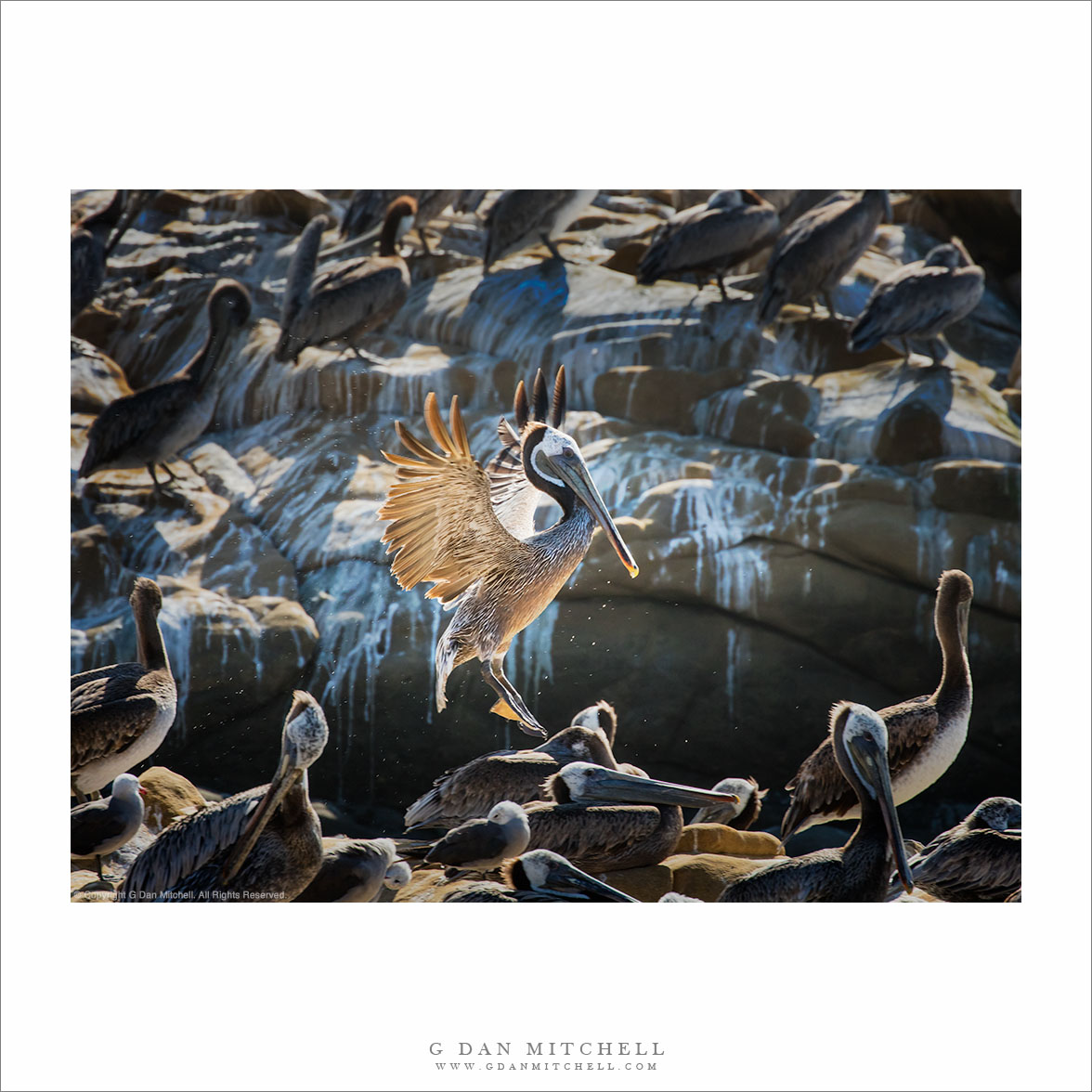
I’ve only tried the combination on one occasion so far, when the opportunity to photograph wildlife came up on a recent photography venture along the California coast. I put the 100-400 version II and the Canon 1.4x TC on my 5DsR and photographed two wildlife subjects, elephant seals lounging on a beach and pelicans doing everything from flying past to landing to sitting still. (For those who want more information than I can provide here, I wrote about the initial results in a another article.)
While I do not recommend that people whose primary photographic focus is birds in flight rush out and get a 5Ds or 5Ds R, a 100-400 v2, and a 1.4x TC as their primary setup, it does work decently and in some cases extremely well. Most importantly, it means that my primary landscape photography setup and can also work very effectively with non-landscape subjects, including wildlife — a task that will severely challenge the best current mirrorless options.
“The Landing” — A brown pelican joins the flock on a rock along the Pacific coast of California
The combination focuses well and provides good resolution, even with moving subjects — though, obviously, not as well as using something like a 1Dx with a 300mm f/2.8 prime. It is good enough that I can track birds in flight and catch sharp photographs of them in motion.
Photographer and visual opportunist. Daily photos since 2005, plus articles, reviews, news, and ideas.
Manage Consent
To provide the best experiences, we use technologies like cookies to store and/or access device information. Consenting to these technologies will allow us to process data such as browsing behavior or unique IDs on this site. Not consenting or withdrawing consent, may adversely affect certain features and functions.
Functional
Always active
The technical storage or access is strictly necessary for the legitimate purpose of enabling the use of a specific service explicitly requested by the subscriber or user, or for the sole purpose of carrying out the transmission of a communication over an electronic communications network.
Preferences
The technical storage or access is necessary for the legitimate purpose of storing preferences that are not requested by the subscriber or user.
Statistics
The technical storage or access that is used exclusively for statistical purposes.The technical storage or access that is used exclusively for anonymous statistical purposes. Without a subpoena, voluntary compliance on the part of your Internet Service Provider, or additional records from a third party, information stored or retrieved for this purpose alone cannot usually be used to identify you.
Marketing
The technical storage or access is required to create user profiles to send advertising, or to track the user on a website or across several websites for similar marketing purposes.