
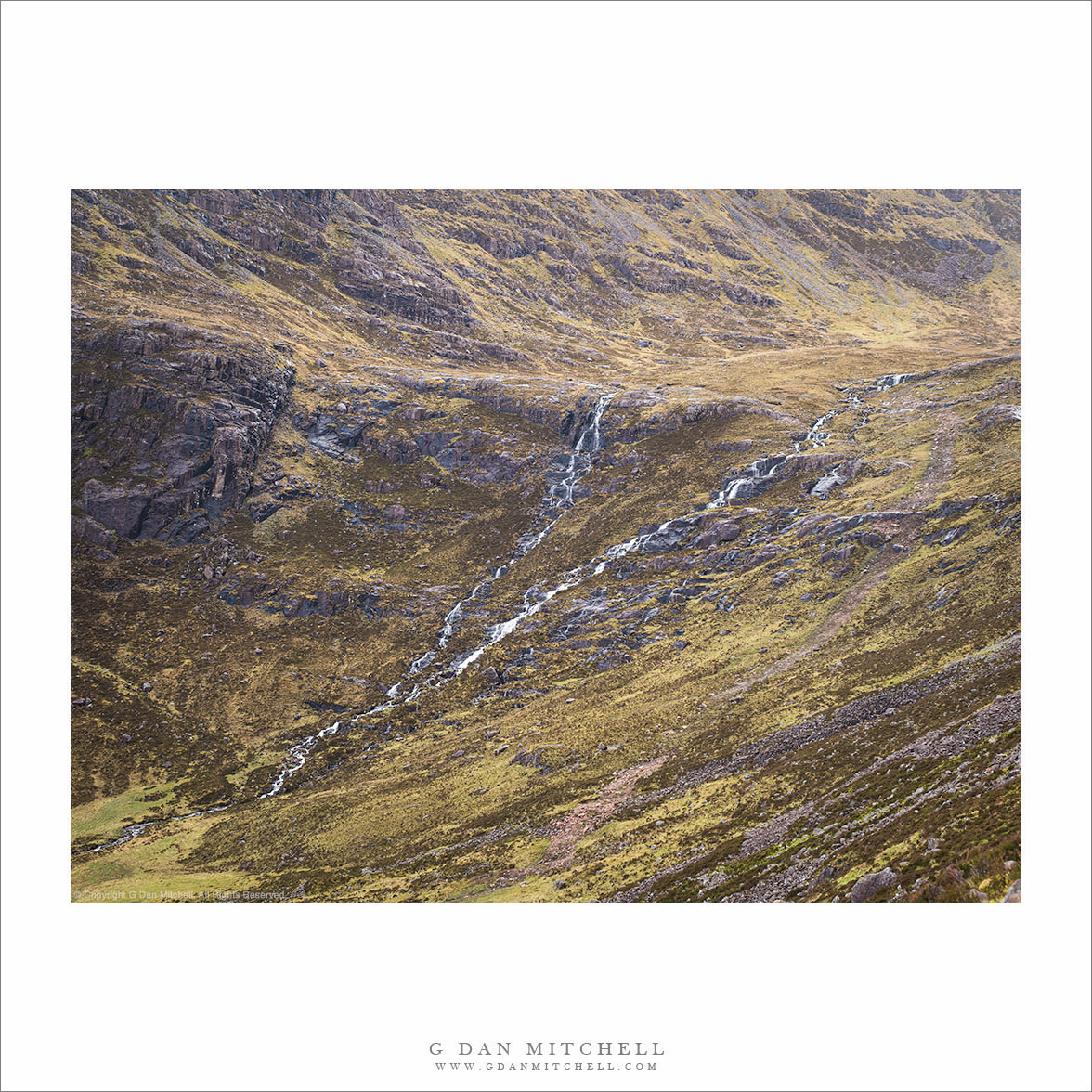
From what we could see, there don’t seem to be roads into the highest portions of the Scottish highlands. There are quite a few roads near to them, and it is common to find yourself driving up or down a river valley below the tall mountains, But actually getting into that high, rugged terrain seems to require walking in most areas. So we were surprised and happy to find ourselves headed over a pass on a road that took us quite high up.
The location is Applecross Pass, which rises quickly from the sea at the village of Applecross. The road ascends above the tree line, and the landscape is like what one sees driving or hiking through the alpine zone back in the continental US — except that at times you can see the ocean nearby! This little creek descends precipitously from the pass, and its open, rugged surroundings reminded me of the alpine country of the Sierra Nevada.
COMMENT OR QUESTION? Scroll down to the comment form.
G Dan Mitchell is a California photographer and visual opportunist. His book, “California’s Fall Color: A Photographer’s Guide to Autumn in the Sierra” (Heyday Books) is available directly from him. Blog | Bluesky | Mastodon | Substack Notes | Flickr | Email
All media © Copyright G Dan Mitchell and others.
One of the wonderful things about such Scottish cascades is that some of them (perhaps not these) are ephemeral. Here today while it rains, gone tomorrow. One of the most wonderful images of these was by Mark Littlejohn, celebrated in https://www.onlandscape.co.uk/2014/11/mark-littlejohn-landscape-photographer-year/. I managed one such image of a hillside at the inland end of Loch Etive. Not sure if this happens so much elsewhere? You probably know!
Thanks for mentioning that.
I’m not yet familiar enough with the Scottish landscape to fully recognize all of those things, but I can imagine that many of the smaller creeks and streams fluctuate quite a bit as the rains come and go.
This does happen elsewhere, and I had a memorable experience with it a few years ago in the Sierra Nevada backcountry. A group of us, all photographers, hiked in to a somewhat remote location. As we arrived, crossed a small stream and a meadow to get to our campsite, we could tell that it was about to rain. (A bit of afternoon summer rain is not that unusual here.)
We set up camp quickly. Literally within minutes the heavens opened up and the heaviest backcountry rain I have experienced began. We were pinned down in our tents for hours, with streams of water flowing beneath the tent floors. (Fortunately we had picked an elevated camp location.)
Before long we began to hear a sound like the roar of jet engines. A small stream right below us, so small that we had been able to easily step across it earlier, had now turned into a raging, dangerous torrent. Within hours, the muddy runoff water in the stream had turned a nearby sky-blue lake a muddy brown.
I spend a lot of time photographing desert areas of California and the Southwest. Most of the time there is little or no water anywhere, but when big storms do arrive, within hours there can be enough water flowing to destroy roads, wash out bridges, and fill playas.