This is the time of year when people plan their summer travels. Recently I’ve noted people trying to figure out what gear will work for photography while traveling, what kind of camera and what lenses to take. What is the best approach? Take the whole kit? Just use your smartphone? Get something special just for travel photography?
I do a fair amount of travel photography, and I wrote an article sharing some of my ideas: Travel Photography Gear. Click the link and take a look!
“Je Suis Bleu” — Sidewalk, graffiti covered wall, and women (virtual and real) on a Paris street
A starting assumption: There is no one “right” or “best” approach to photography while traveling, and what works for me may be far from ideal for you. It depends a lot on your goals and the role photography plays in your travels. The article explores some of the options and variables.
I’m hopeful that this article may help you figure out what will work for you.
COMMENT OR QUESTION? Scroll down to the comment form.
Reader “Paul” asks about gear for backcountry photography and how it may vary from trip to trip:
Dan, I’m curious. On your trips, what percentage of your pack is reserved for anything photographic in terms of weight? And what percentage is camping? Or does that change with your experience and knowing ahead of time what your photographic expectations are?
Great questions, Paul. The answer gets a bit complicated, but let me try to get to the heart of what I think is a question about how much weight/stuff to carry for various sorts of backcountry trips. (A longer article — My Backcountry Photography Equipment — goes into even more detail.)
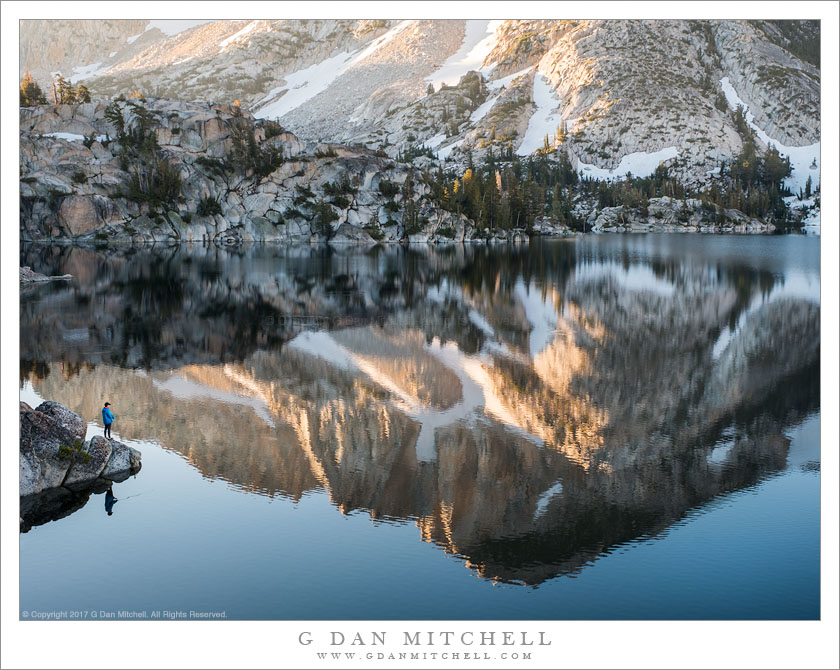
A solitary sunrise angler stands on shoreline rocks at an alpine Sierra Nevada lake reflecting a nearby peak
As you imply in your question, the answer varies — sometimes a lot — depending on a bunch of factors: how fit/young you are, the terrain you’ll cover, your willingness to bear weight for photography, whether your focus is more on miles covered per day or the photography itself, what you’ll do with the photographs after the trip, and more.
This is the first of what will be a series of articles looking at steps you can take to improve your chances of producing compelling photographs.
A recent stay in Yosemite Valley during my Yosemite Renaissance artist-in-residency reminded me again that while many aspects of photography are out of our control, there are things we can do to increase the odds of success.
On this visit I had three late April spring days to photograph in the park, which mostly means “in Yosemite Valley” at this time of year when the high country is still snowed in. By non-photography standards, the Valley was beautiful — if a bit crowded. The sun was out, the sky was blue, temperatures were comfortable, rivers were full of early snowmelt, the waterfalls were flowing, there were hints of green in the seasonal vegetation, and too many tourists were already showing up!
I did the usual things: I got up before dawn to find the early light. I stuck around until the last light faded. I returned to subjects that I knew from past experiences to be promising. I considered where the light would be at different times of day. I went looking for new subjects in likely places. I wandered. I kept my equipment with me at all times. I made photographs, and some of them are even pretty good, but at times it was hard to “see” something special in these conditions.
What’s not to like, right? From a photographer’s point of view these are not ideal conditions for photography. As pleasant as nice weather is for hiking and camping and picnicking, it can be hard to find exceptional photographs in such everyday light. I and many of my fellow Sierra photographers prefer interesting and unusual conditions — precipitation, broken light, mist and clouds, some haze.
On the final morning I was up and heading into the Valley well before sunrise. The light was unspectacular, with thick overcast cutting off the morning light. But then I caught sight a bit more light in the east, and soon I saw some breaks in the clouds. Within fifteen minutes the conditions opened up and I was treated to an exceptional spectacle of light and clouds and landscape that lasted for several hours, during which I photographed continuously. I made more interesting photographs during these few hours than during the rest of the visit.
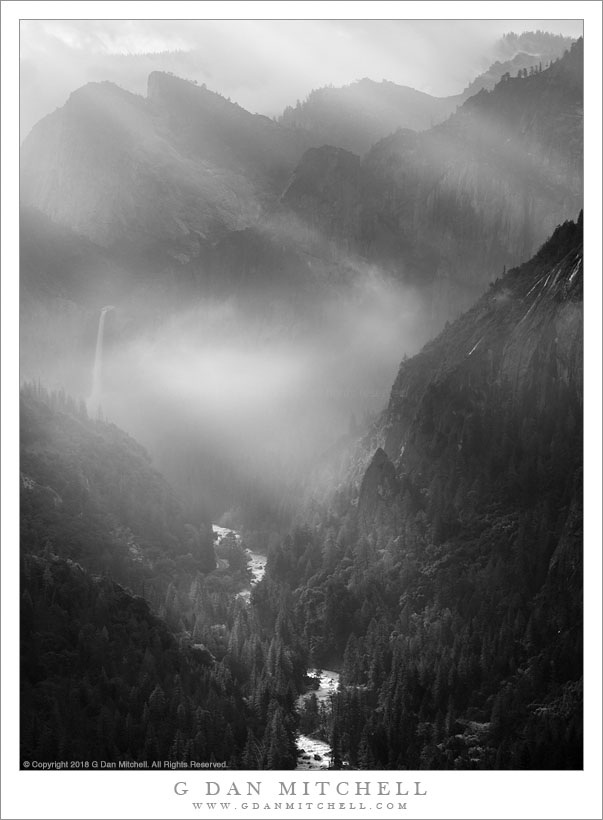
The morning sun breaks through clearing clouds above Merced Canyon
To state the obvious, “exceptional” and “unusual” conditions are not the norm. The blue-sky “blah” light is. If you show up on ten randomly selected days, nine of them are going to be, literally, unexceptional, and if you are looking for something unusual and beyond-the-norm you aren’t likely to find it.
It can be difficult to figure out what gear will work well for photography while traveling, what kind of camera and what lenses to take. I do a fair amount of travel photography, and I’ll going this use this article to summarize a few approaches that can work. (Article updated April 25, 2026.)
“Je Suis Bleu” — Sidewalk, graffiti covered wall, and women (virtual and real) on a Paris street
A starting assumption: There is no one “right” or “best” approach to photography while traveling, and what works for me may be far from ideal for you. I’m hopeful that this article may help you figure out about what fits your approach to travel.
Photographer and visual opportunist. Daily photos since 2005, plus articles, reviews, news, and ideas.
Manage Consent
To provide the best experiences, we use technologies like cookies to store and/or access device information. Consenting to these technologies will allow us to process data such as browsing behavior or unique IDs on this site. Not consenting or withdrawing consent, may adversely affect certain features and functions.
Functional
Always active
The technical storage or access is strictly necessary for the legitimate purpose of enabling the use of a specific service explicitly requested by the subscriber or user, or for the sole purpose of carrying out the transmission of a communication over an electronic communications network.
Preferences
The technical storage or access is necessary for the legitimate purpose of storing preferences that are not requested by the subscriber or user.
Statistics
The technical storage or access that is used exclusively for statistical purposes.The technical storage or access that is used exclusively for anonymous statistical purposes. Without a subpoena, voluntary compliance on the part of your Internet Service Provider, or additional records from a third party, information stored or retrieved for this purpose alone cannot usually be used to identify you.
Marketing
The technical storage or access is required to create user profiles to send advertising, or to track the user on a website or across several websites for similar marketing purposes.