
Tag Archives: recommendation

The Economics of DSLR “Protective” Filters

The subject of whether or not to get so-called “protective” UV filters for DSLR lenses comes up a lot. I used to respond to the question frequently – so frequently that I eventually gave up and just wrote a post on the subject that I could refer people to when they ask.

However, during a recent weak moment I wrote a new response to the notion that ‘protective’ filters provide good value for all photographers. As I do from time to time, I’m sharing it here:

Someone wrote: … would you rather pay $150 on a filter that *might* compromise your shot or spend $150 on replacing the front element and have *no* possible risk of image degradation from the extra piece of glass?

I replied: This is essentially an insurance question. Obviously, if we knew that our lens would certainly be destroyed in a way that was 100% preventable by using a filter we would almost certainly get a filter. But that is an imaginary scenario that is far from reality.

Most lenses will never be damaged in any serious way. My hunch is that this is actually the fate of a very small percentage of lenses – probably far less than 10%, and I would bet closer to 1%.

Of those that are damaged, only some will suffer a blow to the front element. There are many other modes of failure – a dropped lens that breaks the mechanism, something crashing into the side of the lens, water damage, etc.

Of those that suffer a blow to the front of the lens structure, only some will result in contact with the front element. Of those in which contact with the front element occurs, some would not cause any damage or any significant damage. Some would damage the front element, but would be violent enough that the filter would not have prevented the damage. A few that might not have damaged the front element will send glass shards from the broken filter into the front element and damage it. In some subset of cases, all of the variables might line up just right and prevent damage.

At this point the user would have to replace the broken high quality filter at a cost that varies depending on a number of factors. Let’s use a figure if $100 for an expensive L zoom. The owner has now invested something on the order of $200… which is not much different from the cost of replacing a front element, as I understand it.

In terms of the probability of damage, the cost of the filter, the likelihood that the filter would save the day… the filter is probably one of the worst insurance investments you could make.

Am I unalterably and completely opposed to the use of ‘protective’ filters? Almost, but not quite. While I do not think that it makes sense to automatically stick such a filter on every lens for general use – see the link above for more on this topic – I can think of one sort of situation in which I might use one. I would consider a filter if I were shooting a sealed-body camera (such as a Canon 1-series) and was working in conditions that were truly dangerous to my equipment (and not just a bit of mist or ocean spray) and I was using of the small number of L lenses that become sealed (and not all do) with the addition of a filter.

Other than that? No.

G Dan Mitchell Photography | Flickr | Twitter | Facebook | Email
Text, photographs, and other media are © Copyright G Dan Mitchell (or others when indicated) and are not in the public domain and may not be used on websites, blogs, or in other media without advance permission from G Dan Mitchell.
Shopping for your first DSLR? Some Advice

Recently I’ve seen a lot of posts around the web by individuals looking to upgrade from point and shoot cameras to their first DSLR – and in a few cases by folks who intend to bypass the P&S step entirely and just start right out with a DSLR.

Among these folks the questions are usually “which camera should I get?” and “what lens(es) should I get?” These questions are phrased in various ways: “Is camera X a good choice?” “What is the best lens for Camera Y?” “I hear that lens/camera Z is the best – is this right?” “I’m just getting started and I plan to get the very best camera and lens available.” “What lenses do I need to complete my setup?”

While there are exceptions to almost every rule, in the case of new DSLR shooters I have some strong opinions about what the best approach will be in most cases. The good news is that the “right” answer is probably also the least expensive, the most conducive to learning about your relationship to DSLR photography, and the most adaptable to a variety of future directions that you might find your photography taking. Continue reading Shopping for your first DSLR? Some Advice

Corner Sharpness of the Canon 17-40mm f/4 L Lens on Full Frame

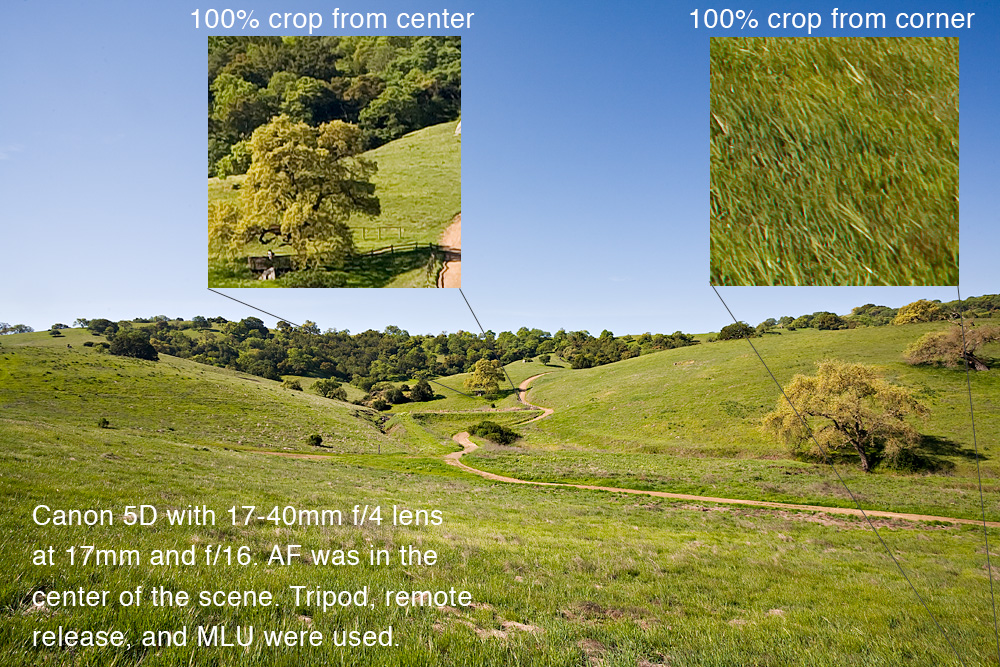
Since the question of how the Canon EF 17-40 f/4 L performs across the frame for landscape photography comes up periodically, I have posted an older test photo I made last year (2007) – updated here to include a comparison corner and center sharpness.

Canon5D17_40f16CornerVsCenter.jpg

Technical data: Canon 5D. Canon EF 17-40mm f/4 L lens. Focal length: 17mm. Aperture: f/16. Shutter speed: 1/60 second. Shot on the tripod with MLU and remote release. If the full image were reproduced at this resolution the print would be about five feet wide. (Not that I’d do that – it is a really boring photograph! :-) In a more typical size print the corners would like very good, indeed.

A 100% crop would not be expected to be “razor sharp” – and we see typical results here. It is impressive to see how well the corner image quality holds up – despite the fact that grass is one of the most challenging subjects for a digital sensor and the fact that this part of the scene was much closer to the camera than the focus point in the center of the scene – i.e. the corner section showing the grass is only a few feet from the camera, and the camera is focused hundreds of feet away on the objects in the center of the frame. (On that subject, I’m convinced that a good number of the reports of “poor corner performance” in ultra wide lenses are actually due to the subjects in the corner being much closer to the camera position than the subjects in the center of the frame, especially when the “tests” are done by shooting actual landscape subjects.)

BOTTOM LINE: What does this tell us, how do we view this in the context of reports of soft corners on the EF 17-40mm f/4 lens, and what does this mean for anyone trying to choose a wide (or ultra-wide in the case of full-frame cameras) Canon zoom lens?

While this lens is soft in the corners when shot wide open, the lens is not particularly soft in the corners when stopped down. If your primary use for such a lens is, for example, shooting very low light handheld wide angle photographs the 17-40 is perhaps not your best choice. (The EF 16-35mm f/2.8 on full frame or the EFS 17-55mm f/2.8 IS on a cropped sensor body could be more appropriate zooms.) On the other hand, if you are primarily interested in subjects that are usually shot at smaller apertures (urban/wild landscapes, architecture, etc.) then the 17-40 can be an outstanding lens – though this is more true on a full frame body than on a crop body, given that you are unlikely to use the smaller apertures on a crop sensor body given the diffraction blur issues there. So, to state it very succinctly…

… the Canon EF 17-40mm f/4 lens is an excellent lens for shooting deep DOF small-aperture photography on a full-frame camera. (It is OK but not necessarily ideal for use with cropped sensor bodies, where I would prefer the EFS 17-55mm f/2.8 IS.)

G Dan Mitchell is a California photographer whose subjects include the Pacific coast, redwood forests, central California oak/grasslands, the Sierra Nevada, California deserts, urban landscapes, night photography, and more.
Blog | About | Flickr | Twitter | Facebook | Google+ | 500px.com | LinkedIn | Email

Text, photographs, and other media are © Copyright G Dan Mitchell (or others when indicated) and are not in the public domain and may not be used on websites, blogs, or in other media without advance permission from G Dan Mitchell.


Lens Protection: Ultraviolet (UV) Filter or Lens Cap and Hood?

(This has become one of the most-read articles at this site. For some reason, the question of whether or not it makes sense to add these little filters to your lenses generates a lot of interest… and sometimes a lot of lively debate. Portions are now a bit dated — the article comes from 2007 — but the general concepts discussed here still hold. From time to time I make small updates based on new information or questions that have come up. Note that there are links to a couple of related posts listed near the end of the article.)

Sellers sell, and some buyers buy, ultraviolet (UV) filters for their cameras. The main advantages are said to be twofold: some reduction of haze that is invisible to the human eye but which the camera purportedly might register, and some protection for the front element of your lens.

On the other hand many photographers wouldn’t think of putting an extra layer of unnecessary glass in front of their lenses. They would rather accept the (rather small) possibility of a scratch on the front element of a lens than possibly reduce the quality of their images, and/or they prefer to protect the lens by using a lens cap and lens hood.

I’m in the latter camp. I no longer use any UV filters* and I can think of darned few situations in which I’d want to use one. (One possible exception being the use of fully-sealed lenses on which the seal is completed by adding a front filter – and here only if I were to use the lens in an extremely hostile environment and with a fully environmentally sealed camera body.) My preference is to handle my camera and equipment relatively carefully, keep the gear protected when not actually using it, use a lens cap, and to almost always use a rigid lens hood.

Continue reading Lens Protection: Ultraviolet (UV) Filter or Lens Cap and Hood?