
Corner Sharpness of the Canon 17-40mm f/4 L Lens on Full Frame

Since the question of how the Canon EF 17-40 f/4 L performs across the frame for landscape photography comes up periodically, I have posted an older test photo I made last year (2007) – updated here to include a comparison corner and center sharpness.
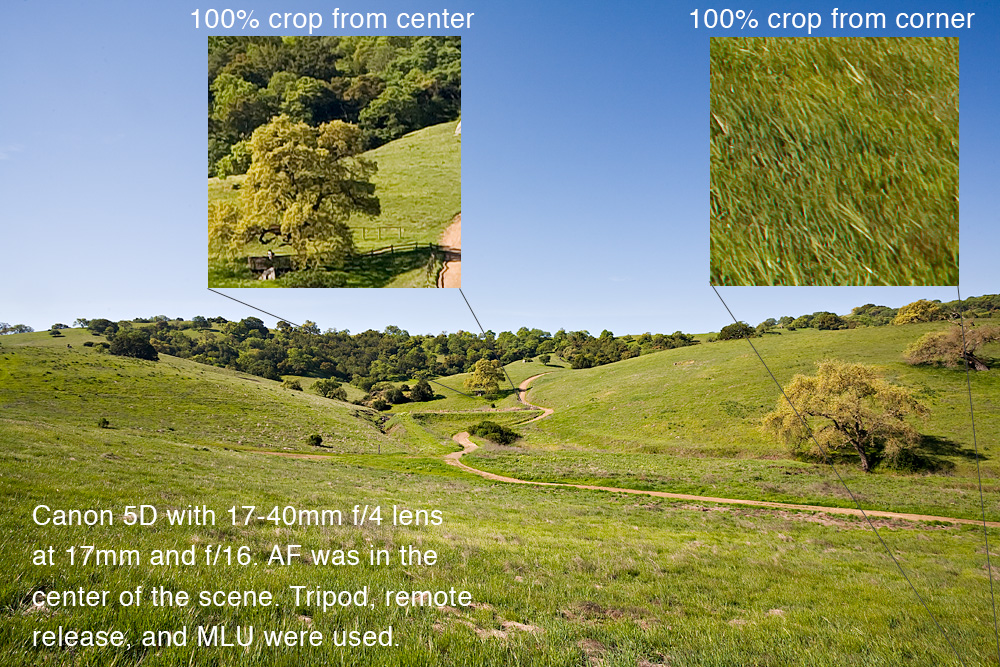
Canon5D17_40f16CornerVsCenter.jpg

Technical data: Canon 5D. Canon EF 17-40mm f/4 L lens. Focal length: 17mm. Aperture: f/16. Shutter speed: 1/60 second. Shot on the tripod with MLU and remote release. If the full image were reproduced at this resolution the print would be about five feet wide. (Not that I’d do that – it is a really boring photograph! :-) In a more typical size print the corners would like very good, indeed.

A 100% crop would not be expected to be “razor sharp” – and we see typical results here. It is impressive to see how well the corner image quality holds up – despite the fact that grass is one of the most challenging subjects for a digital sensor and the fact that this part of the scene was much closer to the camera than the focus point in the center of the scene – i.e. the corner section showing the grass is only a few feet from the camera, and the camera is focused hundreds of feet away on the objects in the center of the frame. (On that subject, I’m convinced that a good number of the reports of “poor corner performance” in ultra wide lenses are actually due to the subjects in the corner being much closer to the camera position than the subjects in the center of the frame, especially when the “tests” are done by shooting actual landscape subjects.)

BOTTOM LINE: What does this tell us, how do we view this in the context of reports of soft corners on the EF 17-40mm f/4 lens, and what does this mean for anyone trying to choose a wide (or ultra-wide in the case of full-frame cameras) Canon zoom lens?

While this lens is soft in the corners when shot wide open, the lens is not particularly soft in the corners when stopped down. If your primary use for such a lens is, for example, shooting very low light handheld wide angle photographs the 17-40 is perhaps not your best choice. (The EF 16-35mm f/2.8 on full frame or the EFS 17-55mm f/2.8 IS on a cropped sensor body could be more appropriate zooms.) On the other hand, if you are primarily interested in subjects that are usually shot at smaller apertures (urban/wild landscapes, architecture, etc.) then the 17-40 can be an outstanding lens – though this is more true on a full frame body than on a crop body, given that you are unlikely to use the smaller apertures on a crop sensor body given the diffraction blur issues there. So, to state it very succinctly…

… the Canon EF 17-40mm f/4 lens is an excellent lens for shooting deep DOF small-aperture photography on a full-frame camera. (It is OK but not necessarily ideal for use with cropped sensor bodies, where I would prefer the EFS 17-55mm f/2.8 IS.)

G Dan Mitchell is a California photographer whose subjects include the Pacific coast, redwood forests, central California oak/grasslands, the Sierra Nevada, California deserts, urban landscapes, night photography, and more.
Blog | About | Flickr | Twitter | Facebook | Google+ | 500px.com | LinkedIn | Email

Text, photographs, and other media are © Copyright G Dan Mitchell (or others when indicated) and are not in the public domain and may not be used on websites, blogs, or in other media without advance permission from G Dan Mitchell.


When NOT to Visit the Racetrack

A reader sent me an email today after reading my piece on photographing the moving rocks at the Racetrack Playa, saying that he was hoping to visit the Playa later this year and asking for advice. He said he plans to visit in June.

Advice… Do not go to the Racetrack Playa in June. Or during any of the hot season months.

While I have little doubt that it is possible for well-equipped and very experienced desert travelers accompanied by similarly experienced folks to go there at that time of year, there are a number of reasons to warn everyone else against trying it:

  • The climate in Death Valley is quite hostile during much of the year. During the summer you can count on temperatures well over 100 degrees F. You shouldn’t be surprised by temperatures over 110 degrees, and much hotter temperatures have been recorded. For this reason, the Death Valley “high season” is more or less November through perhaps the first week of April.
  • Add to the above, the following additional challenges of the Racetrack Playa: You’ll drive a 55 mile round trip on an extremely washboarded gravel road; there will likely be few if any other people out there; there is absolutely no water on this road and there are no services whatsoever; there is no cell phone service. In the event of a breakdown you will probably be out there for a long time – perhaps a very long time.
  • If all of that wasn’t enough, quite frankly the photography is a whole lot better during the opposite season, when some clouds occasionally come through and add interest to the scene.

More advice… If you go to the Racetrack during a wet season – please stay off the playa! Better yet, save your Racetrack visit for a more appropriate time. Here’s the deal:

  • A playa is a very flat place formed when silt-laden water from surrounding hills flows into a low place with no outlet, floods it with muddy silt, and then dries and leaves behind a virtually completely flat surface.
  • Playas are often dry for extended periods of time – but on occasion they are wet. Very wet. And muddy.
  • Footprints on the playa last for years.
  • If you drive miles and miles to have the experience of visiting this vast, untracked place and find it to be wet… stay the hell off the playa so that the everyone who visits the playa for the next X number of years after your visit doesn’t experience a wonderous place marred by your semi-permanent foot prints in the dried surface.

If I know that the playa is flooded or muddy I won’t even go out there.


G Dan Mitchell is a California photographer and visual opportunist. His book, “California’s Fall Color: A Photographer’s Guide to Autumn in the Sierra” (Heyday Books) is available directly from him.

G Dan Mitchell: Blog | Bluesky | Mastodon | Substack Notes | Flickr | Email


All media © Copyright G Dan Mitchell and others as indicated. Any use requires advance permission from G Dan Mitchell.

Electronic Flash and Landscape

The Strobist has a piece today that hits two of my interests, landscape and night photography, and ties them together with the use of strobes and light painting.

Using Speedlights with Landscapes – You might not think a small flash — or even a flashlight — could make such a big difference in a landscape photo. But the trick is waiting for the ambient to come to you, and being selective about what you light. [Strobist]

Follow the link for the full post and photographic examples.

While I have done a bit of “light painting” in my night photography, I’m not a “flashy kind of guy” myself. However, I’m becoming more intrigued after following the Strobist for the past month or two. If you don’t already subscribe to their news feed, I recommend it. Visit The Strobist to find out more.


G Dan Mitchell is a California photographer and visual opportunist. His book, “California’s Fall Color: A Photographer’s Guide to Autumn in the Sierra” (Heyday Books) is available directly from him.

G Dan Mitchell: Blog | Bluesky | Mastodon | Substack Notes | Flickr | Email


All media © Copyright G Dan Mitchell and others as indicated. Any use requires advance permission from G Dan Mitchell.

Two Birds, Corralitos Pond

Two Birds, Corralitos Pond
Two Birds, Corralitos Pond. Calero Hills, California. January 20, 2007. © Copyright G Dan Mitchell

One of several photographs I made on a very foggy early morning last year at this pond in the oak/grassland where I frequently hike.

(keywords: two, birds, corralitos, pond, calero, hills, santa clara county, park, california, usa, brush, bushes, lake, water, reflection, flying, fog, mist, morning, black and white, nature, hiking, outdoors, winter, landscape, stock)