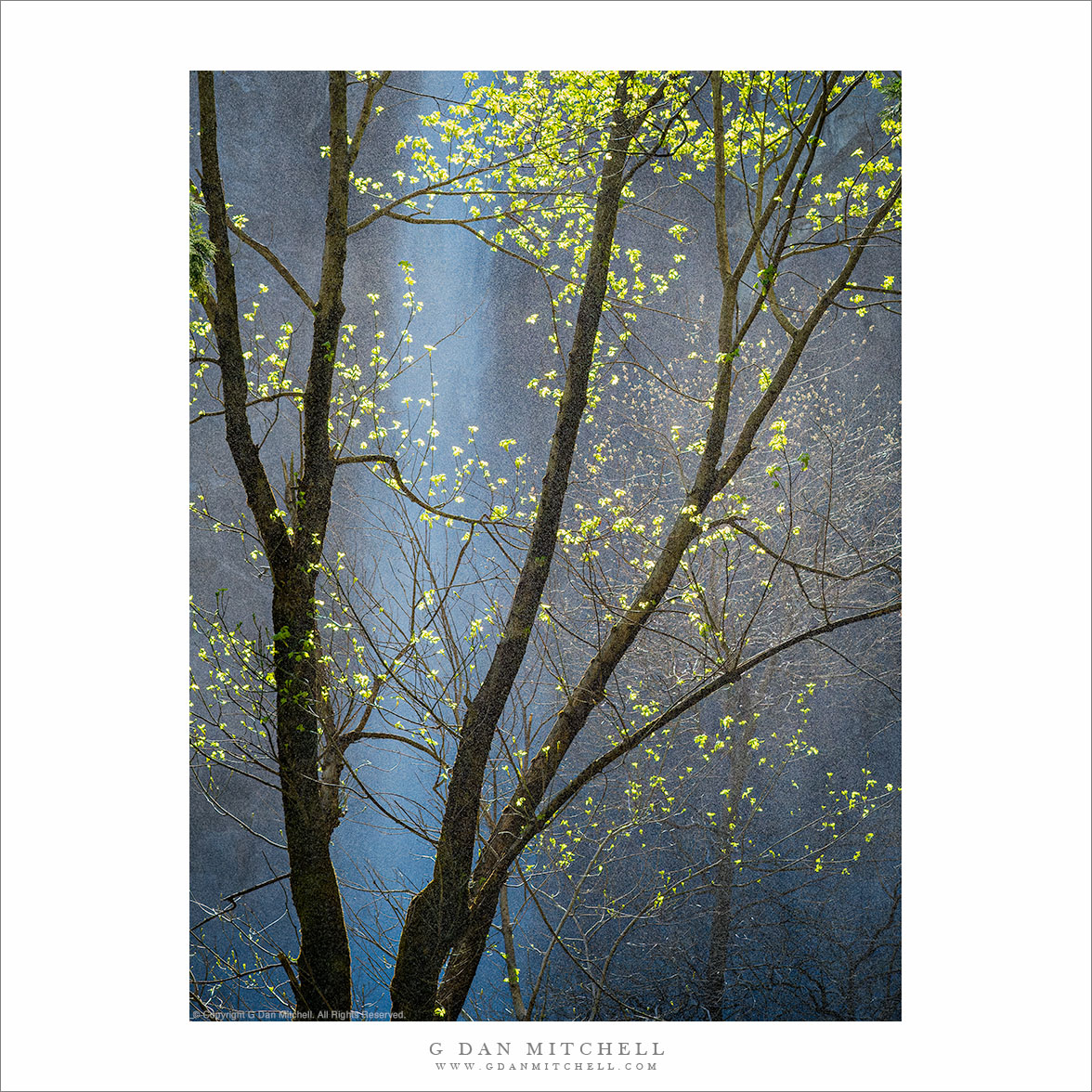
Imagining that a photograph that is “straight out of camera” is better than one that has been “manipulated” in post is equivalent to imagining that the words coming straight out of one’s mouth are better than those resulting from careful and thoughtful editing.
While there is an art to extemporaneous expression, there is at least as much art in carefully crafted work. Continuing to refine and perfect the content and its expression is not remotely unethical. The objective is to produce a pure, clear, concise, more powerful and direct expression of the artist’s truth.
This is true of essentially every mode of human expression: painting, sculpture, movie-making, writing, music, and on and on. Even the seemingly extemporaneous expressions (jazz, etc) are the result of long preparation and practice and planning and are ultimately not simply things that happen in the moment.
It is nonsensical to imagine that photography should be the one art that eschews careful refinement and thought and the distillation and perfection of expression that can make it truer and more powerful.
Over the past few weeks the arguments about “photoshopping” and “manipulation” have again come to the fore, this time as the result of the so-called “scandal” around alterations to some photographs by Steve McCurry. The discussions have evolved in all sorts of ways — as they typically do — some of which I regard as unfortunate: pronouncements about which techniques are “ethical” or “unethical,” declarations that photographs must be “true,” the usual stuff about “getting it right in the camera,” and more. In my view, much of this is naive and unrealistic.
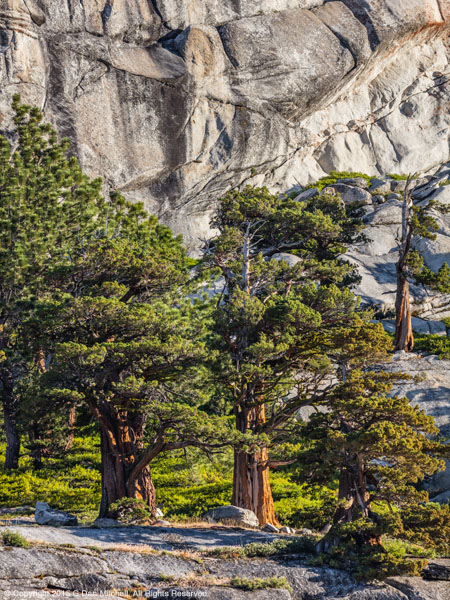
Sierra Nevada Trees And Granite
At the heart of the issue are some problematic notions, including the following.
The camera sees accurately, and any modification of what comes out of the camera subverts the camera’s truth. Some assume that the way the machine “sees” is more accurate than the way our eyes and brains see, and that it is the preferred mode of seeing. There are huge problems with this assumption, beginning with the fact that people and cameras see in very different ways. (I’m more interested in how people see.) The eyes scan a scene, adapting to localized elements of the subject, and the full image never exists aside from a kind of mental abstraction of it. The camera non-selectively records light levels from the entire scene at one instant, all with the same “settings.” There’s much more to this, and the subject is far too big to fully deal with here. Suffice it to say that your eyes/brain are not a camera, and this makes a very big difference.
Modifying photographs in post-production (or “post”) makes them less honest and accurate. Some think that modifying what comes from the camera is dishonest. In fact, if the way that humans see is our model for accurate seeing, as I believe it should be, the way the camera sees is often quite inaccurate. (Who sees in black and white or telephoto or with tilt/shift adjustments or with colored filters or constrained to rectangles?) In order to render an image that is more faithful to the way humans see, it is often necessary to massage the image that comes from the camera.
The use of techniques for “manipulating” or “photoshopping” photographs is unethical. Some take the position that “manipulating” images is wrong, but it seems absurd to make such a blanket statement. If your photograph was slightly underexposed, how is it unethical to increase the brightness in post so that it looks exactly as it would have looked with a slightly longer exposure? How can it be OK to use a telephoto lens but not OK to crop in post? Why would it be OK to use a tilt/shift lens but not to adjust perspective lines in post? Are the “rules” the same for photojournalism and for photographic abstractions?
People often want to see this set of issues as a binary, where things are either right or wrong, but it is nothing like that at all.
Before I offer an example, I would like you to try an exercise — and doing it and considering the results is very important for understanding what follows. Go look at some subject in the bright sun that includes some shadows. As you do, look at the brightest areas in the scene, and consider whether you can see any details, however faint, in those brightest areas. You should be able to. Now shift your gaze to a shaded area. You should be able to see some detail there, too. (Your pupils likely closed down a bit when you looked at the bright area — in photographic terms, you used a smaller aperture — and they likely opened up a bit when you looked at the shadow area.)
This presents a classic photographic problem. Virtually no digital camera and no film can handle the widest dynamic ranges of common scenes that we photograph. Producing a realistic photograph of such scenes requires “manipulation,” and without it the scene will not correspond at all to what we see. Continue reading Photographs and Reality: A Complicated Relationship→
The 31st annual Yosemite Renaissance Exhibit opens this weekend in Yosemite Valley. Come on by if you are in the park! The free opening Artists Reception is on Friday, February 26 at 5:30-7:30pm in the Visitor Center Gallery. The show then runs from Saturday, February 27 though May 1.
Yosemite Renaissance features artists who work in and around Yosemite and the Sierra. It includes a range of media — photographs, painting, ceramics, sculpture, and more.
I’m honored that one of my photographs was again included in the exhibit — for the fourth year in a row. This time it is a photograph I made at Devil’s Postpile National Monument last year: “Basalt Columns, Lichen, Autumn Plants”
This post derives from something I wrote elsewhere in a discussion about a photograph that included something that wasn’t originally in the scene, a discussion that became rather polarized.
“Not everybody trusts paintings but people believe photographs.”
― Ansel Adams
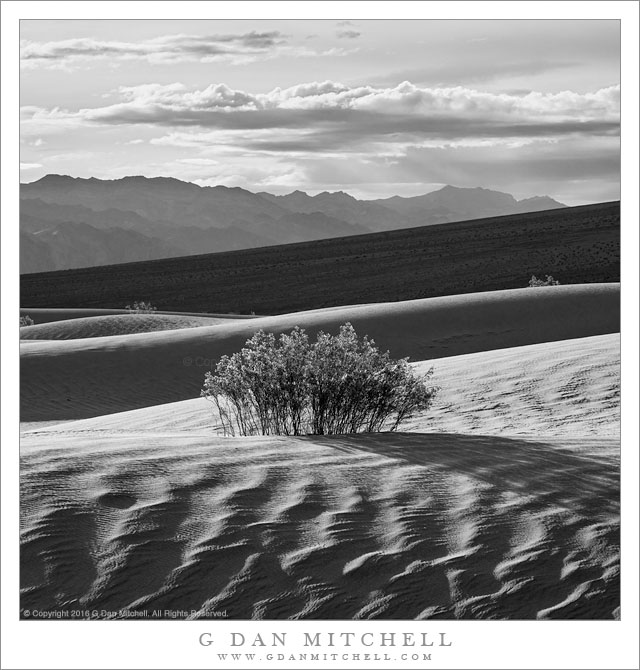
An imaginary landscape derived from subjects photographed in Death Valley National Park.
All photographs lie. But all photographs carry a burden of reality.
Except for photographers who overtly and obviously manipulate reality in major ways as a central concept of their work — see Jerry Uelsmann, for example, or some work by John Paul Caponigro, among others — viewers come to photographs believing that the images had their genesis in the real. Photographers can respond to this basic presumption in photography in a number of ways, and perhaps in landscape photography the response has even more implications.
Let’s say you are Caponigro or Uelsmann and a major point of your photography is to produce visual art that derives from and references the landscape but then combines it with non-landscape elements or takes those elements and fundamentally rearranges them so that they intentionally no longer can be taken to represent the real landscape. These photographers openly embrace and build their work on creating imaginary fantastical worlds out of materials derived from the real landscape, creating what I refer to as “imaginary landscapes.” The photographer and the viewer are on exactly the same page here – both accept and embrace the fantasy and the sometimes more ambiguous line between the real and the imagined. This work seems completely honest and genuine.
On the other hand, let’s say you are a photographer who builds and bases a reputationnot on the creation of visual fantasies — things we all know are not and cannot be real — but instead on going to great lengths to travel to “special places,” often telling stories of finding special places and special conditions that less focused and dedicated photographers do not find. Continue reading Gray Areas→
Photographer and visual opportunist. Daily photos since 2005, plus articles, reviews, news, and ideas.
Manage Consent
To provide the best experiences, we use technologies like cookies to store and/or access device information. Consenting to these technologies will allow us to process data such as browsing behavior or unique IDs on this site. Not consenting or withdrawing consent, may adversely affect certain features and functions.
Functional
Always active
The technical storage or access is strictly necessary for the legitimate purpose of enabling the use of a specific service explicitly requested by the subscriber or user, or for the sole purpose of carrying out the transmission of a communication over an electronic communications network.
Preferences
The technical storage or access is necessary for the legitimate purpose of storing preferences that are not requested by the subscriber or user.
Statistics
The technical storage or access that is used exclusively for statistical purposes.The technical storage or access that is used exclusively for anonymous statistical purposes. Without a subpoena, voluntary compliance on the part of your Internet Service Provider, or additional records from a third party, information stored or retrieved for this purpose alone cannot usually be used to identify you.
Marketing
The technical storage or access is required to create user profiles to send advertising, or to track the user on a website or across several websites for similar marketing purposes.