The 31st annual Yosemite Renaissance Exhibit opens this weekend in Yosemite Valley. Come on by if you are in the park! The free opening Artists Reception is on Friday, February 26 at 5:30-7:30pm in the Visitor Center Gallery. The show then runs from Saturday, February 27 though May 1.
Yosemite Renaissance features artists who work in and around Yosemite and the Sierra. It includes a range of media — photographs, painting, ceramics, sculpture, and more.
I’m honored that one of my photographs was again included in the exhibit — for the fourth year in a row. This time it is a photograph I made at Devil’s Postpile National Monument last year: “Basalt Columns, Lichen, Autumn Plants”
This post derives from something I wrote elsewhere in a discussion about a photograph that included something that wasn’t originally in the scene, a discussion that became rather polarized.
“Not everybody trusts paintings but people believe photographs.”
― Ansel Adams
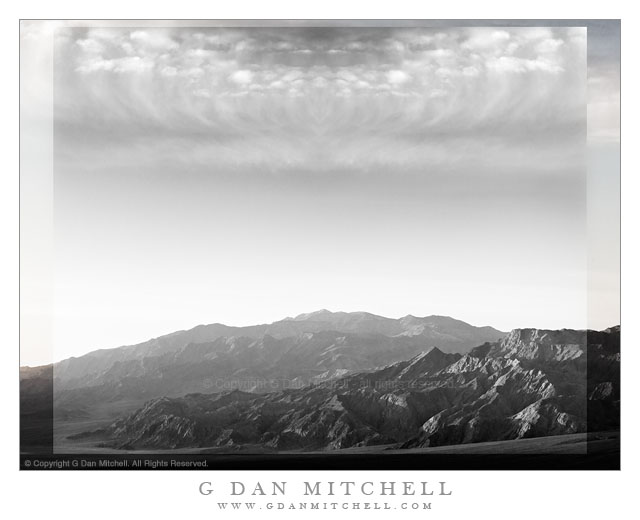
An imaginary landscape derived from subjects photographed in Death Valley National Park.
All photographs lie. But all photographs carry a burden of reality.
Except for photographers who overtly and obviously manipulate reality in major ways as a central concept of their work — see Jerry Uelsmann, for example, or some work by John Paul Caponigro, among others — viewers come to photographs believing that the images had their genesis in the real. Photographers can respond to this basic presumption in photography in a number of ways, and perhaps in landscape photography the response has even more implications.
Let’s say you are Caponigro or Uelsmann and a major point of your photography is to produce visual art that derives from and references the landscape but then combines it with non-landscape elements or takes those elements and fundamentally rearranges them so that they intentionally no longer can be taken to represent the real landscape. These photographers openly embrace and build their work on creating imaginary fantastical worlds out of materials derived from the real landscape, creating what I refer to as “imaginary landscapes.” The photographer and the viewer are on exactly the same page here – both accept and embrace the fantasy and the sometimes more ambiguous line between the real and the imagined. This work seems completely honest and genuine.
On the other hand, let’s say you are a photographer who builds and bases a reputationnot on the creation of visual fantasies — things we all know are not and cannot be real — but instead on going to great lengths to travel to “special places,” often telling stories of finding special places and special conditions that less focused and dedicated photographers do not find. Continue reading Gray Areas→
Three manufacturers companies now produce widely available full-frame digital cameras with features that are attractive to folks who photograph landscape subjects, among other things. Two of them recently released new models that are getting a lot of attention, and plenty of photographers are interested in their relative merits and perhaps in choosing among them.
Here is a statement that a thoughtful, experienced, knowledgable photographer who has looked at the options carefully and selected one of them might make:
I chose this camera because it exemplifies the continuing evolution and improvement of digital cameras. It introduces useful and powerful improvements that offer the potential of a range of image quality improvements. The camera has the ability to produce photographs with outstanding image quality in a wide range of conditions and circumstances, and photographers who use it are going to be very pleased with what it can do. It has its pluses and minuses, and other cameras may be a bit stronger or weaker in various areas, but on balance it is a first-class and powerful tool that works extremely well for the most demanding photographers. I recommend that other photographers take a look at it!
The question: To which of the three (and a half?) above-listed cameras does this statement apply?
If you have paid a lot of attention to the passionate and hyperbole-filled discussions and “tests” that inevitably accompany the release of new cameras, you have read proclamations that any one of those is “the best” or even that it will transform your photography. And it is possible that “the answer” is already obvious to you, and you are certain that one surpasses the others in obvious ways. You might even have come to the conclusion that a photographer choosing one of the other options is making a mistake, is probably unaware of the significance of the error, and that his/her photographs are likely to suffer as a consequence of this flawed decision.
Let’s say you are looking for a new camera. You want to make a smart decision, especially since you are sinking your hard-earned money into the purchase. You sure don’t want to make a mistake and end up with deficient gear. So you do the smart thing — you do some research. You look around on the web, find some articles, and you discover that there is a lot of contradictory information. Some tell you that Product X is wonderful, while others are adamant that Product X is pathetic and that Product Y is far superior. The Product X fans point out that Product Y is deficient in other critical ways by comparison to Product X.
You have some unanswered questions.
I keep hearing that Camera X has terrible noise compared to Camera Y. In fact, I found some photographs that demonstrate how bad this noise is. Why in the world would anyone get Camera X?!
Both sides provide “evidence.” Photographers love evidence, especially evidence of a failure to achieve divine technological perfection, and double-especially when the failure is demonstrated in a brand they don’t own. They get a little testy though, when the “evidence” makes their product look weak! (For a fun detour, look up the term confirmation bias on the web. Also, this is an important time for a reminder that photography is about photographs, not about cameras.)
I want to construct a little story for you based on “evidence.” We’ll start with evidence that makes a particular product (one that I rely on) look particularly bad. But before we start, you need to promise to read the whole thing. I’ll try to make it worthwhile.
OK, I promise to read it all, and with an open mind.
Good. Here we go.
Lots of people are concerned with the related issues of dynamic range (the camera’s ability to record image data from both light and dark sources in a single photograph) and noise (non-image artifacts that are, in a rough sense, sort of like “grain” on film).
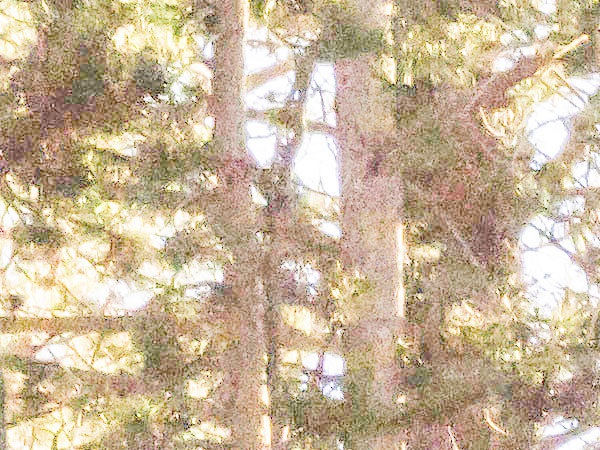
I’ll begin with an example of noise in a photograph I made using the the new and very expensive Canon EOS 5Ds R, a 50.6MP full frame DSLR that Canon released recently.
Example #1
Man, that is awful! That 5Ds R obviously produces terrible noise. It is so bad that the photograph is unusable, at least for anything other than an article demonstrating how bad it is! And the color is pathetically bad, too!
Photographer and visual opportunist. Daily photos since 2005, plus articles, reviews, news, and ideas.
Manage Consent
To provide the best experiences, we use technologies like cookies to store and/or access device information. Consenting to these technologies will allow us to process data such as browsing behavior or unique IDs on this site. Not consenting or withdrawing consent, may adversely affect certain features and functions.
Functional
Always active
The technical storage or access is strictly necessary for the legitimate purpose of enabling the use of a specific service explicitly requested by the subscriber or user, or for the sole purpose of carrying out the transmission of a communication over an electronic communications network.
Preferences
The technical storage or access is necessary for the legitimate purpose of storing preferences that are not requested by the subscriber or user.
Statistics
The technical storage or access that is used exclusively for statistical purposes.The technical storage or access that is used exclusively for anonymous statistical purposes. Without a subpoena, voluntary compliance on the part of your Internet Service Provider, or additional records from a third party, information stored or retrieved for this purpose alone cannot usually be used to identify you.
Marketing
The technical storage or access is required to create user profiles to send advertising, or to track the user on a website or across several websites for similar marketing purposes.