It is no secret that I’m pretty serious about my landscape photography. I spend a lot of time going to interesting places, searching out subjects, and making photographs. In fact, this activity is undoubtedly the single biggest influence on the nature of my outdoor experiences.
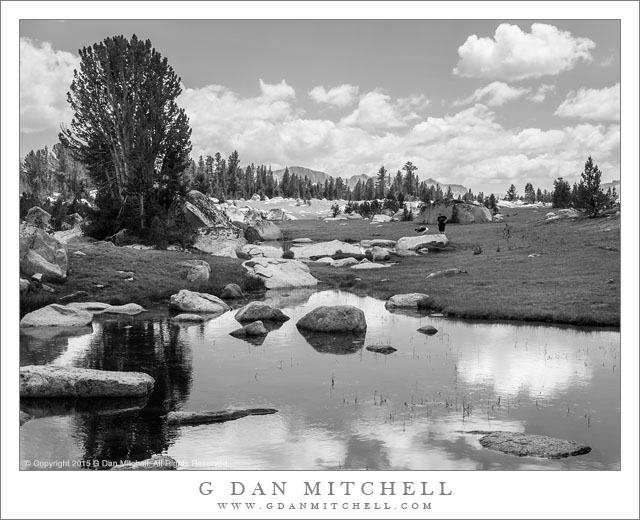
Midday summer sky reflected in a subalpine tarn, Yosemite National Park
I embrace this effect and regard it as highly positive. I’m convinced that photography deepens my appreciation and understanding of these places and subjects. Like every photographer I know who shares my passion for these subjects, entering the natural world to make photographs focuses my perceptions in powerful ways. I slow down. I stop. I look. I ponder. I wonder. I indulge my curiosity and I see things that I would otherwise miss. I’m intensely aware of light, color, atmosphere, form, and subject.
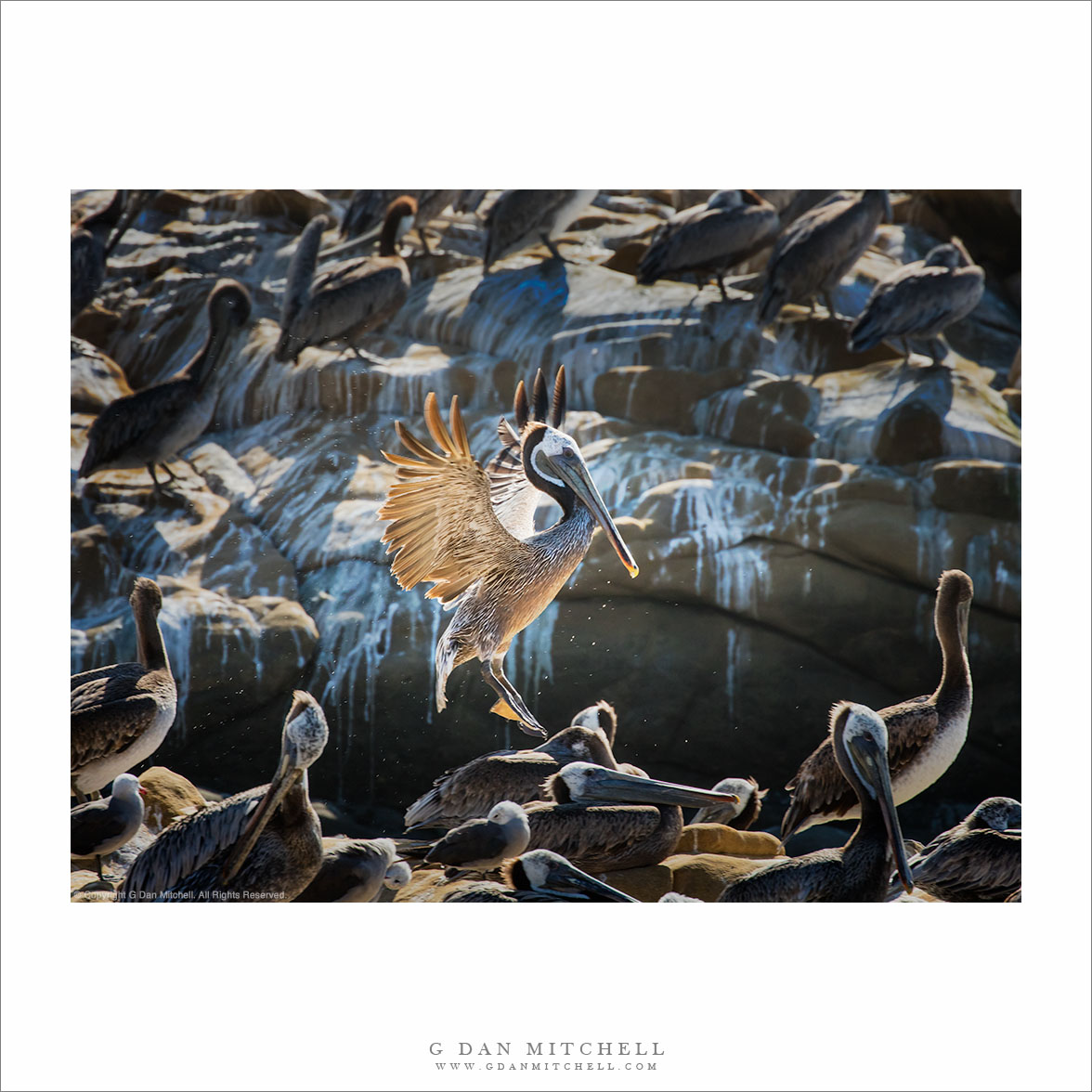
Brown pelican flight above the shoreline of Monterey Bay, Moss Landing, California
Rediscovering this photograph and a few of its buddies makes for a bit of an odd story. Earlier today I got a message telling me that one of the drives attached to my computer was nearly full. That seemed a bit surprising, but it also was clearly an issue I had to address, so I set about looking for unnecessary files on that volume. In doing so I “discovered” a folder full of raw files and a few Photoshop files that I had apparently transferred to the computer last year… and then forgot. Most of the files there turned out to be unneeded, and I reclaimed 5GB of disk space by deleting them. But among there were s small number of shorebird photographs that I had forgotten.
The photographs came from an amazing and surprising spur-of-the-moment visit to Monterey Bay last June. For weeks I had been hearing stories of whales coming very close to the shoreline, and I had even observed a few from the cliffs in the Big Sur area. A news story claimed that they were now inside Monterey Bay and even coming very close to the beaches an Moss Landing — and friends had photographs to prove it. So over the hill we went to go there ourselves. When we arrived we were, indeed, impressed by how close the whales came to the beach — I had no idea they did that. But as impressive was the huge collection of birds that was perhaps attracted to the same food sources that drew the whales. I had never seen such numbers of these birds along the coast. Among them were a large number of brown pelicans, so many that photographing them was almost too easy.
(“A Photograph Exposed” is a series exploring some of my photographs in greater detail.)
Black and white photograph of two “moving rocks” on the Racetrack Playa at Death Valley National Park. Morning light with unusual clouds, and the Grandstand in the distance.
Moving rocks, lenticular clouds — morning on the Racetrack Playa.
This photograph from Death Valley’s Racetrack Playa is one of the first I made when I began photographing this landscape seriously, and it remains one of my favorites from the park — yet it also carries a flaw that I’ll describe below.
My first visit to Death Valley National Park had been about seven years earlier at the very end of the previous millennium, when I was one of several adults accompanying a group of middle school and high school students on a visit that was to include a short backpack trip in the Cottonwood Canyon area. The story of that trip deserves its own article, one that would include snow, near-hypothermia, winds that blew down tents, a retreat from the pack trip, an attempt to hike down the upper portion of Death Valley, water shortages, a dust storm, a dangerous situation with a bus, and more.
I’ll never forget my first view of Death Valley on that first visit. We arrived in the park after dark, stopping between Towne Pass and Stovepipe Wells at a small campground a few thousand feet above the valley floor, where we set up in the darkness and went to sleep. Having never seen the Valley before, the next morning I unzipped my tent and stepped outside to see the stupendous “oh wow!” landscape of Death Valley and the mountains on the far side in the beautiful morning light. I was hooked, and I’ve been going back annually since then. Continue reading A Photograph Exposed: “Two Rocks, Morning, Racetrack Playa”→
Canon recently released the successor to their venerable 100-400mm telephoto zoom lens, the new EF 100-400mm f/4.5-5.6L IS II lens. I have relied on the older model for some time now… but my copy of the new lens arrived a few days ago. Now that I have used it for a day of wildlife and landscape photography I would like to share some first impressions
First, a few technical details. The new lens covers essentially the same range as the older model — a focal length range of 100mm to 400mm and a variable aperture range of f/4.5 (at 100mm) to f/5.6 (at 400mm). Both lenses use a zoom mechanism that extends at longer focal lengths. However, there are some technical differences:
Photographer and visual opportunist. Daily photos since 2005, plus articles, reviews, news, and ideas.
Manage Consent
To provide the best experiences, we use technologies like cookies to store and/or access device information. Consenting to these technologies will allow us to process data such as browsing behavior or unique IDs on this site. Not consenting or withdrawing consent, may adversely affect certain features and functions.
Functional
Always active
The technical storage or access is strictly necessary for the legitimate purpose of enabling the use of a specific service explicitly requested by the subscriber or user, or for the sole purpose of carrying out the transmission of a communication over an electronic communications network.
Preferences
The technical storage or access is necessary for the legitimate purpose of storing preferences that are not requested by the subscriber or user.
Statistics
The technical storage or access that is used exclusively for statistical purposes.The technical storage or access that is used exclusively for anonymous statistical purposes. Without a subpoena, voluntary compliance on the part of your Internet Service Provider, or additional records from a third party, information stored or retrieved for this purpose alone cannot usually be used to identify you.
Marketing
The technical storage or access is required to create user profiles to send advertising, or to track the user on a website or across several websites for similar marketing purposes.