(I haven’t shared a Morning Musings post in months, so it seems like this one is overdue!)
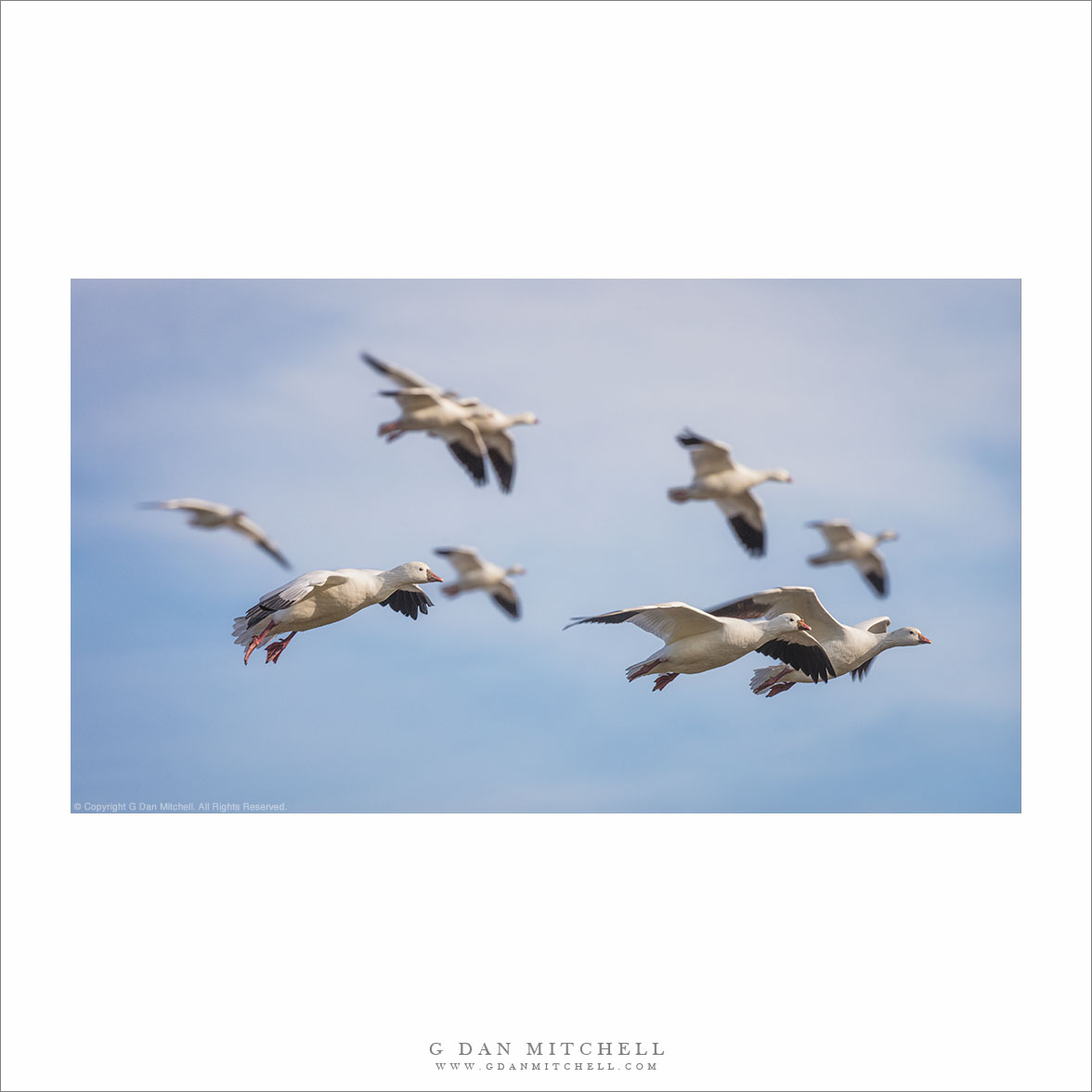
Sharing this photograph got me thinking again about how many aspects of photography are usually beyond our control. Consider all of the things that come together in this photograph:
- I was at a location with an area of perhaps 4 or 5 square miles, and at this place there are many locations from which I could photograph. It just so happened that I was at the right spot when a flock of geese lifted off and then returned.
- The light filled shadows and didn’t overpower white highlights because there was a bit of thin overcast.
- I was upwind of the birds so their landing pattern brought them down facing my direction.
- The three sharply focused foreground birds aligned with a group of six birds a bit farther away and beyond the plane of focus.
- Each bird’s head is visible, with none blocked by other birds.
- A lighter area of sky is centered beyond the birds, making them a bit more distinct, and this is roughly encircled by darker sky, focusing attention on the birds.
- Looking more closely at the position of the birds, there is a mirrored pair at upper left. Two distant birds perfectly frame the single bird at lower eft. A pair of in-focus birds leads the group toward the lower ridge edge of the frame… with a pair of more distant birds right above them.
I could keep going, but you get the point.
In almost all photographs (aside from some fully constructed images perhaps) there are elements and conditions that are not under the direct control of the photographer: the weather, who walks by on a city street, wind, the time of day we when we show up, the mood of our subject, which way we happened to look, the season, whether something else we saw delayed our arrival, something we read or an idea mentioned by a friend, how he subject may or may not remind us of something we’ve seen before, how patient or impatient we feel, whether or not we notice something that was not what we came for. Sometimes an error produces a new idea that we had not thought of.
Again, I could keep going.
None of this is to say that we have no control over the nature of our photographs. Among many possible subjects, we pick some and ignore others. Given time we put more or less thought into elements of composition. We try to choose the times and places we think are most conducive to success. We bring equipment suitable to the opportunities and/or we adapt when the gear isn’t quite ideal. We bring our past experience with light and color and texture and composition… and with the subjects themselves.
Indeed, this list isn’t complete either.
Somewhere I recall reading that one difference (though not the only one) between painting and photographing is that, generally, every mark on the canvas was put there intentionally by the painter. In a sense, the parinter “knows” every detail. Photographers often discover things in their images that they had not even fully noticed, if at all, when they made the exposure.
There’s an old saying that we don’t take photographs, but rather we make photographs. This acknowledges the intentional choices and decisions that the photographer makes between the moment of seeing and ultimate act of printing. But if we are honest, unlike painters, we don’t literally make everything in a photograph. In fact we do take as a starting point what we are given, to a greater or lesser extent.
That taking is generally not random, and I don’t mean to minimize the role of intent in photography. If it were purely about taking, then all photographs and all photographers would be equal, and that is clearly not the case. Each photographer puts his or her own stamp on their taking. It is partly a matter of what we notice, but also of how we see. Two photographers who set up next to one another rarely produce the same photograph because each sees something different in what is in front of them, each is attentive to different details in the subject, one might be drawn to texture and another to color or form, each imagines a different final image.
It is important to know how to control and shape as many aspects of photograph-making as possible. Preparation and practice and experience are obviously important. But in the end, to a greater or lesser extent, as photographers we always work with what we are given or what we find, and it is largely about what we do with those things that we can’t control.
Leave a comment or question using the form. (Click the title to see the full article and to comment if you are viewing it on the home page.)
G Dan Mitchell is a California photographer and visual opportunist. His book, “California’s Fall Color: A Photographer’s Guide to Autumn in the Sierra” (Heyday Books) is available directly from him. Blog | Bluesky | Mastodon | Substack Notes | Flickr | Email
All media © Copyright G Dan Mitchell and others.