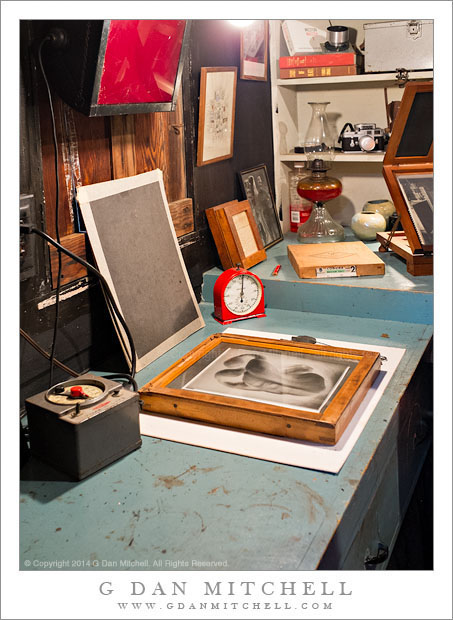
In late September I had the opportunity to join a group of photographers visiting the Wildcat Hill Weston home in the Carmel Highlands area of the California Coast. The Weston family, members of which still live and work here, trace their family history at this place back to the great photographer, Edward Weston. The main house is maintained in much the state it would have been in quite a while ago, and there are wonderful archival objects — photographs, art, objects, this darkroom, etc — everywhere. This small darkroom, designed for contact printing, is a small space off the main room of the building. Not only does it have fascinating historical interest for photographers, but it is also remarkable to see the modest and personal space in which so much Weston photography was realized.
G Dan Mitchell is a California photographer and visual opportunist whose subjects include the Pacific coast, redwood forests, central California oak/grasslands, the Sierra Nevada, California deserts, urban landscapes, night photography, and more. Blog | About | Flickr | Twitter | Facebook | Google+ | 500px.com | LinkedIn | Email
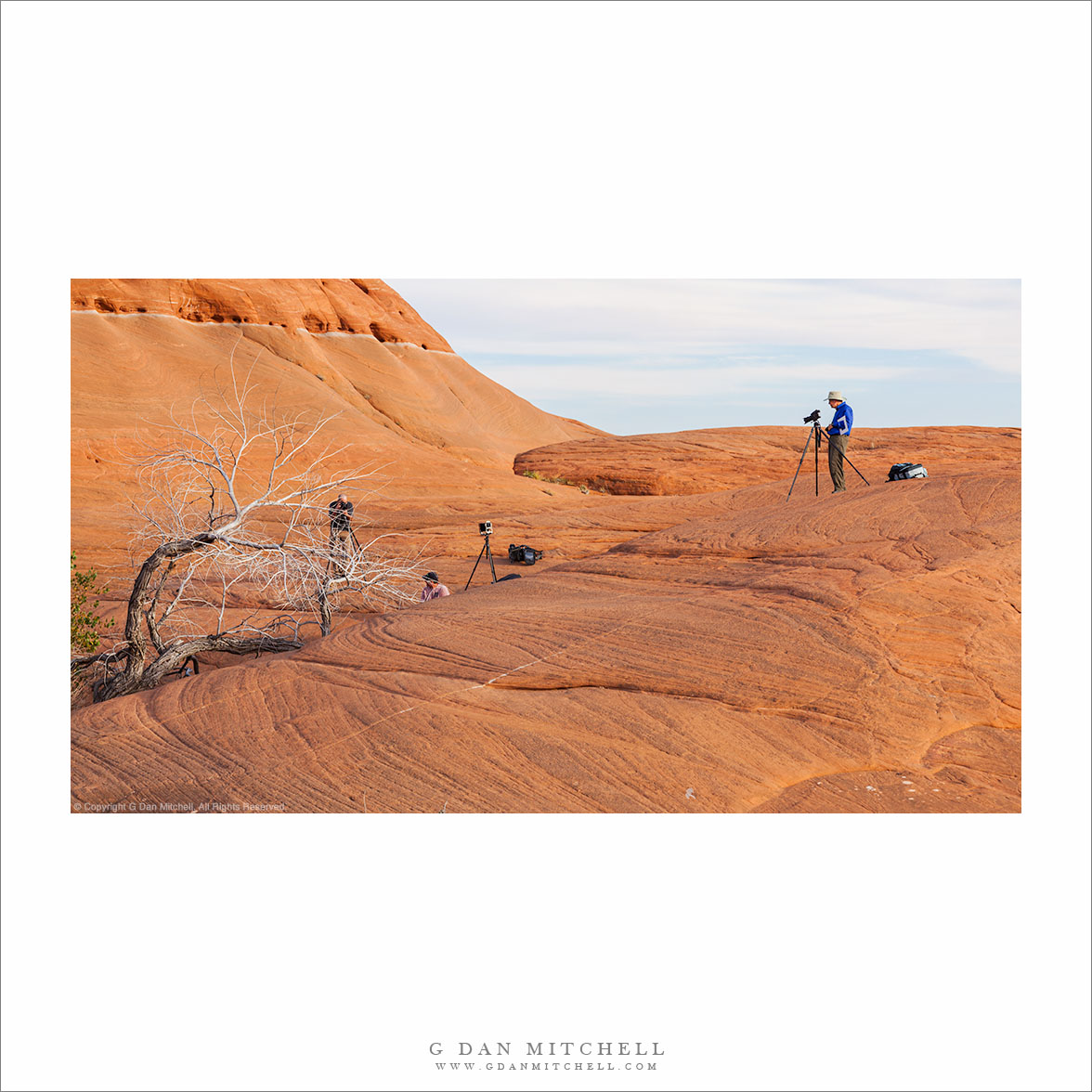
“Working the Red Rock Landscape” — Photographers at work in Utah’s red rock country
Morning Musings are back! Today I have a few general thoughts about tripods — not aimed at those who are already confirmed tripod users, but rather at those who find it hard to bother using them.
To start, let’s admit that one does not always need a tripod. For certain types of photography in which quick response is required and being too obviously a photographer can interfere with photographs, it is usually better to not use one. There are exceptions to every rule, but you are unlikely to use a tripod for most street photography, for personal and family photography at home and on vacations, for certain kinds of portrait work, casual travel photography, and so on.
Let’s also agree that using a tripod is a burden, especially at first when you haven’t accepted the extra trouble and when you haven’t developed instincts that make tripod use a lot more automatic. I’ll readily admit to being less than thrilled on about the 50th time that I must remove my tripod from the car or pack, extend and lock the legs, level the thing, attach the camera, and only then make a photograph… after which I have to reverse the process: remove the camera, collapse the tripod legs, stow the thing once again. The slightly put-upon feeling diminishes as you get used to it, but it never goes away entirely. (The good news here is that the process of setting up and using the tripod does eventually become much quicker and much more automatic.)
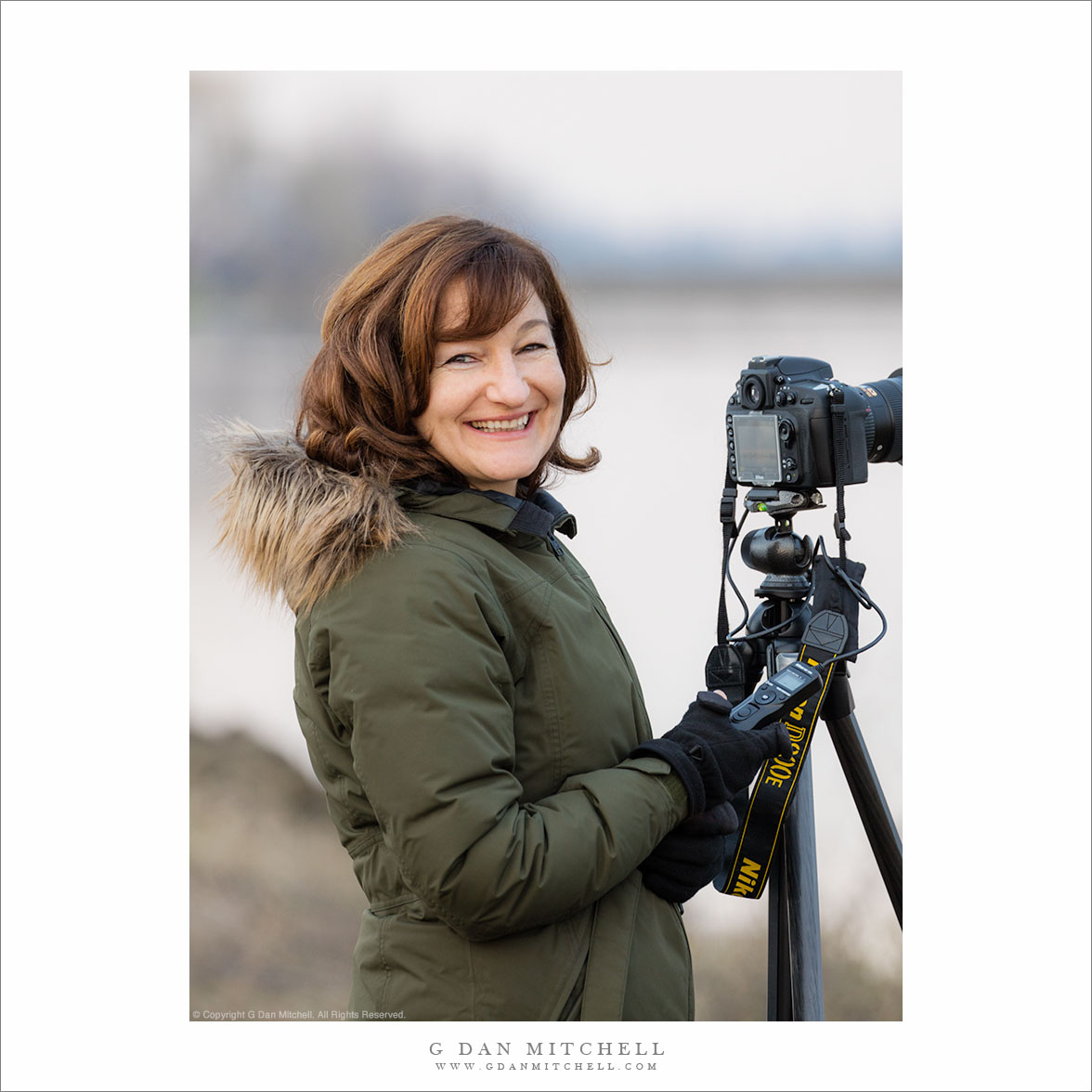
“Photographer Franka M. Gabler” — Franka M. Gabler in the field photographing in the San Joaquin Valley
So, why use it then? There are more reasons than you might imagine.
Stability is an obvious advantage of the tripod. While you can, with care and practice, often hold a camera quite steadily and produce very sharp images when shooting handheld, you simply cannot eliminate all of the blur that comes when you hold the camera in your hands. And if you do happen to have very steady hands, you still will make mistakes that produce blur — working a bit too fast you may introduce a bit of camera vibration in some shots and you will reduce the number of successful results. A good tripod used correctly can virtually eliminate camera motion and vibration. This is especially important when doing types of photography that intrinsically require longer shutter speeds. This obviously includes night photography. Low light, low ISO, long lenses, and small apertures often require landscape photographers to use rather long shutter speeds.
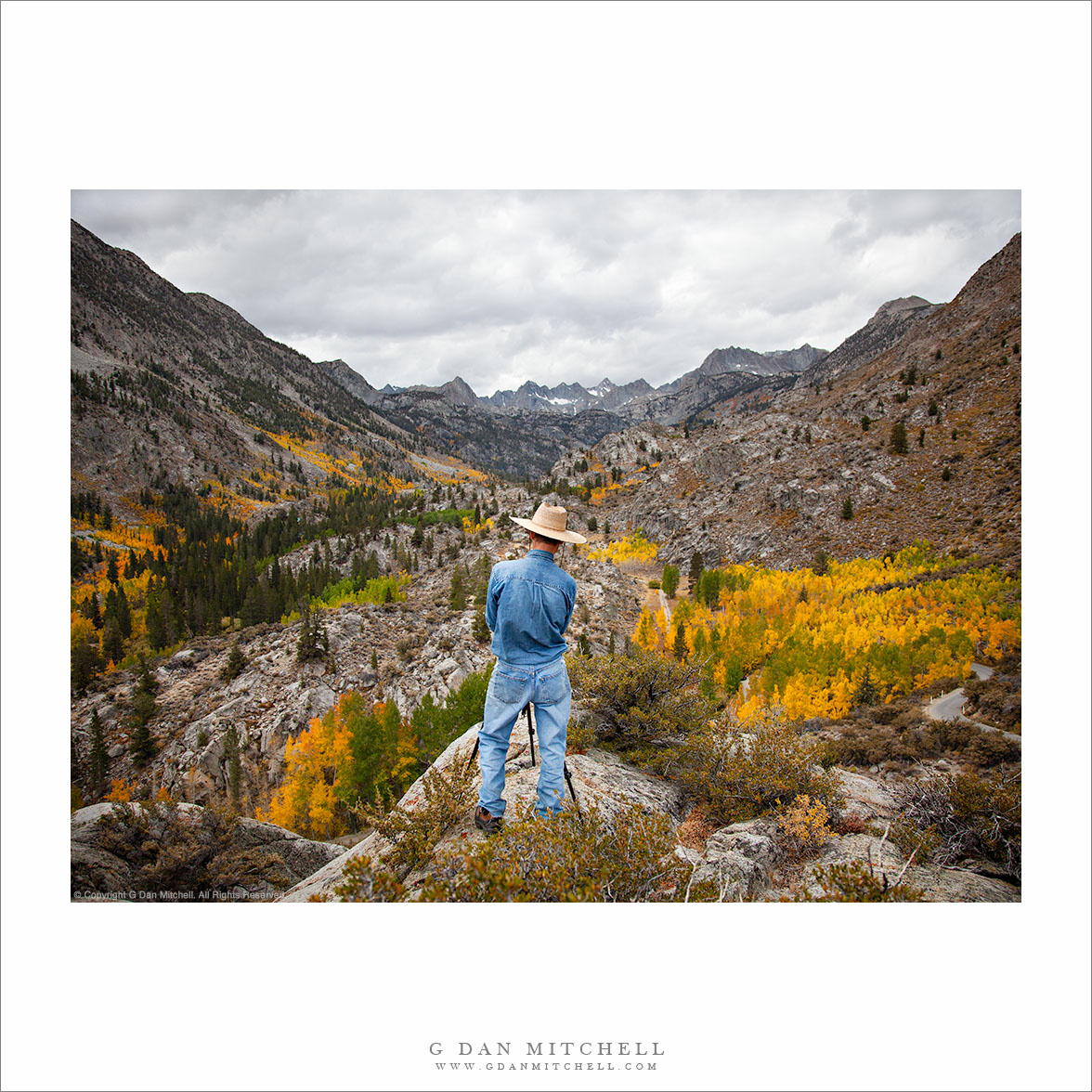
“Photographer, Sabrina Basin” — A photographer working the autumn colors from a ridgetop in Sabrina Basin, Sierra Nevada, as an early fall storm comes in.
High resolution cameras can capture images that may be reproduced at much larger sizes, and at those sizes the effects of minor camera stability issues become more visible. If you want to take advantage of such cameras’ potential for higher image resolution, the stability that comes with tripod use can be critical.
My web presence has long included this blog and a separate online gallery housing a large archive of photographs — perhaps about 3000 of them at last count. Earlier this week the gallery had a technical issue that snowballed and eventually took that gallery completely offline.
During the past few days I have spent way to many hours trying to get the gallery working again, and I have (mostly) succeeded at this point. A new version of the gallery now holds essentially all of the photographs that were at the old gallery. The format is a bit different, though the underlying organization of the images is similar. At this point, the titles ofphotographs do not display correctly, and you’ll see file names where there used to be titles. This is fixable, but not right away.
If you tried to find the old gallery and couldn’t, thanks for your patience. If you haven’t seen the gallery, feel free to wander over there and take look!
G Dan Mitchell is a California photographer and visual opportunist whose subjects include the Pacific coast, redwood forests, central California oak/grasslands, the Sierra Nevada, California deserts, urban landscapes, night photography, and more. Blog | About | Flickr | Twitter | Facebook | Google+ | 500px.com | LinkedIn | Email
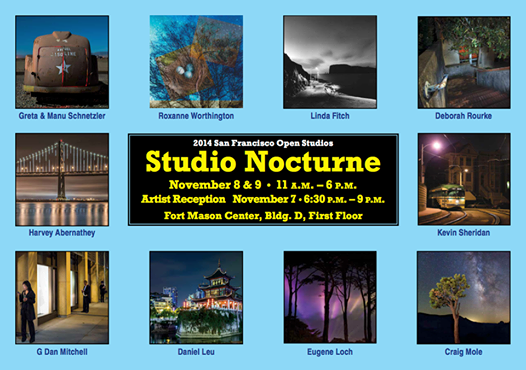
Studio Nocturnes 2014 — Exhibiting at San Francisco Artspan 2014
Once again this year I will exhibit along with my fellow Studio Nocturne photographers at the 2014 Artspan San Francisco Open Studios.
The photographers ofStudio Nocturne specialize in night photography… and a few other subjects. Studio Nocturne is exhibiting at the 2014 ArtSpan San Francisco Open Studios this fall — we’ll be at the historic Fort Mason once again this year, our twelfth year exhibiting at this annual San Francisco event. We look forward to seeing you there! Join us at the Friday November 7 evening reception and/or during our Saturday November 8 or Sunday November 9 hours.
Studio Nocturne Exhibit and Sale Saturday, November 8 & Sunday, November 9
11:00 AM – 6:00 PM
Preview and Artist Reception
Friday, November 7
6:30 PM – 9:00 PM
(Reception and Preview information subject to change)
2014 San Francisco Open Studios Fort Mason Center
Building D, Ground Floor
G Dan Mitchell is a California photographer and visual opportunist whose subjects include the Pacific coast, redwood forests, central California oak/grasslands, the Sierra Nevada, California deserts, urban landscapes, night photography, and more. Blog | About | Flickr | Twitter | Facebook | Google+ | 500px.com | LinkedIn | Email
Photographer and visual opportunist. Daily photos since 2005, plus articles, reviews, news, and ideas.
Manage Consent
To provide the best experiences, we use technologies like cookies to store and/or access device information. Consenting to these technologies will allow us to process data such as browsing behavior or unique IDs on this site. Not consenting or withdrawing consent, may adversely affect certain features and functions.
Functional
Always active
The technical storage or access is strictly necessary for the legitimate purpose of enabling the use of a specific service explicitly requested by the subscriber or user, or for the sole purpose of carrying out the transmission of a communication over an electronic communications network.
Preferences
The technical storage or access is necessary for the legitimate purpose of storing preferences that are not requested by the subscriber or user.
Statistics
The technical storage or access that is used exclusively for statistical purposes.The technical storage or access that is used exclusively for anonymous statistical purposes. Without a subpoena, voluntary compliance on the part of your Internet Service Provider, or additional records from a third party, information stored or retrieved for this purpose alone cannot usually be used to identify you.
Marketing
The technical storage or access is required to create user profiles to send advertising, or to track the user on a website or across several websites for similar marketing purposes.

 G Dan Mitchell is a California photographer and visual opportunist whose subjects include the Pacific coast, redwood forests, central California oak/grasslands, the Sierra Nevada, California deserts, urban landscapes, night photography, and more.