“Photographer, Canyon Country” — Photographer at work deep in a Southwest Utah canyon.
Deserts offer few clues about the scale of the landscape. Unlike forest scenes, where trees often provide a frame of reference, plants play a lesser role. Even when there are plants it can be unclear from a distance whether they are large trees or small shrubs. Here the inclusion of the human figure clarifies the scale of the grand Utah red rock landscape.
Recently I have heard some photographers suggest that IBIS-equipped cameras have made tripods obsolete. IBIS is a fine thing, but that overstates the case.
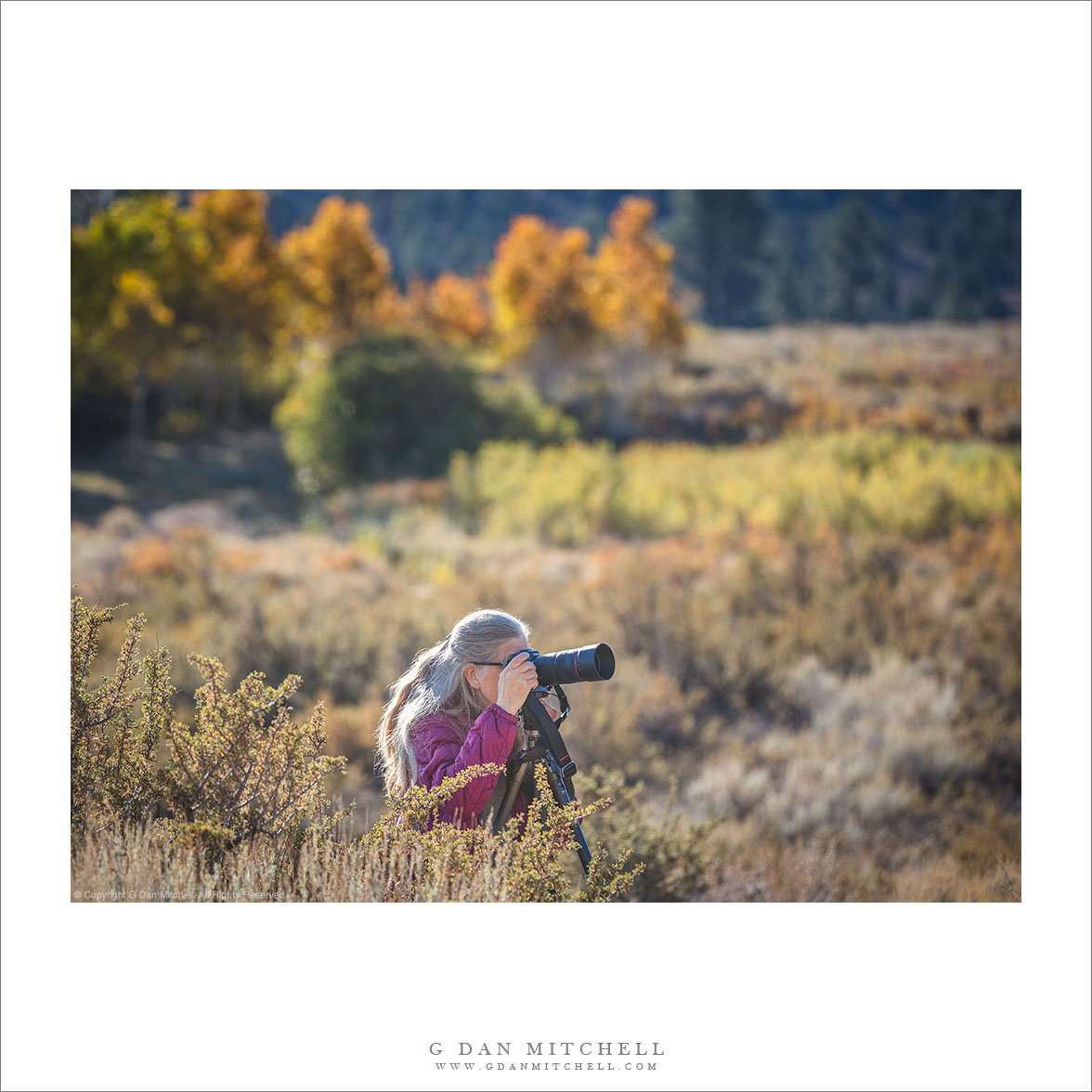
“Photographer Patricia Mitchell” — Photographer Patricia Mitchell at work in early morning autumn light in the Eastern Sierra Nevada.
Contemporary cameras incorporate remarkable advances in camera and lens image stabilization. Some newer cameras with IBIS (In-camera Image stabilization) claim to extend the useful range of shutter speeds for handheld photography by as much as seven stops.
IBIS can be very useful for photographers who shoot handheld. I do urban night street photography using a handheld, IBIS-equipped camera that supports high ISOs — and I can capture subjects that would have been just about impossible to photograph a few decades ago.
“Photographer Patricia Mitchell” — Photographer Patricia Mitchell at work in early morning autumn light in the Eastern Sierra Nevada.
Someone has a birthday this week, so it seems appropriate to feature a photograph of, um, someone here. Photography is often a solitary activity — one person, a subject, a camera, how to see — and most of the time the two of us photograph alone. But every so often we get a chance to head out together on a trip that involves photography. We had such an occasion earlier this fall — and it has been too long! — when we did a weeklong trip that took us to the Eastern Sierra Nevada and then to Utah and a few nearby locations.
We started in the Sierra, where we headed into the eastern part of the range in search of fall color. Perhaps “search” is the wrong word here, as it is easy to locate! Instead of going to the “usual places” we wandered up some less-travelled roads, including the one that took us to this spot right beneath the eastern escarpment, a place with very few other people where the high desert and the beginnings of true mountain terrain intersect. We arrived on a brilliantly lit morning, with fall color everywhere, and a bit of early snow still on the peaks.
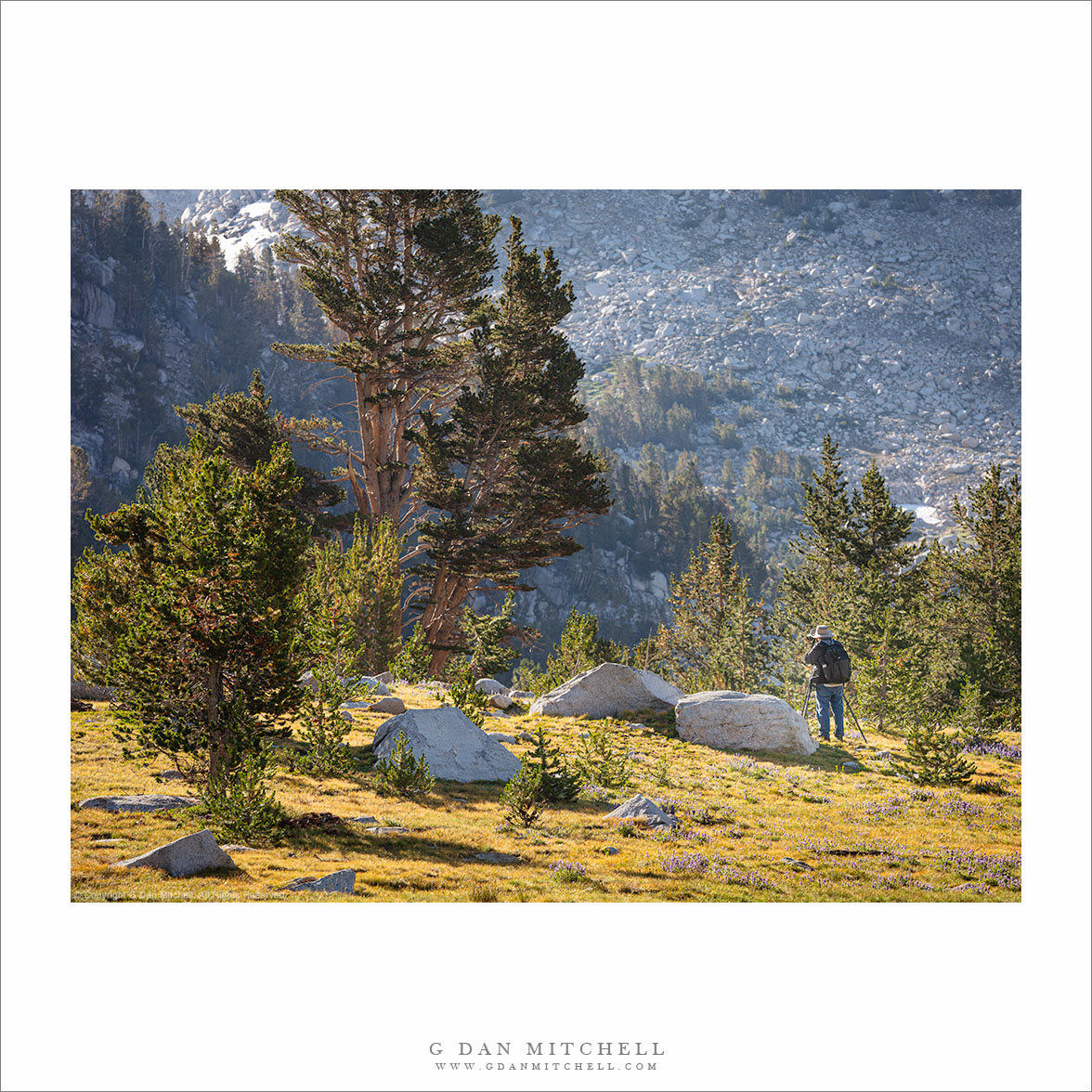
“Photographer Charles Cramer” — Photographer Charles Cramer at work in the John Muir Wilderness.
Photographer Charles (“Charlie”) Cramer at work in the High Sierra of the John Muir Wilderness Area. A group of us spent a week base-camped in a particularly scenic portion of this wilderness area, heading out each day to find and photograph the abundant and beautiful subjects present here – ranging from the intimate (wlldflowers) to the monumental (the peaks of the Sierra crest).
The pace and nature of the work in a place like this might surprise those who haven’t experienced it. Many years ago, when my orientation to the backcountry was via long pack trips on which I moved every day, I worried that I would become bored if I stayed in the same place for more than a night. After years of doing just that, I realize how completely wrong I was. We can easily find a week’s worth of things to investigate and photograph in such places, and at the end of each trip I invariably end up wishing I could stay longer!
COMMENT OR QUESTION? Scroll down to the comment form.
Photographer and visual opportunist. Daily photos since 2005, plus articles, reviews, news, and ideas.
Manage Consent
To provide the best experiences, we use technologies like cookies to store and/or access device information. Consenting to these technologies will allow us to process data such as browsing behavior or unique IDs on this site. Not consenting or withdrawing consent, may adversely affect certain features and functions.
Functional
Always active
The technical storage or access is strictly necessary for the legitimate purpose of enabling the use of a specific service explicitly requested by the subscriber or user, or for the sole purpose of carrying out the transmission of a communication over an electronic communications network.
Preferences
The technical storage or access is necessary for the legitimate purpose of storing preferences that are not requested by the subscriber or user.
Statistics
The technical storage or access that is used exclusively for statistical purposes.The technical storage or access that is used exclusively for anonymous statistical purposes. Without a subpoena, voluntary compliance on the part of your Internet Service Provider, or additional records from a third party, information stored or retrieved for this purpose alone cannot usually be used to identify you.
Marketing
The technical storage or access is required to create user profiles to send advertising, or to track the user on a website or across several websites for similar marketing purposes.