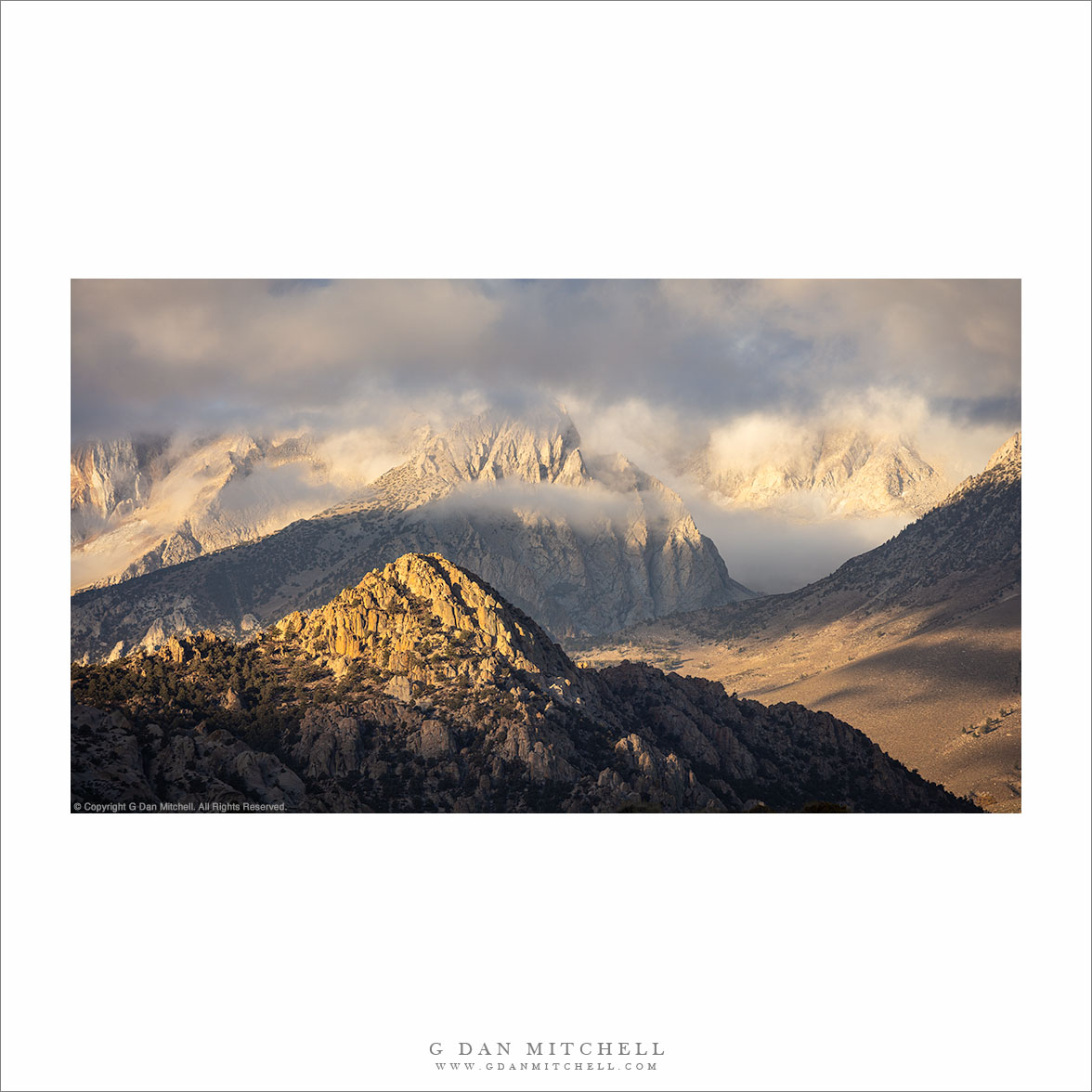
“Sierra Crest Clouds” — Morning clouds and fog drift among Sierra Nevada crest peaks.
We’re back from the Sierra Nevada, and I have some new photographs to share. I was actually on the east side of the range twice over the past couple of weeks, mostly chasing autumn aspen color but also photographing other seasonal subjects. October is probably my favorite time in the range, and there was a lot to see, including this impressive sunrise cloud show along the crest near Bishop.
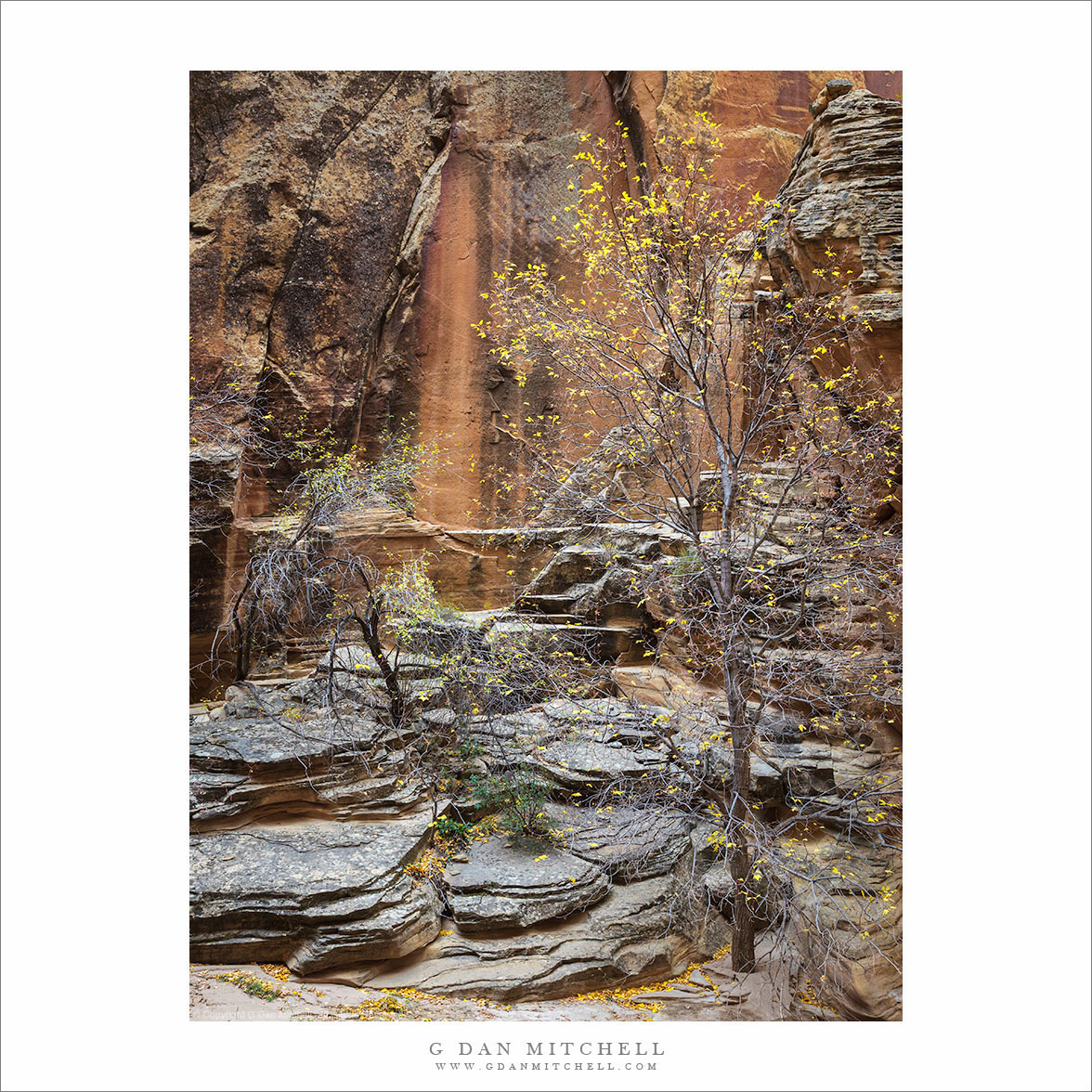
“Canyon Trees, Layered Rocks, Autumn” — Layered rocks and small trees with the last leaves of autumn, Utah.
This was a magical spot at a deeply-shadowed bend in the canyon of an Utah River. A small group of us had spent the morning working our way slowly through a section of red rock canyon, alternating between sun in the straight sections and shade where the river inevitably made the next bend. At every bend we would peek around the corner, see something interesting, and say, “Just to the next bend.” Finally, we ran out of time at this point, photographed here, then turned around and started back.
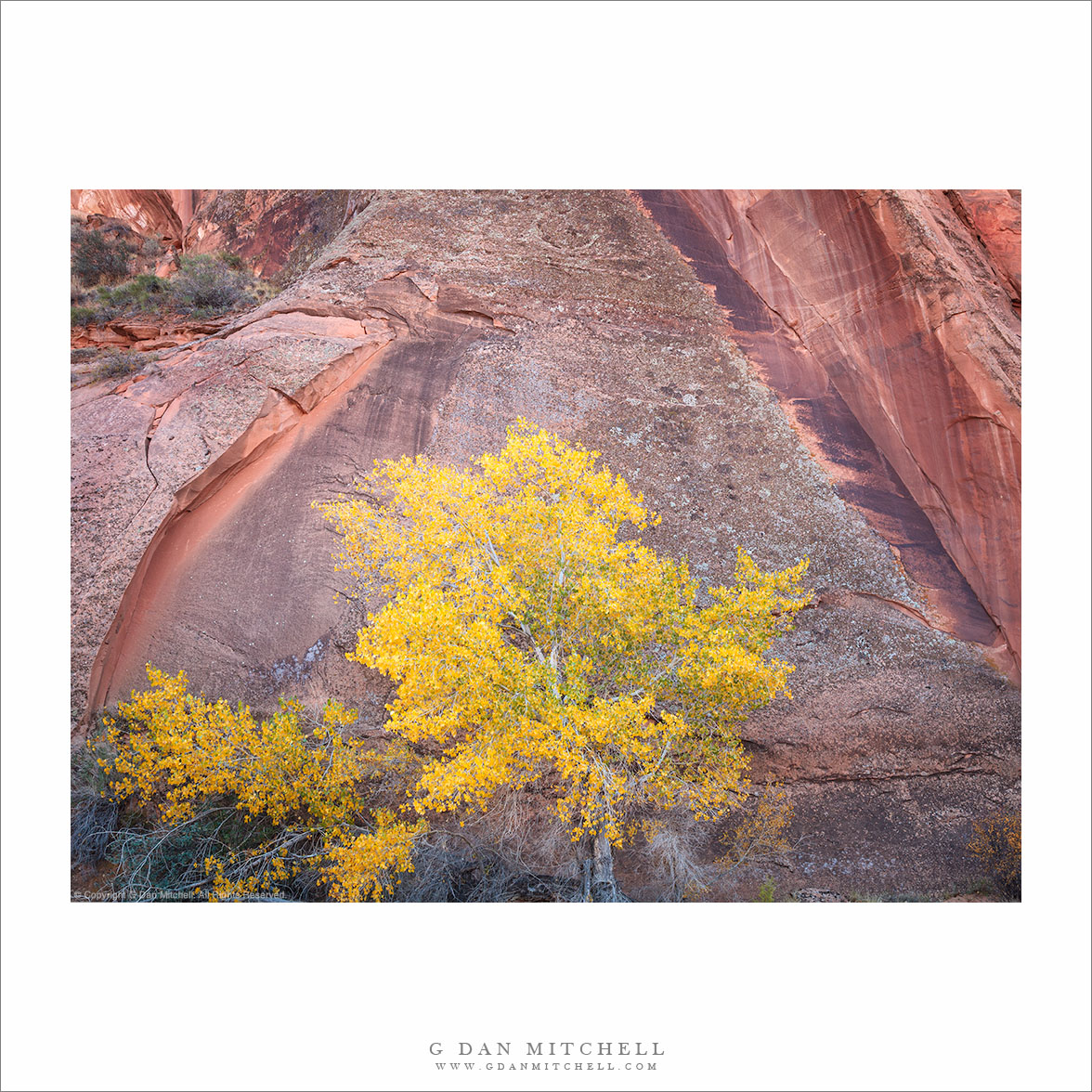
“Autumn Tree, Sculpted Sandstone” — A cottonwood trree with autumn foliage grows next to a sculpted sandstone cliff.
A group of us ventured down into a narrow Utah canyon, lined with red rock walls and dotted with autumn trees. A creek flowed along its length, and the soft sound of its moving water was never far away. With the fall colors and the colorful rock faces there were photographs everywhere. Not surprisingly, our progress was slow… but very productive.
Although it might see counter-intuitive for a place like Death Valley National Park, these mountains typically are snow-capped in the winter. The highest point in the Panamint Range is Telescope Peak, at an elevation of just above 11,000′. That puts it in the alpine zone, and although moisture is usually scarce here, when it does come it can produce snow at that elevation. A cold storm had recently passed, and the snow level in the photo is lower than usual.
Photographer and visual opportunist. Daily photos since 2005, plus articles, reviews, news, and ideas.
Manage Consent
To provide the best experiences, we use technologies like cookies to store and/or access device information. Consenting to these technologies will allow us to process data such as browsing behavior or unique IDs on this site. Not consenting or withdrawing consent, may adversely affect certain features and functions.
Functional
Always active
The technical storage or access is strictly necessary for the legitimate purpose of enabling the use of a specific service explicitly requested by the subscriber or user, or for the sole purpose of carrying out the transmission of a communication over an electronic communications network.
Preferences
The technical storage or access is necessary for the legitimate purpose of storing preferences that are not requested by the subscriber or user.
Statistics
The technical storage or access that is used exclusively for statistical purposes.The technical storage or access that is used exclusively for anonymous statistical purposes. Without a subpoena, voluntary compliance on the part of your Internet Service Provider, or additional records from a third party, information stored or retrieved for this purpose alone cannot usually be used to identify you.
Marketing
The technical storage or access is required to create user profiles to send advertising, or to track the user on a website or across several websites for similar marketing purposes.