I recently received an email from David, who has some questions about depth of field:
As you have a lot of experience of using the Fuji X-E1, may I please ask you for some advice regarding landscape focusing.
My aim is to use the 18-55mm kit lens with the majority of shots taken at the widest end. I have in mind setting the lens at Hyperfocal distances, based on a crop factor of 1.5 and a circle of confusion of 0.02. I think the first figure is reliable, but I’m not sure about the second in relation to the X-E1 – perhaps you could confirm.
I have already done some testing at home using the attached table (which come from the well respected DOFmaster site).
In my experiment I carefully measured distances at apertures of f8 and f11 using a tripod and a printed card as the subject. I set the lens manually at the hyperfocal distance, using the EVF distance scale. I was disappointed to find that the closest point of focus was not as sharp as I had hoped. Have you any idea why this may be?
I did a further test on aperture f11 and this time set the distance scale at 4 feet (2/3 of the way between 3 and 5 feet). This resulted in a sharp image from 3.5 feet. This would suggest that the distance scale is not accurate.
Any suggestions you have to overcome the problem would be much appreciated.
Let me preface my response on the depth of field (DOF) issue by congratulating you for taking the time to conduct your own experiments. One of the great things about digital cameras is that we don’t have to trust what we read — we can easily and quickly conduct the experiments ourselves. In addition to getting the answer to the question at hand, we end up knowing our gear at a much deeper and even intuitive level, which is extremely important when we are in the field and we don’t have time to ponder and calculate, but must instead make a photograph in the moment.
The rest of this post is going to be somewhat involved, so let me share a quick thought right at the beginning:
The usefulness of DOF calculators is very limited, as they are based on subjective assumptions that may not match what you are doing with your photographs. The best way to align your expectations with exposure choices is to test them yourself and evaluate images in the form that you most often produce — and not just at 100% magnification on a computer screen.
What is DOF? Essentially the depth of field is the distance range in front of and behind (unless you focus at infinity) the focus point within which subjects are likely to sharp enough to seem in focus when the photograph is viewed at some arbitrary magnification. This size of this range increases as we stop down (for example, going from f/2.8 to f/8 expands the DOF) and decreases as we open the aperture (going from f/8 to f/2.8 contracts DOF). This is a source of creative control for the photographer. A smaller aperture can allow subjects across a greater distance range to appear relatively sharp, while a larger aperture can keep the primary subject in focus while pleasingly “un-focusing” elements in front of and behind the primary focus point. Continue reading Reader Question: About Depth of Field→
From time to time I see questions from photographers trying to figure out exactly which aperture is the “right” one for a particular photograph. Some will go so far as to consult depth of field calculators (or “DOF calculators”) to help them decide whether the should open up a third of a stop from f/11.
There may be times where that sort of precision aperture selection is useful, but in many cases you can make things a lot simpler*, basically selecting from one of three general options:
If depth of field isn’t a big issue — let’s say you are shooting a relatively flat subject — simply use a “middle of the road” aperture that will be sharp on your lens/camera combination. The old rule of thumb about using f/8 is a decent one to follow here, although cropped sensor shooters might go for something more like f/5.6.
If you need very deep depth of field, go straight to the smallest aperture you feel comfortable using. On a full frame camera this is likely to be about f/16, while on a cropped sensor camera it might be a bit larger, perhaps in the f/11 or so range. If your need for extra deep depth of field is strong enough that you are willing to give up a small degree of overall image sharpness — which will be invisible in small images anyway — you might even go one stop smaller on some occasions to f/22 on full frame and f/16 on crop.
If you need to limit depth of field to throw background elements out of focus, simply try the largest aperture that your lens has — but consider stopping down just a bit if you need just a bit more depth of field.
Basically, for most photographs, especially if you have good light and/or are using a tripod, you could probably get away with considering only three apertures in most cases — the “normal” one, the really small one, and the really big one.
Yes, this is a bit of a simplification, though it really does work in the vast majority of the photographs that most people are making. Clearly things can get a bit more complicated if you are, for example, shooting in very low light or need to deal with moving subjects. In the interest of keeping this “Easy” description easy, I’ll simply acknowledge those possibilities here without elaborating.
G Dan Mitchell is a California photographer and visual opportunist whose subjects include the Pacific coast, redwood forests, central California oak/grasslands, the Sierra Nevada, California deserts, urban landscapes, night photography, and more. Blog | About | Flickr | Twitter | Facebook | Google+ | 500px.com | LinkedIn | Email
(Note: Check the “Deals” page on this blog for more on this promotion, news about deals from ThinkTank Photo, and other periodic updates.)
UPDATE: Canon extended the ‘instant rebate’ promotion into early February. If you are going to purchase from B&H, the last full day to do so is FRIDAY, FEBRUARY 4, 2012!
The Canon ‘Instant Rebate’ promotion at site sponsor B&H features a lot of interesting gear at even lower prices than were available during a late 2011 promotion. In fact, the selection of lenses and electronic flashes and the size of the discounts seem unusually large.
Click the link to You may purchase directly through the following links to B&H (and help support this blog in the process) or click this link to see the full list of eligible equipment and/or purchase from B&H. It runs from November 27 through FEBRUARY 4. (Note that B&H has very limited ordering hours on the final day of the promotion.)
Lenses (Note: This is an exceptional list of lenses and the discounts are larger than usual)
(Note: This article was originally posted in 2007 and I should probably update the test using newer gear – though the point of the test and the post remains. In addition, see some additions/comments in the final section… and disregard the advice to use f/11 as a standard aperture if all else is equal. Note also that these conclusions are not purely about diffraction blur, but about the overall performance of a particular lens for a particular subject.)
Last month I wrote about a set of tests (“Full Frame Lens Test“) that I conducted with my lenses and my Canon 5D body. My object was simply to better understand how the camera/lens combinations would behave so that I could make better decisions about appropriate lenses and apertures while making photographs.
One discovery was that, compared to using a crop sensor DSLR, I can get excellent results when I shoot at smaller apertures with good lenses on the full frame body. I tended to avoid apertures smaller than about f/8 on the crop sensor camera, but there seems to be little or no real liability in using f/11 or even f/16 on full frame.
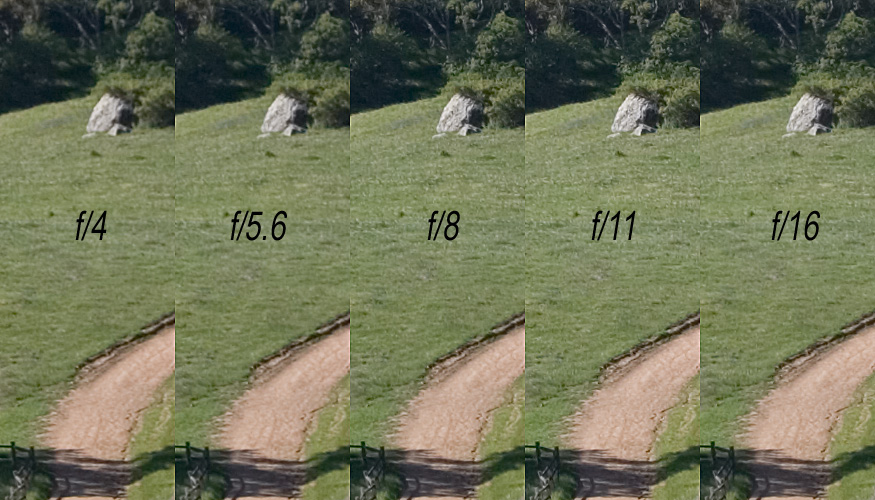
To illustrate I put together the following composite image. (The image appears in reduced form on this page. Click the link to see the full size version.)
A sequence of text photographs illustrating diffraction blur at several apertures on a full frame camera
The example includes five versions of a small section from near the center of a photograph taken with the Canon EOS 5D using the EF 24-105mm L IS lens at a 50mm focal length. The camera was on a tripod, MLU and a remote release were used, and the AF was turned off. The images are 100% crops – in other words, actual pixel size is displayed in these tiny excepts from the much larger original images. (You would virtually never view a print at this magnification. These are equivalent to tiny sections from a print that might be about 5 feet wide!) The images have been slightly sharpened in post-processing, but are otherwise unaltered.
I shot at apertures of f/4, f/5.6, f/8, f/11, and f/16. In terms of the sharpness of this portion of the image, I am quite certain that all five examples are plenty sharp for making prints. That said, there are some differences. To my eye:
The f/4 and, to some extent, the f/5.6 versions are slightly but noticeably softer at this magnification.
The f/8 and f/11 versions seem to me to have approximately equal sharpness. Some parts of the f/8 image seem slightly sharper, but other parts of the f/11 image seem sharper. In the end they are pretty darn equivalent, though I’d maybe give the f/11 a very slight edge overall.
The f/16 image may be slightly less sharp than the f/8 and f/11 versions, but the difference would not be noticeable in a print, even a rather large one. In any case, f/16 appears sharper than either f/4 or f/5.6.
After doing this test I no longer hesitate to shoot at f/11 or f/16. Not only does this give me the possibility of getting greater depth of field when I need it, but it also means that I can compensate for corner softness on some lenses (e.g. the 17-40mm) by using a smaller aperture without fear of losing center sharpness.
(Addition: 4/23/07 – Other Canon L lenses seem to give similar results, including my 17-40mm f/4 L and my 70-200mm f/4 L.)
Added 2/23/08:
In response to a question in a photo forum I put together a sample image showing corner sharpness from the same original images used in the example above. (The earlier example shows 100% crops from near the center of the frame.)
(image temporarily unavailable)
Technical info: Shot using a Canon 5D with the Canon EF 24-105mm f/4 L IS lens at a 50mm focal length. In aperture priority mode, the aperture was changed manually between shots. Initial focus was with AF, which was then switched off before shooting the series. Camera was on a tripod and MLU and remote release were used. Shots were converted from RAW with ACR and no additional post-processing applied. Print made at this resolution would be approximately five feet wide. The crop is from the far lower left corner of the frame.
In addition to noting the softer image in the corner at f/4, also note that the image is a bit darker due to the expected increase in corner light fall-off (“vignetting”) at the largest aperture. Sharpest version in this series shot with a FF body seems to be at f/11 as in the center crop example above. But note that f/8, f/11, and f/16 are not very different in overall sharpness – and in the end any of these apertures would produce a very sharp print.
In response to another forum discussion, I have added another example, this time using the Canon EF 50mm f/1.4 lens and showing performance at f/5.6, f/8, f/11, and f/16. In other respects the test is the same as described already in this post. This image is seen to the right and below.
(image temporarily unavailable)
Conclusions: Based on this set of images and other taken with different lenses under similar conditions, I have come to some conclusions that work for me with my Canon lenses and full-frame Canon 5D body. (See some notes below this bullet list that clarify some of the context of the original conclusions. In short, I have left the original conclusions here, though they wold be different with modern cameras and lenses.)
In general the sharpest whole aperture seems to be around f/11. (But see the “NOTE” below.)
It is very difficult to distinguish any resolution differences at f/8 or f/16 – there are subtle differences when viewing the test images at 100% magnification on my monitor but these are essentially invisible in prints.
f/5.6 or f/22 will tend to be a bit less sharp, though perhaps not for the same reasons. At f/5.6 I begin to notice a bit more of the diminished sharpness as a lens is opened up – more on some lenses than on others. At f/22 the effects of diffraction become just a bit more noticeable. However, if the shot demands it I do not hesitate (much) to use either of these apertures as the very slight decrease in sharpness is quite tiny if visible at all in a print and both provide some other advantages in certain situations. (I’ll even use the largest f/4 aperture on the test lens when isolating the subject is important or when low light demands it – and the results will typically be just fine.)
At larger apertures the performance becomes more tied to the particular lens so it is more difficult to make any generalizations beyond the fact that vignetting increases and sharpness will be less optimal.
The smaller apertures decrease any corner light fall-off (“vignetting”) or softness, generally to a point where both are insignificant.
With all of this in mind, unless I have a reason to select some other aperture I typically use f/11 as my general starting point when shooting with my full-frame DSLR body.
NOTE: Today, with higher quality lenses and sensors with much higher resolution, I would no longer recommend using f/11 as the default aperture. While it certainly is possible to make very sharp photographs at f/11 on a full frame camera, today’s higher resolution sensors move the diffraction-limited aperture to a larger setting. Depending on the lens and the situation, f/5.6 or f/8 would be better defaults, depending on your gear.
G Dan Mitchell is a California photographer whose subjects include the Pacific coast, redwood forests, central California oak/grasslands, the Sierra Nevada, California deserts, urban landscapes, night photography, and more. Blog | About | Flickr | Twitter | Facebook | Google+ | 500px.com | LinkedIn | Email
Photographer and visual opportunist. Daily photos since 2005, plus articles, reviews, news, and ideas.
Manage Consent
To provide the best experiences, we use technologies like cookies to store and/or access device information. Consenting to these technologies will allow us to process data such as browsing behavior or unique IDs on this site. Not consenting or withdrawing consent, may adversely affect certain features and functions.
Functional
Always active
The technical storage or access is strictly necessary for the legitimate purpose of enabling the use of a specific service explicitly requested by the subscriber or user, or for the sole purpose of carrying out the transmission of a communication over an electronic communications network.
Preferences
The technical storage or access is necessary for the legitimate purpose of storing preferences that are not requested by the subscriber or user.
Statistics
The technical storage or access that is used exclusively for statistical purposes.The technical storage or access that is used exclusively for anonymous statistical purposes. Without a subpoena, voluntary compliance on the part of your Internet Service Provider, or additional records from a third party, information stored or retrieved for this purpose alone cannot usually be used to identify you.
Marketing
The technical storage or access is required to create user profiles to send advertising, or to track the user on a website or across several websites for similar marketing purposes.