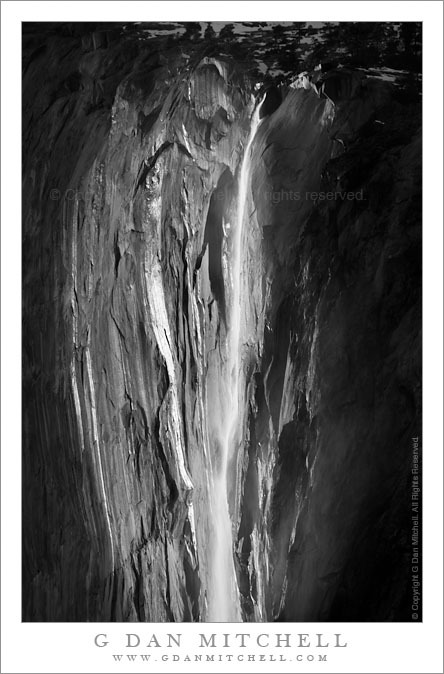
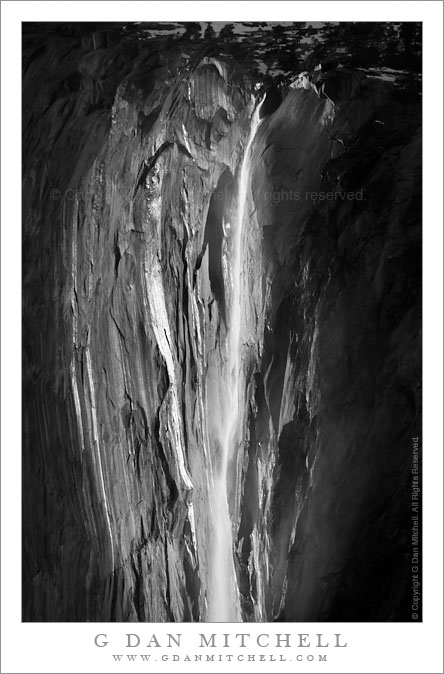
Horsetail Fall in afternoon light, Yosemite Valley
As you may already know, Yosemite Valley’s Horsetail Fall draws visitors and especially photographers ever winter, roughly during the last half of February or so. During this period a miraculous conjunction of sunset light, a gap in the ridges to the west, and a wispy waterfall dropping over the edge of El Capitan may produce a momentary “natural firewall” for those positioned to the east of the waterfall. The sight is quite something… but in some ways it is almost more amazing to encounter hundreds of people who have traveled great distances to stand in cold or even snowy meadows to gaze upwards in hopes of seeing this ephemeral light.
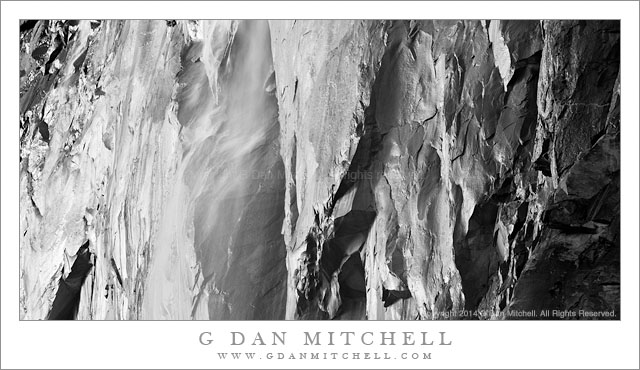
I have photographed it in the past so I generally do not photograph it any more. In fact, I like to joke that one of the nice things about Horsetail Fall is that it clears the rest of the Valley of photographers in the evening! ;-) I must have confused at least a few people when I was there on the first day of March, at a time when people are still hoping to catch the phenomenon. We pulled into one of the two popular areas for viewing the fall, but in the late afternoon, well before the light was even hinting at what it could do later on. I looked up at the cliff high above and saw that recent rains had brought the fall to life, and that winds across the upper face of El Capitan were blowing the fall too and fro and carrying its wispy spray in all directions. The rock face was uniformly damp, and the late afternoon light was bright and silvery on the rock. I put a long lens on the camera and pointed it up toward this bright subject and made a few exposures as the wind whipped the falling water back and forth. Then I packed up and left… just as the evening throng of photographers was arriving and finding their positions to photograph what they hoped would be colorful sunset light.
G Dan Mitchell is a California photographer and visual opportunist whose subjects include the Pacific coast, redwood forests, central California oak/grasslands, the Sierra Nevada, California deserts, urban landscapes, night photography, and more. Blog | About | Flickr | Twitter | Facebook | Google+ | 500px.com | LinkedIn | Email
UPDATE: As of 2020 I am no longer posting annual updates concerning this subject — and I am editing older posts on the subject in light of the need to be more responsible about not encouraging the onslaught. I also no longer recommend going to the Valley to see it. Unfortunately, too much exposure (yes, I played a part in it, unfortunately) has led to absurd crowds, traffic jams, littering, destruction of areas in the Valley where too many people go to see it… and the park has increasingly — and appropriately — cracked down. Parking options have been eliminated, at least one viewing location has been closed. Good news! The rest of Yosemite Valley is still there and often exceptionally beautiful at this time of year.
The silver strand of Horsetail Fall and water reflecting on surrounding cliffs in late afternoon light, Yosemite Valley, California.
Although it seems like it would be extremely difficult to make a truly original photograph of Horsetail Fall at this point, I won’t completely rule out the possibility, and recently I have seen a few interesting and imaginative photographs of the phenomenon.
The necessary conditions are fairly specific, and even when the basics are in place there is no guarantee that the show will occur on a given evening. To be honest, the odds are distinctly against you, and you are more likely to see something that doesn’t match your expectations.
There must be flowing water in the creek near the east end of the face of El Capitan that feeds the fall. This is not a sure thing in mid-winter. There must be sufficient snow above El Capitan and the temperatures must be warm enough to melt it, or there must have been a recent warm storm that brought some rain to higher elevations.
The setting sun must align just right with a gap in the mountains to the west of El Capitan so that the setting sun (miraculously) casts its last beams right on the face of El Capitan where the fall is located. Roughly speaking this occurs during the second half of February, right around February 20 or so.
You must be in a position such that the fall is back-lit by the sunset light beam. In addition, your position must provide a clear view of the fall – not necessarily a simple thing given the forest cover in the Valley. These areas are now subject to terrible crowding that has damaged areas of the park, and the park service is wisely reducing or eliminating access.
Although photographs make it seem like a huge, overpowering spectacle, it is actually very small. It takes place high on a distant cliff face, and to photograph it you’ll need a very long lens.
Finally, the skies to the west of Yosemite must be clear so that the golden hour sunset light is not blocked. Many tell stories of clouds that made it obvious that the show would not happen or, even more frustrating, developing light that was killed at the last minute when the sun dropped behind clouds to the west, which are quite common.
Any post about the February Horsetail Fall occurrence must include a few other important points:
The event has become so popular in recent years that the experience has been significantly compromised. You will not have an experience of relative solitude such as Galen Rowell likely had when he made the iconic photograph of the subject decades ago. Instead you will likely find yourself among hundreds or thousands (you read that right) of other photographers lined up with lenses pointed the same direction.
This, of course, implies that parking and finding “your spot” may both be challenges. As a result of traffic jams, illegal parking, overwhelming crowds, gross littering, and damage to meadow, forest, and river… the park service is wisely putting several access limits in place, even closing one of the favorite areas as of 2020.
If Horsetail isn’t an option, you are are still in one of the most beautiful and compelling places on the face of the planet for making photographs! Speaking of which, while the crowds are focused on Horsetail, you might consider photographing other things away from the crowds…
The annual Yosemite Renaissance art show typically opens at about this time each February and features the work of photographers and other artists working in Yosemite. The show is in the Yosemite Museum Gallery and the 2013 edition runs from February 22 through May 5, with the opening reception at 5:30-7:30 on February 22. (You can view my work in the show this year.) In addition, there is always something interesting to see at the nearby Ansel Adams Gallery – this year an exhibit of Michael Frye’s photographs opens on February 16.
NOTE: The 2017 edition of the exhibit, Yosemite Renaissance 32, opens with a free public reception at 5:30 PM on Friday, February 24. One of my photographs is in the exhibit again this year. See you there!
G Dan Mitchell is a California photographer and visual opportunist whose subjects include the Pacific coast, redwood forests, central California oak/grasslands, the Sierra Nevada, California deserts, urban landscapes, night photography, and more.
UPDATE: As of 2020 I am no longer posting annual updates concerning this subject — and I am editing older posts on the subject in light of the need to be more responsible about not encouraging the onslaught. I also no longer recommend going to the Valley to see it. Unfortunately, too much exposure (yes, I played a part in it, unfortunately) has led to absurd crowds, traffic jams, littering, destruction of areas in the Valley where too many people go to see it… and the park has increasingly — and appropriately — cracked down. Parking options have been eliminated, at least one viewing location has been closed. Good news! The rest of Yosemite Valley is still there and often exceptionally beautiful at this time of year.
The silver strand of Horsetail Fall and water reflecting on surrounding cliffs in late afternoon light, Yosemite Valley.
This being February, it seems that Horsetail Fall has again (and more every year) become a hot topic. Horsetail Fall, sometimes referred to as the “Natural Firefall” has been popularized to an absurd and, frankly, dangerous level on social media and in the press. To be honest, I now recommend that you not go.
The conjunction of elements required to produce the most spectacular Horsetail Fall “event” is complex. First, it depends on the geological coincidences of the placement of the fall in a spot hight on the face of El Capitan that receives a narrow beam of sunset light during two brief periods each year. Second, the fall must be running – in roughly the middle of winter. The area supplying water to the fall is high enough to be snow-covered in a typical winter, but low enough that snow can melt and start the fall flowing even in the cold season – but this is not a sure thing. Essentially, there must be snow and then some warmth to melt it, or else some significant warm rain. Third, a series of meteorological events must play out just right. Obviously, the upper face of El Capitan must be clear of clouds. (Yosemite Valley fog and clouds ringing the cliffs are rather common in the winter season.) The sky west of the Valley must also be clear all the way to the horizon since the best color occurs just before the sun hits the horizon.
Most often the requirements do not align. Many of us can tell stories of light getting better and better, leading toward a brilliant finale… and then the “lights going out” just at the peak of color as the sun dropped behind clouds far to the west.
Hundreds and hundreds Thousands of photographers now show up to try to photograph the thing. I’ve done it in the past, though I’m no longer interested these days – partly because of the absurd crowds and partly because I’m often busy photographing other interesting things!
My best memory of photographing Horsetail was years ago when the park service was doing major road work on Northside Drive, the road along that side of the Valley. The road was completely closed as were the cross-valley roads that travel between Southside and Northside Drives. It had snowed and there was perhaps a foot or more of snow along this section of the Valley floor. I wanted to photograph the fall from a location on the north side of the Valley, so my only option was to put on lots of warm clothes, load up a pack of camera and other gear, and walk across the Valley in the snow. I arrived long before sunset, so I first walked west to El Capitan Meadow where I photographed in rare quiet and solitude on this car-free and carefree late afternoon. Later, I quietly walked back along the road to my shooting location and found perhaps three or four other people there. This quiet, peaceful, and relatively uncrowded experience became my touchstone for photographing Horsetail.
If you go today, there is no way that your experience will be even close, unfortunately.
In recent years, as more people have acquired digital cameras and become more serious about their photography and as the renown of the fall has increased, the crowds have also increased to the point that they have become unmanageable and are damaging the park. As I revise this article in 2020, the problem has become so acute that the park service has wisely put severe restrictions on access — there is no stopping allowed along large sections of nearby Valley roads and one of the popular locations has been completely closed due to damage to forest, meadows, and the river.
* Note: In a wonderful video about Horsetail Fall, Ansel Adams’ son Michael Adams speaks eloquently about his father’s early photographs of the phenomenon. I was intrigued by his comment that Ansel might not have photographed the fall the way we do now because he couldn’t – since he worked with black and white photography. Thinking of this, and being full of myself today, I thought that I’d post a black and white photograph of Horsetail Fall! :-)
G Dan Mitchell is a California photographer whose subjects include the Pacific coast, redwood forests, central California oak/grasslands, the Sierra Nevada, California deserts, urban landscapes, night photography, and more. Blog | About | Flickr | Twitter | Facebook | Google+ | 500px.com | LinkedIn | Email
UPDATE: As of 2020 I am no longer posting annual updates concerning this subject — and I am editing older posts on the subject in light of the need to be more responsible about not encouraging the onslaught. I also no longer recommend going to the Valley to see it. Unfortunately, too much exposure (yes, I played a part in it, unfortunately) has led to absurd crowds, traffic jams, littering, destruction of areas in the Valley where too many people go to see it… and the park has increasingly — and appropriately — cracked down. Parking options have been eliminated, at least one viewing location has been closed. Good news! The rest of Yosemite Valley is still there and often exceptionally beautiful at this time of year.
As more and more people now seem to know, late February is the prime time for the appearance of the “natural fire fall” in Yosemite Valley, when the setting sun may strike Horsetail Fall near the east end of the face of El Capitan, and when viewed from the right angle create a striking light show. I do not plan to be there to photograph the event this year since I’ll likely be shooting somewhere else during the prime time for the fall… and I no longer encourage others to attempt it. I’ll explain below.
The spectacle of Horsetail Fall is now quite well known. The initial renown came after Galen Rowell produced a striking and now-famous photograph of it several decades ago. Eventually others began to photograph it as well. (I read somewhere that several other well-known photographers made images of Horsetail decades earlier, but apparently no one “discovered” the special annual sunset light until Rowell shot it.) Since that time, and especially in the past few years, news of the phenomenon and information about when, where, and how to shoot it has become widespread – especially now that information travels so fast on the Internet. As of this article revision, a plethora of articles (newspapers, magazines, the web) and social media posts have built the thing up beyond all reason, with predictable and unfortunate results.
Twice each year, the setting sun lines up just right so that it casts its final light directly on this waterfall for a few weeks. The phenomenon is ephemeral and dependent on a series of conditions that must all occur at the right time. First, it must be during that short window of time when the setting sun strikes the location of the fall on a high cliff. Second, the waterfall must be flowing. Typically this means that there has been a good amount of snow followed by a warm-up that melts enough of it to get the fall going, though a warm winter rain could accomplish the same thing. Third, the western horizon must be clear so that the sun’s light will not be obstructed as it sets. (Those who have tried to shoot the fall a few times may have experienced disappointment when a crescendo of light potential occurs late in the day… only to be suddenly switched off as the sun drops behind low clouds to the west. To be honest, this happens more often than not.)
The photographer wants where light hits the fall more or less from behind. The number of suitable locations is quite limited and — no surprise — they end up being hugely crowded.
Having said all of this, be aware that it is going to be extremely difficult to get a photograph of Horsetail that hasn’t already been done. I’ve seen a few, but most essentially duplicate existing images. In some ways, I think that contemplating the fact that such a thing actually happens in a place that already contains as many marvels as we see in the Valley may be more rewarding than making another photograph of it.
A downside to the experience is that the popularity of “bagging this shot” has taken off remarkably in the past few years. Yosemite Valley is obviously already a place where it is tempting to run from well known spot to well known spot trying to recreate the well known photographic images that others have produced there. (Ironically, those who take this approach often miss many, many less known subjects in the Valley that can be every bit as beautiful and rewarding.) With Horsetail, the rush of photographers is compressed into a very short time period and focused on a few (mostly only two!) very popular shooting locations. Those who shoot from them on prime evenings may arrive in the morning to reserve a spot… to find a crowd of photographers is already set up.
As of the date of this revision in 2020 the situation has become quite insane, and the park service has had to take serious steps to control the mess. Literally thousands of photographers and others have been arriving in places that used to handle a dozen or two folks. Traffic jams ensued, the experience has been significantly degraded, parking is a mess, and the crowds are damaging park features. As of this year large sections of park roads are now off-limits to parking and one of the two popular locations has been completely closed.
I strongly urge you to NOT go.
I was fortunate a few years ago to have a nearly solitary experience photographing the fall. That winter Northside Drive was closed and all traffic was routed in and out of the Valley along Southside Drive. It had snowed, and one of the locations for photographing the fall was only accessible by hiking across the Valley in snow to Northside Drive and then walking a bit further in the snow to the place from which I shot. I walked over early and spent an hour or more shooting alone in the silent and snow-covered El Capitan meadow! Then, as sunset approached, I walked quietly to a place where I could see the fall and joined a small handful of fellow photographers waiting for the event. We weren’t disappointed.
That is the way I want to remember photographing Horsetail Fall.
(Some of my Horsetail photographs are found here.)
Photographer and visual opportunist. Daily photos since 2005, plus articles, reviews, news, and ideas.
Manage Consent
To provide the best experiences, we use technologies like cookies to store and/or access device information. Consenting to these technologies will allow us to process data such as browsing behavior or unique IDs on this site. Not consenting or withdrawing consent, may adversely affect certain features and functions.
Functional
Always active
The technical storage or access is strictly necessary for the legitimate purpose of enabling the use of a specific service explicitly requested by the subscriber or user, or for the sole purpose of carrying out the transmission of a communication over an electronic communications network.
Preferences
The technical storage or access is necessary for the legitimate purpose of storing preferences that are not requested by the subscriber or user.
Statistics
The technical storage or access that is used exclusively for statistical purposes.The technical storage or access that is used exclusively for anonymous statistical purposes. Without a subpoena, voluntary compliance on the part of your Internet Service Provider, or additional records from a third party, information stored or retrieved for this purpose alone cannot usually be used to identify you.
Marketing
The technical storage or access is required to create user profiles to send advertising, or to track the user on a website or across several websites for similar marketing purposes.

 G Dan Mitchell is a California photographer and visual opportunist whose subjects include the Pacific coast, redwood forests, central California oak/grasslands, the Sierra Nevada, California deserts, urban landscapes, night photography, and more.