
Category Archives: Equipment

Mini Medium Format… or Not?

A photographer and friend asked me for my thoughts on mini medium format, or “miniMF,” camera systems. I told her the answer was complex and that I’d write it up at the blog. Here it is!

I have attempted to include several things in the article: a bit of background regarding formats, some objective facts (“the numbers”) about them and their relationships, pluses and minuses of various options, my own current subjective thoughts on what this means to me, and a few alternative perspectives.


The evolution of digital medium format cameras has been among the most interesting photographic developments over the past few years. High MP backs from companies like Phase One and Leaf became the high-end standard for digital image making, and other companies have recently entered the market. The larger sensors may provide improved image quality in several ways: greater system resolution, greater pixel resolution, improved dynamic range, less noise, and more.

It wasn’t that long ago that digital formats larger than full frame were out of reach for nearly all photographers, with costs that were frequently many tens of thousands of dollars, often for only the digital back, which had to be attached to a medium format body.

However, in the last few years several manufacturers have driven down the cost of camera systems using larger-than-full-frame sensors, and now digital “medium format” (more on that term in a moment) bodies are available for less than $7000. A range of manufacturers are now in this market, including Fujifilm, Pentax, and Hasselblad.

When the costs of larger sensor bodies were in the mid-$20k and up (sometimes very up) range, few photographers using full frame DSLR or mirrorless cameras could realistically consider them as options. But the current $6500-$9000 price isn’t that much higher than the most expensive full frame bodies. At these prices the potential improvements in image quality are enough to make folks take a closer look, especially if they are photographers who produce large and high quality prints on a regular basis.

I began to pay attention when the miniMF Pentax 645d came out some years ago (though I was a bit disappointed to find out that the sensor wasn’t really “645” size), and my interest only increased as Pentax updated to the 645z and then as Fujifilm and Hasselblad brought out competing products. I thought a lot about the possible value of such systems for my photography, and I considered getting one. I haven’t done ao — though I won’t rule it out in the future — but I would like to share some of my musings about the choices. Continue reading Mini Medium Format… or Not?
“DSLR Killer!” — Maybe and Maybe Not

Sony, a company that has made innovative inroads in the camera market in the past few years, just announced its new Sony A9, yet another innovative product that continues the impressive progress of  mirrorless cameras. Some describe it as a “DSLR Killer.” I’m not so sure.  Some thoughts follow.

(Sit back. This isn’t going to be a short post! Hint: It isn’t anti-a9, though it isn’t exactly pro-a9 either.)

First, some personal background and perspectives. I use both mirrorless and DSLR camera systems — a Canon system based around the 5DsR and a Fujifilm system based around the XPro2. I use both for serious photography. Either may be my first choice, depending upon my subject and other conditions, and each excels at some things and is less capable at others. All of this is my way of saying that I’m not “pro-DSLR” or “pro-mirrorless,” and that I’m fairly brand-agnostic. (My first digital cameras back in the pre-2000 “stone age” period were mirrorless!) There are a lot of great cameras coming from by a range of manufacturers today and choosing one brand over another makes little difference to one’s photography.

I’m convinced at this point that mirrorless cameras have the potential to become the predominant serious cameras eventually, and that they are already serious tools that can be the best choice in some situations. Their pluses, both current and potential, include the following: Continue reading “DSLR Killer!” — Maybe and Maybe Not

A Few (More) Thoughts on Back-Country Photography

I recently was asked a few questions about backpacking photography, mostly related to equipment, so I thought I’d post something to augment an existing article on this website: My Backpacking Photography Equipment. (You’ll probably want to take a look at that one, too!)

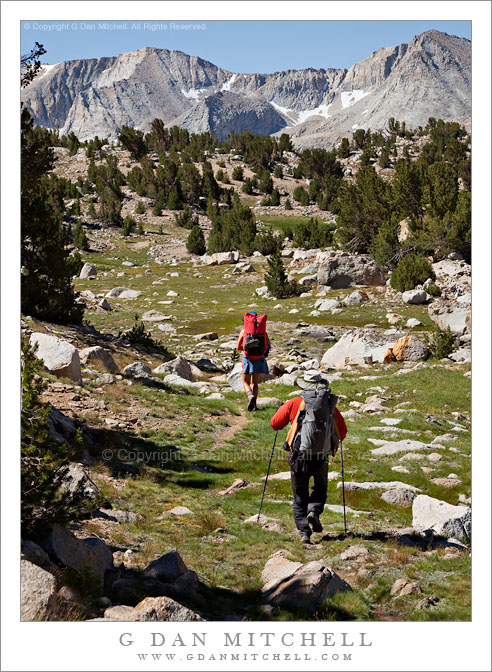
Backpackers, Near MIlestone Basin

Scott emailed recently to ask several questions, and I’ll consider some of them here. His first question has to do with gear, as in  “how much” to take. He suggests that it is hard to find a balance between high enough quality imagining, sufficient equipment to cover possibly opportunities, and carrying the stuff! Once you start carrying the stuff on your back, fundamental compromises among conflicting demands are necessary.

He carries the following gear: Continue reading A Few (More) Thoughts on Back-Country Photography

Camera Format Size Comparisons

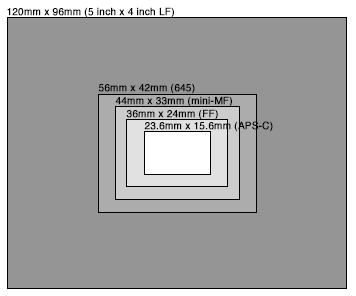
For those who have reasons to think about the relative sizes of various film and digital formats…

Format Comparisons
Large format (4 x 5), medium format (film 645), mini medium format (“mini-MF 33mm x 44mm), full frame (24mm x 36mm), APS-C (1.5x cropped sensor)

… this illustrates that the differences in size (and potentially in various aspects of image quality) may be smaller than you imagine.


G Dan Mitchell is a California photographer and visual opportunist. His book, “California’s Fall Color: A Photographer’s Guide to Autumn in the Sierra” is available from Heyday Books and Amazon.
Blog | About | Flickr | Twitter | FacebookGoogle+ | LinkedIn | Email


All media © Copyright G Dan Mitchell and others as indicated. Any use requires advance permission from G Dan Mitchell.