Category Archives: Equipment

Reader Questions — March 10, 2017

Photographers write to me with questions, and I always try to reply. In many cases I prefer to reply here on the website so that others who may have the same questions can see the answers, too. Today I’m going through a backlog of questions on a variety of topics: neutral density filters, photographing in Utah, the Canon 5DsR, use of photographs by non-profits.


Pete writes: Dan enjoy your website! Question:Have the Mark III – May get the 5DSR – Has anyone used the 5DSR with Neutral Density Filters 6,10,15 etc.. and what have been the times -lengths – and outcomes? Any noise issues? Other problems noted?

Thanks for writing, Pete. I use a 10-stop neutral density (ND) filter sometimes and I use the 5DsR… but so far I haven’t used the two together! That said, I can’t think of any problems that would be specific to the use of these filters on the 5DsR. I do have experience using the 5DsR with much longer exposure times for night photography, and it works quite well for that.

For those who don’t know, the very dark 5-10 stop and more ND filters can be used to extend the exposure time in daylight conditions. Depending on the filter and your aperture choice you could get 30 second or long exposures. Their use presents a few challenges: Continue reading Reader Questions — March 10, 2017

Comparing 33 x 44mm “miniMF” and 24 x 36mm Full Frame Sensors

Comparing Full Frame and miniMF Sensors
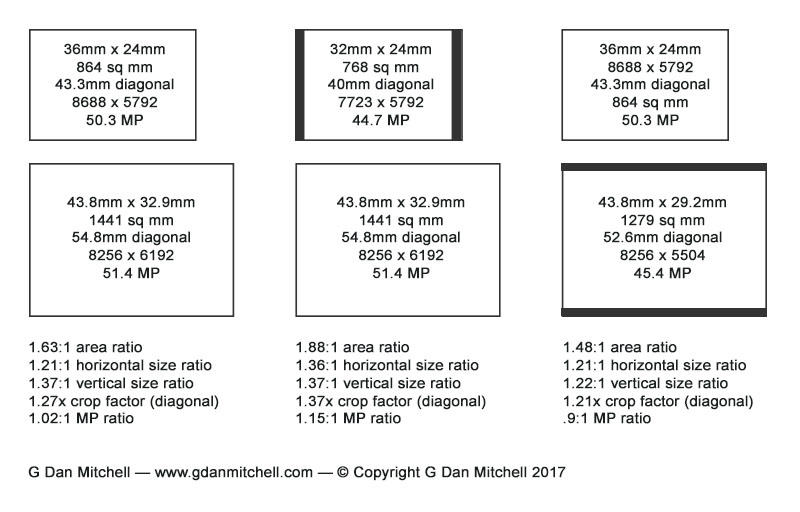
Comparing full frame 24mm x 36mm and Fujifilm mini-MF 33.8mm x 43.8mm sensors

Starting a few years ago with cameras like the Pentax 645d and then 645z and continuing with new cameras from Hasselblad and Fujifilm, systems using  the “miniMF” 33mm x 44mm sensors have become more readily available and less expensive.

In preparation for writing something about the merits of the two types of systems I created this image that holds quite a bit of technical comparison data based on pixel counts (e.g. — “megapixels”), sensor size, and ways of comparing them.

For now I won’t try to analyze this too much, except to say that comparisons between the two formats are more complicated than you might think and they are somewhat subjective — it matters how you plan to use them. For example, do you prefer to use the 3:2 aspect ratio of full frame,  or the 4:3 ratio of miniMF, or will you adapt to whichever you are using? This chart shows you how that affects your comparisons.

NOTE: The graphic is a first attempt at including a lot of information in a single chart. It has some problems, especially with the numbers representing crop factor. I’ll update the image to correct the errors before long, and at that point I’ll use it in a more substantive post about comparing the formats.

© Copyright 2016 G Dan Mitchell – all rights reserved.


G Dan Mitchell is a California photographer and visual opportunist. His book, “California’s Fall Color: A Photographer’s Guide to Autumn in the Sierra” is available from Heyday Books and Amazon.
Blog | About | Flickr | Twitter | FacebookGoogle+ | LinkedIn | Email


All media © Copyright G Dan Mitchell and others as indicated. Any use requires advance permission from G Dan Mitchell.

A Few Thoughts On EVF Versus OVF Cameras

This is one of my occasional posts adapted from something I wrote elsewhere but felt might we worth sharing here on the blog.

A person had asked about “switching” from a Canon DSLR to a Fujifilm mirrorless camera, and some others had replied with points about the ergonomics of the smaller cameras along with some comments about using electronic viewfinders (EVF) in place of optical viewfinders (OVF). Since I use both (OVF and EFV, Canon and Fujifilm) I thought my thoughts might be relevant. 

Note: A few details of the article were updated on March 8, 2018 to reflect more recent developments – for example, referring to contemporary products from companies mentioned here.

EDITING CURRENTLY UNDERWAY


If the goal is a smaller camera and you already are invested in a Canon DSLR system, one option is to consider one of the much smaller Canon bodies. I know a couple of serious photographers who use the little SL1 for travel and certain other kinds of photography, often with smaller and lighter lenses. This gives you a traditional SLR OVF if you are concerned about using an EVF.

Here are some thoughts about perceived/real potential “downsides” (from some perspectives”) of the Fujifilm x-trans cameras specifically and regarding mirrorless cameras in general:

The EVF — The EVF versus OVF issue is complicated and, in a number of ways, subjective. Early on there was a lot of resistance to the EVF products — I think it was a combination of resistance to something new along with the relatively poorer performance of the initial versions. (They were slow, had lower resolution, and generally did not provide as positive of an experience.) I had such cameras a long time ago. (Does anyone else recall the Canon Pro1 of a dozen years ago?) More recent EVFs are far better in every measurable way — though they still won’t be for ideal everyone.

EVFs have pluses and minuses. In the minus category…

  • they show you a video image of the world, rather than an optical view of the “actual” subject
  • as video devices they are never be truly realtime displays — there is always at least some display latency
  • it takes more battery power to drive a video display.

In the plus category…

  • they are usable in extremely low light due to exposure simulation
  • additional useful data can be overlaid on the scene image
  • useful focusing aids can be incorporated into the display, etc.
  • they can reduce the size/weight of the camera and permit use of smaller lenses

In the end, you simply have to try an EVF camera for a while. Lots of people are fine with them, and even some of us who prefer the quality of an OVF are happy to use EVF if it is part of a package that has other advantages for the kinds of photography we are doing. Continue reading A Few Thoughts On EVF Versus OVF Cameras

Fujifilm Camera/Lens Promotion

FUJIFILM PROMOTION

I’m a big fan of the Fujifilm x-trans cameras and the Fujifilm lenses. (I use the XPro2 and several of the lenses for my street and travel photography. Fujifilm has one of their periodic promotions going on up until close to Christmas, and it reduces prices on cameras and lenses by as much as $400. Here is a list the items from site-affiliate Adorama. (You can also fine many of them at site-affiliate B&H via their link in the sidebar, and their Black Friday link at the end of this post.)

(Link to all.)

Cameras

Some of the best bargains here are on older 16MP cameras such as the XT10, XT1, and X100T, but there is good pricing right now on the newer 24MP XPro2, the camera I currently use.

Lenses

The Fujifilm lenses are excellent, and they cover most photographers’ needs. The primes are excellent — I rely on the 14mm f/2.8, 23mm f/1.4, 35mm f/1.4, and 60mm f/2.4 macro. I’ve used the 18-55mm kit lens and the 55-200mm tele-zoom, which is a very nice lens in a compact, light and affordable package.  Recently I have also been using the 50-140mm f/2.8, which is the equivalent of the high end 70-200mm f/2.8 lenses from major DSLR manufacturers. I’m likely to acquire the 16-55mm f/2.8 before long.

(Note: the numbers in parentheses are “angle of view equivalent focal lengths” on full frame cameras.)