I will have more to say about this video and its context in a later post (though see below for a bit more information), but I wanted to share this Scot Miller video about the band of photographers known informally as “The First Light Group” and my role in the group.
There’s a lot more to say about the First Light project, but for now here is a little background. In the early 2000s the group assembled, with support from the Yosemite Conservancy, and headed into the Sierra Nevada backcountry with a special mission: to place landscape photographers in the wilderness for extended periods of time to create photographs that embody the character of these remote places. Over a period of nearly two decades we photographed all over the range.
You can subscribe to Scot Miller’s YouTube channel, where you’ll find more First Light videos and plenty of other material from him.
A bit more than two decades ago (I believe it was 2001), the Yosemite Fund (now the Yosemite Conservancy) initiated a project to put groups of landscape photographers into the Yosemite backcountry for a week or more at a time. With pack animal support, the photographers were able to bring the range of equipment required to do this work, and to remain “out there” long enough to become deeply acquainted with these places and produce an extensive body of photographic work.
The initial group was comprised of Charles Cramer, Karl Kroeber, Scot Miller, Mike Osborne, and Keith S. Walklet. I started tagging along in about 2008 and eventually became one of the gang. Over the years the group — will occasional others join us — continued to photograph in the Yosemite backcountry and eventually branched out to work in other locations in the high country.
There have been few projects like this one, supporting serious photography in the High Sierra over a period of many years and producing an exception body of work.
Scot Miller is not only a fine still photographer, but also a very accomplished videographer. In addition to making his own beautiful photographs on these trips, from the very beginning he was documenting the group’s work in video form. More recently Scot managed to do a series of interviews with each of us, and he has begun releasing them on YouTube.
Below are links to some of the videos that are currently available. First the “origin story” of the group.
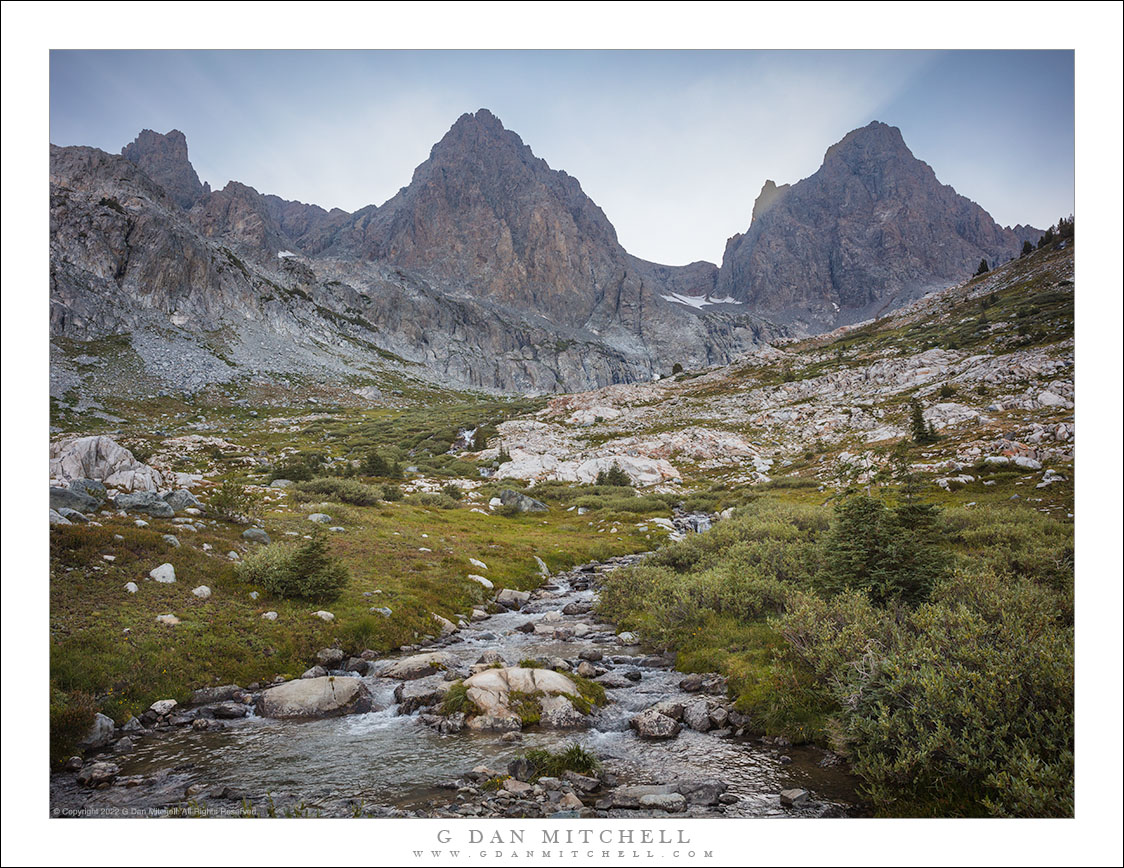
Alpine stream, meadows, boulder fieldsEast of Peaks, End of Day— and one tiny photographer — beneath high peaks in shadow as the day ends.
Those of you who see my photography online may have noticed the “continued:” links accompanying my short social media posts. They take you to a bit more information about each image that I post with the original at my website. The story that I’ll share with this photograph is longer than usual, so you may want to click through and take a look! It goes into the background behind this trip, a bit about who participated, and a little surprise in the image that you would probably not otherwise notice. Tempted? Click that link!
This photograph comes from a weeklong trip into the Sierra backcountry with a group of fellow photographers and friends. Almost 15 years ago I was privileged to link up with another such group (informally known as the “First Light” group, after the title of their book) that did trips like this since 2001. There is an even longer history of similar trips going all the way back to Ansel Adams and the Sierra Club. The concept of such trips was to establish a basecamp at a suitable backcountry location for a week or more of exploration and photography. Because no effort was spared to use high end equipment, pack train support was used to bring camp gear in and out as the photographers carried additional gear in backpacks.
This year’s trip included a different set of photographers, though with links to the First Light crew. (Three of us had been on at least one of the previous trips and I’ve been on several.) In fact, we we loosely emulated the predecessor trips in many ways. (“First Light II?” “First Light, TNG?” “Second Light?”) We walked to our destination, packers brought in the bulk of our gear, we established a base camp, and we spent a week exploring and photographing all around our camp in a wide range of conditions. Perhaps best of all, we got to become a little community of backcountry photographers for the week — surviving the Great Torrential Rain of 2022 together, fixing and eating group meals, sharing stories and tips in the evenings and slow midday hours, heading out to photograph in constantly evolving sub-groups, and more.
The group included Michael Frye, Claudia Welsh, Franka Gabler, David Hoffman, Jerry Bosworth, Patricia Mitchell, and myself. Jerry was the initial inspiration for this trip when he responded to a post of mine about a particular Sierra feature and mentioning that it was perhaps a place that he might not get to again. My reply, which was basically “what about a pack train?,” and his enthusiastic response got the ball rolling… and a few months later we were in the Sierra again. It turned out to be an absolutely wonderful combination of personalities.
There’s a lot more I could (and eventually will) write about the group itself and our adventures, but I’ll use this photograph to share one little vignette. I’ve written about the horrible weather we had on the first couple of days of the trip. Finally, on this afternoon and evening, things cleared up and we all gradually headed up into the same area of the high country, following a stream swollen by the heavy rain. Eventually we emerged from forest and into the open alpine country, were we could see the peaks towering above to our west. I made this photograph just before I turned around — the light was starting to fade as the sun had long dropped below the peaks. If you look very closely, you might be able to spot a very tiny Michael Frye among the rocks and meadows.
G Dan Mitchell is a California photographer and visual opportunist. His book, “California’s Fall Color: A Photographer’s Guide to Autumn in the Sierra” is available from Heyday Books, Amazon, and directly from G Dan Mitchell.
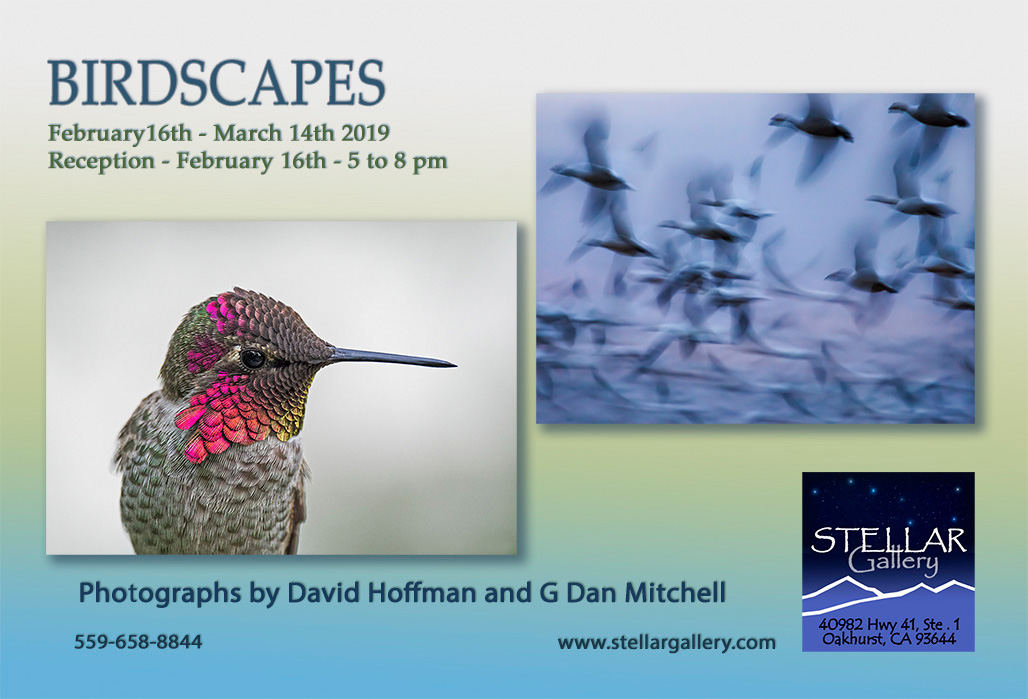
Photographs by David Hoffman and G Dan Mitchell February 16th to March 14th, 2019 at Stellar Gallery, Yosemite Gateway Gallery Row 40982 Hwy 41, Suite 1, Oakhurst CA 93644
Artists Reception, Saturday Feb 16th – 5 to 8 pm
BIRDSCAPES features works by two photographers best known for landscape photography. Both Dave and G Dan are not only inspired by the beauty of wild lands and natural places, they are inspired by their flora and fauna as well. Birds are an integral part of most environments. Their nesting habits, migration patterns and survival strategies express volumes about the places they live, and ultimately our own habitat as well.
David Hoffman
Over the many years during which I have been involved in photography, I would have described my field of interest as landscape and nature with the emphasis on landscape. Wildlife of any sort was usually something that fortuitously showed up to be incidentally included in a landscape photograph.
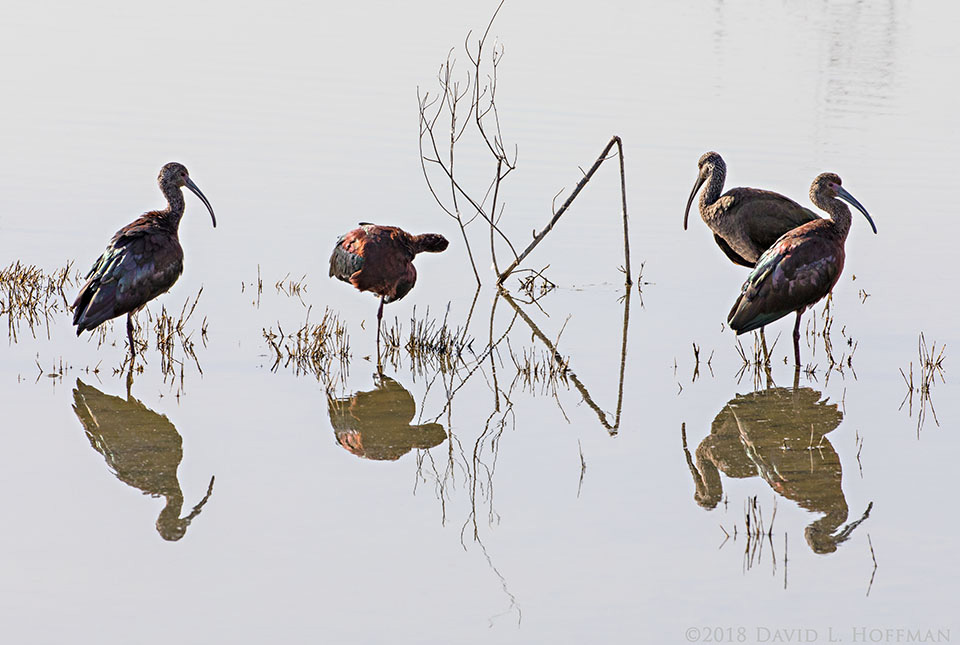
In recent years I began photographing winter wetland landscapes in the Pacific Flyway and migratory birds naturally became a feature of many of the landscape images. As time went on, the birds went from being a mere feature of the landscape to being deliberately featured in their wetland habitat.
The photographs that I have included in the exhibit Birdscapes run the gamut from huge flocks of geese in the Pacific Flyway to a portrait of a hummingbird.
G Dan Mitchell
I have photographed the landscape for years, but more recently the photographs have included birds. I began to photograph birds in the locations I visit — geese and sandhill cranes in California’s Central Valley, brown pelicans along the Pacific coast, tundra swans and golden eagles near Oregon’s Klamath Lakes, trumpeter swans in Washington’s Skagit Valley. Migratory birds connect us to remote landscapes where they breed. Their presence brings landscapes to life. The sound of thousands of geese and cranes in the pre-dawn cold of a winter morning always makes me smile.
The photographs in “Birdscapes” come from several of these locations. They represent multiple ways of “seeing” birds. Some look closely at individuals, often focusing on the beauty of the birds in flight and the moments of take-off and landing. In others thousands of birds fill the sky. Almost all reflect the light and atmosphere of the places where birds are found —morning and evening twilight, colorful light of dawn and sunset, fog and clouds, or crystal-clear winter skies.
The galleries at Gallery Row in Oakhurst offer a wide selection of fine art and fine craft, and host exhibits and special events that support the arts in the Yosemite area. Thank you for supporting the arts!
Photographer and visual opportunist. Daily photos since 2005, plus articles, reviews, news, and ideas.
Manage Consent
To provide the best experiences, we use technologies like cookies to store and/or access device information. Consenting to these technologies will allow us to process data such as browsing behavior or unique IDs on this site. Not consenting or withdrawing consent, may adversely affect certain features and functions.
Functional
Always active
The technical storage or access is strictly necessary for the legitimate purpose of enabling the use of a specific service explicitly requested by the subscriber or user, or for the sole purpose of carrying out the transmission of a communication over an electronic communications network.
Preferences
The technical storage or access is necessary for the legitimate purpose of storing preferences that are not requested by the subscriber or user.
Statistics
The technical storage or access that is used exclusively for statistical purposes.The technical storage or access that is used exclusively for anonymous statistical purposes. Without a subpoena, voluntary compliance on the part of your Internet Service Provider, or additional records from a third party, information stored or retrieved for this purpose alone cannot usually be used to identify you.
Marketing
The technical storage or access is required to create user profiles to send advertising, or to track the user on a website or across several websites for similar marketing purposes.


Join the discussion — you are welcome to leave a comment or question. (Comments are moderated and may not appear immediately.)