
Category Archives: Photographs: Death Valley

Crossing Tracks, Racetrack Playa

Crossed Tracks, Racetrack Playa

Crossed Tracks, Racetrack Playa. Death Valley National Park, California. April 2, 2007. © Copyright 2007 G Dan Mitchell – all rights reserved.

The tracks of the famous “moving rocks” of the Racetrack Playa cross in evening light.

This was an absolutely beautiful evening on the playa, with wonderful light and interesting clouds. I was impressed by these long and straight moving rock trails that crossed and were heading in nearly opposite directions.

There is at least one believable theory about how the rocks moved. (No, not the one involving alien landings… ) It goes sort of like this: A playa like this one is formed by, believe it or not, flooding. During occasional wet seasons, the water washes down from the surrounding hills and fills the playa with silt and few inches of water. The original theory suggested that this was enough – that strong winds would be enough to move the rocks across the slick surface of the playa. (The rocks seem to come from a hill at the sound end of the playa.)

There is a problem with this notion. While the Racetrack is a very windy place, and the winds might be strong enough to move small rocks, someone calculated that in order to move the largest rocks the winds would have to be in the range of several hundred mph! The playa is windy, but no that windy!

Then someone realized that, counterintuitive though it may be, it can get cold enough on the playa to freeze the surface of water collected there. If the rocks were to become locked in the surface ice, the winds could act on the area of the ice surface much as they do on arctic ice packs. As the ice moves it might drag the rocks along, and if sections of the playa were frozen or if the ice broke up groups of rocks might be moved in the same manner. A further “refinement” of the theory suggests that if the surface froze as the water level was rising that rocks locked in the ice might even be slightly lifted, making it easier for them to move.

This seems reasonable given some of the visible evidence. In places groups of several rocks that are somewhat close together have left parallel curving tracks – the explanation is that they were locked together in a section of the ice that moved them in the same way. It even is consistent with the appearance of strange phenomenon such as these rock tracks that cross at right angles – they would have been moved at different times and under different wind conditions.

I have not read any theories about how often the rocks move. When I first heard about the place many years ago, I think I almost imagined a magical place where rocks were sailing about on the flat surface. Then I visited and I began to imagine that the rocks might only move in wet years – perhaps every decade or so. But with more visits and more thought, it began to seem to me (in my unscientific musings) that the conjunction of conditions required to move the rocks (flooding, freezing, plus high winds) might actually occur very rarely. I now make the assumption that the actual movement of the rocks may be a very rare thing, indeed.

G Dan Mitchell Photography | Flickr | Twitter (follow me) | Facebook (“Like” my page) | LinkedIn | Email
Text, photographs, and other media are © Copyright G Dan Mitchell (or others when indicated) and are not in the public domain and may not be used on websites, blogs, or in other media without advance permission from G Dan Mitchell.
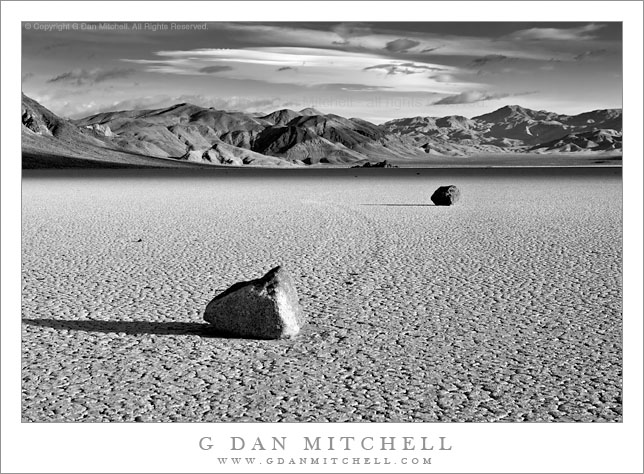
Two Rocks, Morning – Racetrack Playa

Two Rocks, Morning, Racetrack Playa - Black and white photograph of two "moving rocks" on the Racetrack Playa at Death Valley National Park. Morning light with unusual clouds, and the Grandstand in the distance.
Black and white photograph of two “moving rocks” on the Racetrack Playa at Death Valley National Park. Morning light with unusual clouds, and the Grandstand in the distance.

Two Rocks, Morning – Racetrack Playa. Death Valley National Park, California. April 3, 2006. © Copyright G Dan Mitchell – all rights reserved.

This is my all time favorite photograph from the Racetrack Playa. A combination of factors all came together at this precise moment to make this work. First of all, I actually had to be at the Playa, which is no small task in and of itself. From my San Francisco Bay Area location this is a round trip drive of well over 1000 miles, the last 30 miles of which is a two-hour adventure on an extremely washboarded gravel road. Then, unlike most visitors, I stayed overnight at the playa and got up before dawn to scope out the early light.

Before I took this shot I had already seen these two lonely rocks with the expanse of the playa behind them and the Grandstand and further peaks in the distance. I had made some photographs of this scene that didn’t really work for one reason or another and had then gone on to photograph other examples of the playa’s “moving rocks.” But I wasn’t optimistic on this morning – there was a howling gale blowing across the playa and thick clouds had come up over the tall ridge to the east and the overall lighting was not so great. It was a tremendous wilderness experience – a wild and lonely morning that I would never forget –  but not one that promised great photography.

I did note that the distant peaks to the north were in the sun and that there were some very interesting cloud formations appearing there. Then I saw that the direct sun was beginning to strike the far northern end of the playa, and then gaps began to appear in the thick clouds overhead. Because of the extremely strong winds, beams of light coming through the clouds were flying across the surface of the playa at a high rate of speed, creating rapid changes in its appearance as bands of light and shadow were in constant motion. This was no static landscape!

I remembered the two rocks and quickly located them and set up my gear. While many people may assume that landscape photography is a slow, deliberate process – find a scene and carefully go about getting everything ready to take “the shot” – this was anything but. The entire surface of the playa was constantly changing – light appearing here, a shadow racing past over there, cloud shapes changing in the distance. I made several exposures and this one turned out to be my favorite: the foreground rocks casting sharp shadows from the strong sidelight, a line of shadow across the distant playa near the Grandstand, the cloud shadows on the mountains, and those amazing cloud forms in the distance.

(This is an updated version of a photograph from 2006.)

G Dan Mitchell is a California photographer whose subjects include the Pacific coast, redwood forests, central California oak/grasslands, the Sierra Nevada, California deserts, urban landscapes, night photography, and more.
Blog | About | Flickr | Twitter | FacebookGoogle+ | 500px.com | LinkedIn | Email

Text, photographs, and other media are © Copyright G Dan Mitchell (or others when indicated) and are not in the public domain and may not be used on websites, blogs, or in other media without advance permission from G Dan Mitchell.