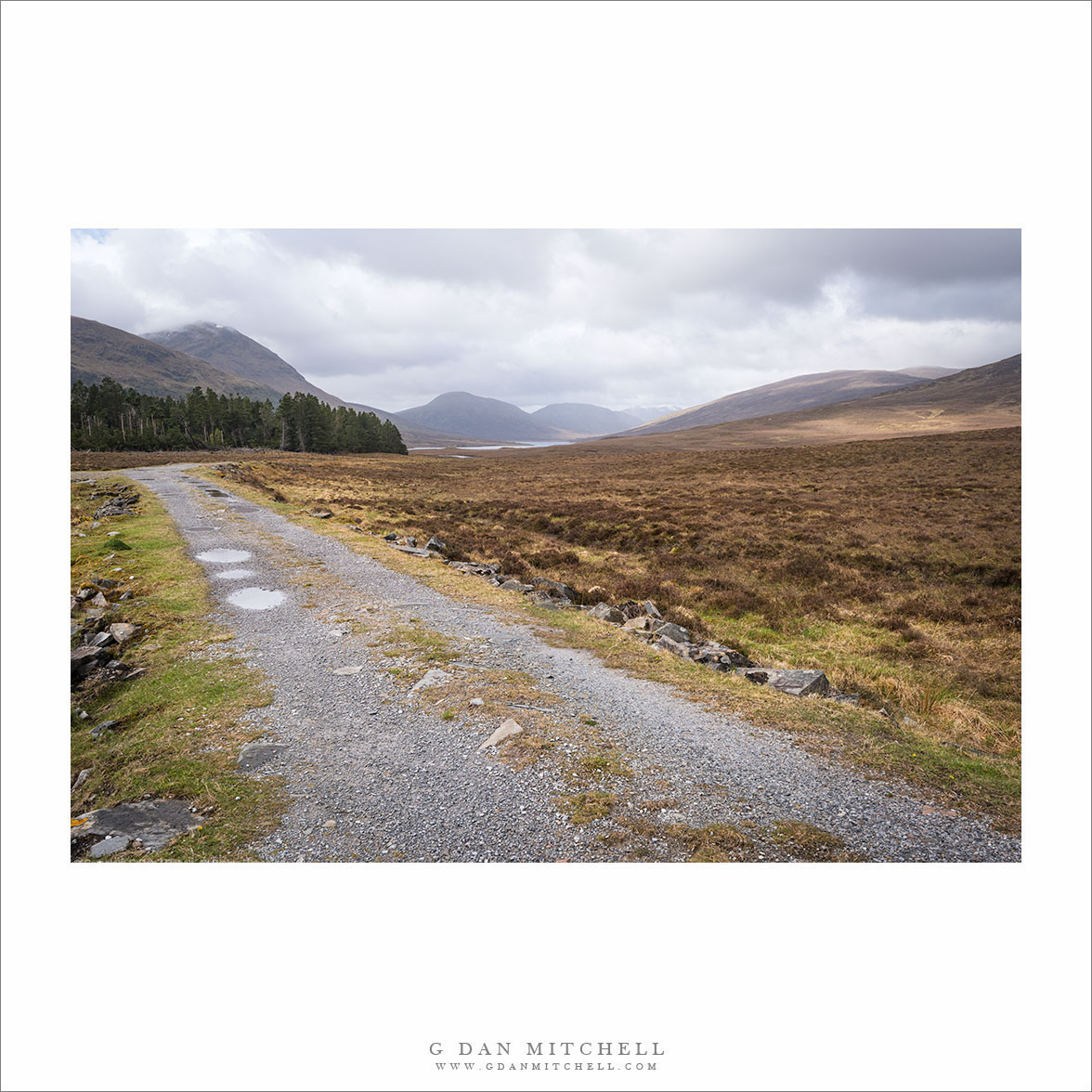
“Trail, Highlands Valley” — A path leads into a highlands valley as rain falls on distant hills.
Somewhere in northwest Scotland, between Shieldag and Applecross, we paused on our drive through this broad valley. It was surprisingly cold — there was new snow on peaks on either side — and rain showers passed across the landscape. Nearby was what appeared to be an old road, now marked as a foot trail, heading off into the valley — the sort of trail that makes you aware that there are places more remote than where you stand.
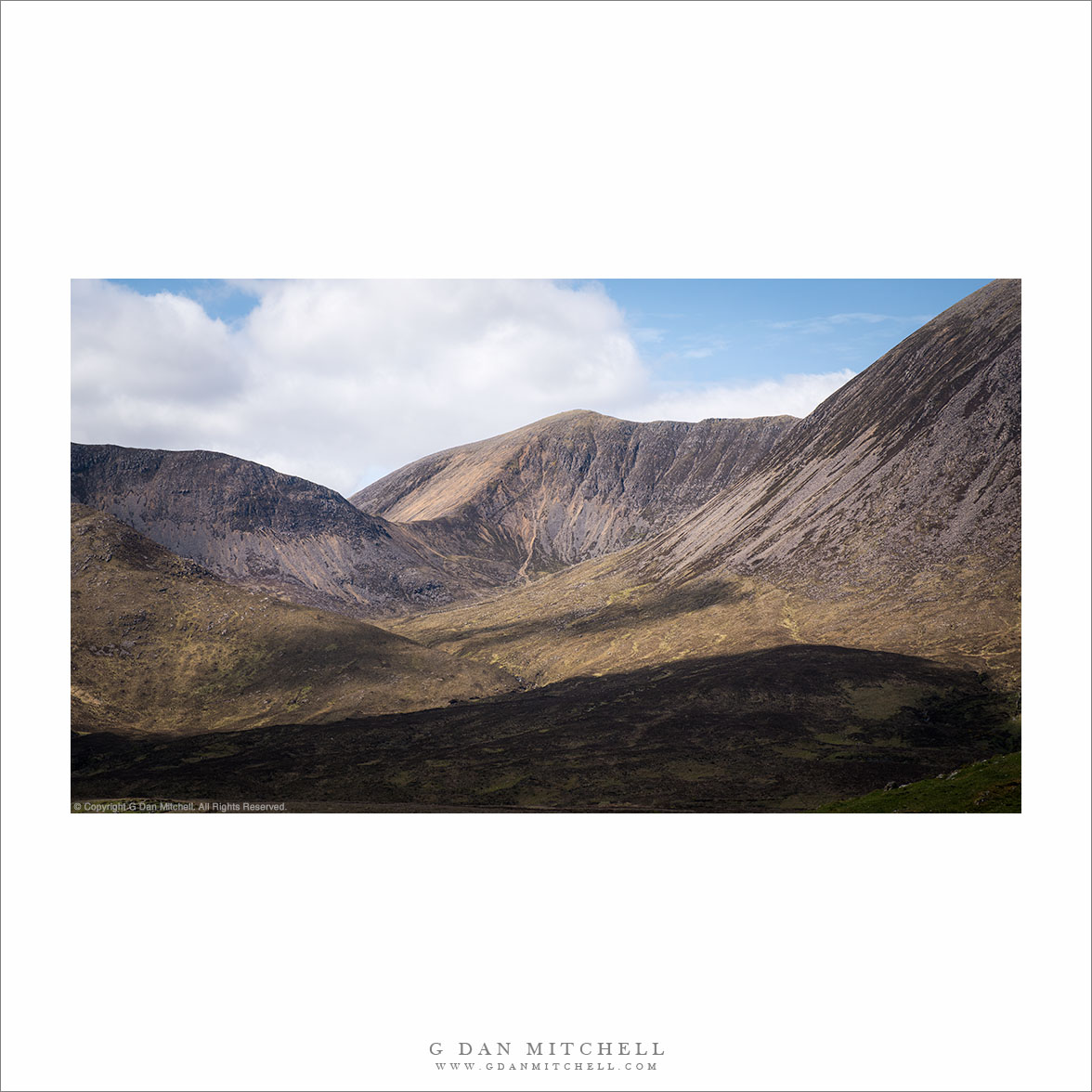
“Mountains, Clouds, and Shadows” — Clouds shadows drift across mountain terrain on the Isle of Skye.
I know I’ve mentioned this before, but one thing that impresses about the mountains of Scotland is that they have the appearance alpine terrain in my California High Sierra. There are few or no trees, the only vegetation is the sort that lies under your feet if you walk through it. The peaks are sharp and rugged and rocky. The entire landscape — mountains, streams, valleys — is laid bare. In the Sierra I must go well above 10,000′ to see this. In Scotland it begins barely above sea level.
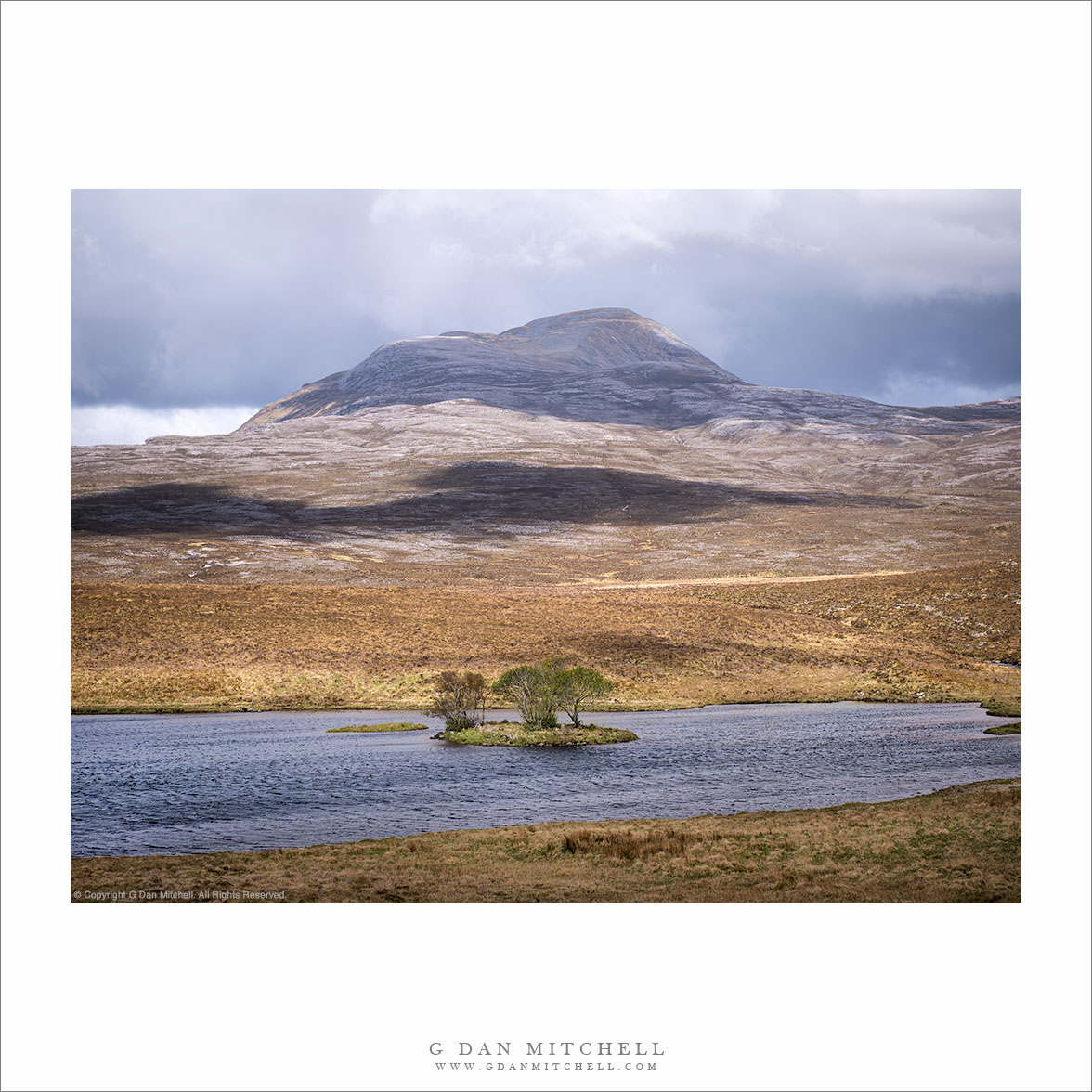
“Canisp and Loch Ewe — Canisp peak rises above Loch Ewe with a tree-covered island.
Some travelers like to know everything about their destinations before they depart. I can understand — one reason we travel is to learn about new places and, more practically, knowledge can help you travel efficiently. But I’m partial to not knowing everything in advance, instead leaving plenty of room for discovery. (Of course, it helps — a lot — that my wife is a planner!) The details of this photograph may be a case in point. (There has been an update to this post. Click the “more” link below to see… more.)
“Desert Holly, Dry Wash” — A desert holly plant, either dead or dormant, in the middle of a dry wash, Death Valley.
Desert Holly must be one of the must adapted and tenacious plans in Death Valley National Park. It grows in some of the least likely spots — places where there is barely any soil, where the sun bakes the land, and where water is rare. Desert Holly plants can occasionally put out a beautiful cover of pale green leaves, but more often the plant looks dormant or dead, with many dead leaves and very dry branches.
This specimen grew in a desert wash, where water occasionally passes through this very dry area. It has to rely on fairly rare flows of water. Plants grow in much of Death Valley, but few do in this location. While a few further up the wash had green foliage, I saw only dry, desiccated leaves on this one.
Photographer and visual opportunist. Daily photos since 2005, plus articles, reviews, news, and ideas.
Manage Consent
To provide the best experiences, we use technologies like cookies to store and/or access device information. Consenting to these technologies will allow us to process data such as browsing behavior or unique IDs on this site. Not consenting or withdrawing consent, may adversely affect certain features and functions.
Functional
Always active
The technical storage or access is strictly necessary for the legitimate purpose of enabling the use of a specific service explicitly requested by the subscriber or user, or for the sole purpose of carrying out the transmission of a communication over an electronic communications network.
Preferences
The technical storage or access is necessary for the legitimate purpose of storing preferences that are not requested by the subscriber or user.
Statistics
The technical storage or access that is used exclusively for statistical purposes.The technical storage or access that is used exclusively for anonymous statistical purposes. Without a subpoena, voluntary compliance on the part of your Internet Service Provider, or additional records from a third party, information stored or retrieved for this purpose alone cannot usually be used to identify you.
Marketing
The technical storage or access is required to create user profiles to send advertising, or to track the user on a website or across several websites for similar marketing purposes.


Join the discussion — you are welcome to leave a comment or question. (Comments are moderated and may not appear immediately.)