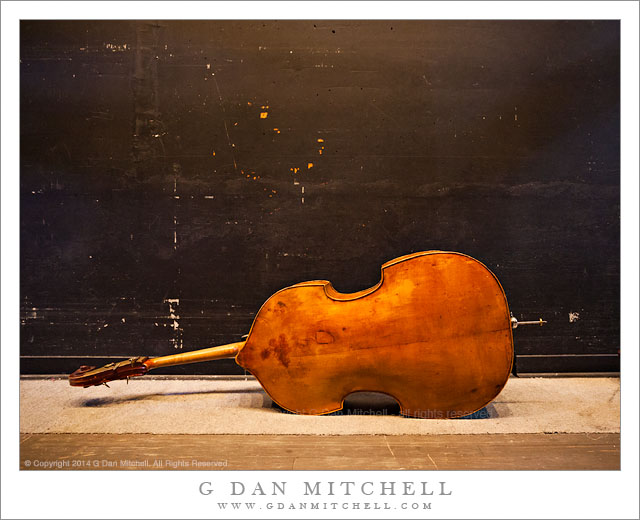
A double bass rests back stage during a break in a rehearsal of Symphony Silicon Valley
This is a photograph from my ongoing project related to classical music performing groups and the musicians who belong to them. It falls into a category I have mentioned before, namely photographs of people and things that happen to turn up in the small areas of interesting backstage light that I have discovered. As I have worked several venues over the past two years I have gotten to know many things about them intimately, and one of those things is the location of the many little unexpected pools of interesting light. Sometimes I “stalk” those spots, just waiting for someone or something to happen there, and I always check them as I walk around the theater with my camera.
This is, obviously, a visually simple image—just a double bass lying on its side during a break in a rehearsal. (I was attracted by the contrast between the warm colors and interesting textures of the instrument and the “industrial” surroundings with their signs of heavy use and even minor damage.) From my point of view, however, it could lead to thoughts of a whole range of other things. I’m fascinated by what an instrument is and what it isn’t. Instruments, musical and otherwise, are often remarkable things in that they allow us to do things that we can’t otherwise do with our minds and bodies alone. The instruments of classical (and many other types of) music are fundamentally pretty simple things and often the result of some really “primitive” technologies, yet they are remarkably adapted to the purposes for which they are intended, generally as a result of a long and complex evolutionary process. But in the end, I would argue that even the most beautiful and sophisticated instrument is no more than a tool, and the really interesting things are how the tool is used by a person or persons to produce something far more meaningful and interesting than the instrument itself.
G Dan Mitchell is a California photographer and visual opportunist whose subjects include the Pacific coast, redwood forests, central California oak/grasslands, the Sierra Nevada, California deserts, urban landscapes, night photography, and more. Blog | About | Flickr | Twitter | Facebook | Google+ | 500px.com | LinkedIn | Email
“You don’t make a photograph just with a camera. You bring to the act of photography all the pictures you have seen, the books you have read, the music you have heard, the people you have loved.” ― Ansel Adams
Lots of people like a photograph I made last September in the Sierra, an image that features a bit of cracked granite along the edge of a small lake, with its inverted form reflected in the water.
“Fractured Granite, Reflection” — The base of a rugged granite wall reflected in the still surface of a sub-alpine Sierra Nevada lake
It seems pretty straightforward as an image. Rocks. Water. No trees. (Among some photographer friends of mine there is a sort of joke. One asks of another returning from a morning of photography, “What did you shoot?” The answer is always the same, “Rocks. Trees. Water.” And it is often true.) Nothing stupendous or iconic. Shooting this frame wasn’t all that complex, really. I only had to walk a short distance to get to the spot and no climbing was involved. From one side of this little lake I could look across and get a clear shot of this little scene. As I recall, I didn’t even have to change my lens. I just set up the tripod, used some relatively basic settings, aimed the camera over there, found a composition, made the shot. I’ll bet I didn’t spend more than five minutes here.
Well, OK, it wasn’t quite that easy. I had been photographing right around this spot for a few days, and while I had a general idea in my mind about a photograph containing these sorts of elements, I had undoubtedly walked past this spot a number of times without even seeing it. In my defense, the area is small and it isn’t surrounded by anything so stupendous that one’s attention would immediately be drawn to it. And this time the light was a bit special, with soft early light reflected in various ways from the surroundings. And this time the air was completely still, so the reflection was nearly perfect.
Actually this little lake is one of perhaps a half dozen or more in this little valley, a valley which is itself located within a larger group of valleys that hold dozens of such lakes. And, all told, I spent about six days wandering around this set of valleys and these lakes, making often just looking, perhaps filing an idea away for better light, and eventually making a few hundred photographs. Many of them are fine and competent photographs, but during this week only a handful rise to a higher level and perhaps only one or two rise to a significantly higher level. (I reserve the right to change my mind about a few of the others since sometimes a photograph’s potential doesn’t reveal itself right away.)
So I suppose it was a bit misleading to say that it only took five minutes to make this photograph. It actually took six days. Oh, did I mention that it also took two days on the trail to get to this spot, crossing two 11,000’+ passes and climbing one more ridge to get to this location at 11,000′? And another two days to get back out again? I guess I forgot that part. So it was actually 10 days, not just six. We lived at 11,000′ in our base-camp—oh, that’s right, we camped—and got up every morning before sunrise, went out and photographed for perhaps 3-4 hours, knocked off in the middle of the day to take care of camp business, and then went out for another 3-4 hours each evening, typically returning after dark to fix dinner.
I suppose that I should also point out that this wasn’t my first trip to this location either. Some decades earlier, on my first solo backpacking trip, I went out for two weeks, self-contained and carrying camera gear, and on about the tenth or eleventh trail day I had a bit of free time, so I left my camp at another nearby lake, thinking I would hike up into this area and make some photographs. I climbed the steep trail, at one point being surprised when a trio of big horn sheep spooked a few feet from me and the clatter of rocks roused me from my hiker’s revery. I dropped my pack and pulled up my camera, but the animals were already too far away down the rocky ridge. Yet, among the images I carry in my mind (many of which I eventually discover again in actual photographs) is the indelible memory of looking up at those three big horns right above me.
Now that I’m thinking of one earlier trip, I suppose I should acknowledge that whatever ability I have to “see” and photograph in the Sierra did not simply happen overnight, nor was it really just a matter of learning to operate a camera and find cool places. I recall the first time that I was aware than making a photograph was something more important than snapping a picture of the thing in front of me. I don’t remember exactly, but I must have been perhaps 10 or 11 years old, and I had a small camera that my father had loaned me. The family was in Yosemite and we hiked to Vernal Falls. No, I do not recall photographing that iconic subject, but I’m sure I must have. But on the way back, I distinctly recall rounding a corner of the trail and looking up and seeing a dome across the Valley—it must have been North Dome—and being struck by the form and position of the thing in ways that I can’t quite articulate. I knew that I had to make a photograph, but I also knew that I couldn’t just point the camera. I recall climbing up from the trail onto a small promontory where I saw some tree branches, and finding a spot where I could frame that dome with closer trees, and I made a photograph that felt like it wasn’t a snapshot.
And, speaking of long stories, that might well have been one of a series of influences (others included photograph books my father left lying around, including some I still own) that compelled me toward heading into the back-country on my first pack trip just before my 16th birthday. I did not know what to expect, but I found magic. The place I went on that first trip is, objectively speaking, nowhere near as spectacular as places I have since visited, but its effect on me was no less powerful. I crossed my first Sierra pass and dropped into another valley full of lakes, spending a few days there before emerging a confirmed backpacker… and eventually a cross-country skier… and for a while a climber… and through almost all of it a photographer.
Some years ago I made a game out of estimating how many days I had spent on the trail in the Sierra. I was shocked—and a bit proud!—when I figured out that by backpacking days added up to something like a year and a half. And, of course, since that time I’ve spent many more days on the trail, though I haven’t recalculated the total.
What does that have to do with this photograph? After substantial time in these places they get into your blood. What originally seemed novel and, to be honest, a bit foreign to a city kid becomes comfortable and familiar. You settle into routines of the back country. I recall that when I first began backpacking it might take a few days to really get to the point where I was “fully there” on the trail. Eventually it would take, oh, about ten minutes. And as all of these things—rocks, water, trees—became more a part of who I am they also became more a part of what and how I see. Where someone on their way to, say, Yosemite Valley might…
G Dan Mitchell is a California photographer and visual opportunist. His book, “California’s Fall Color: A Photographer’s Guide to Autumn in the Sierra” (Heyday Books) is available directly from him.
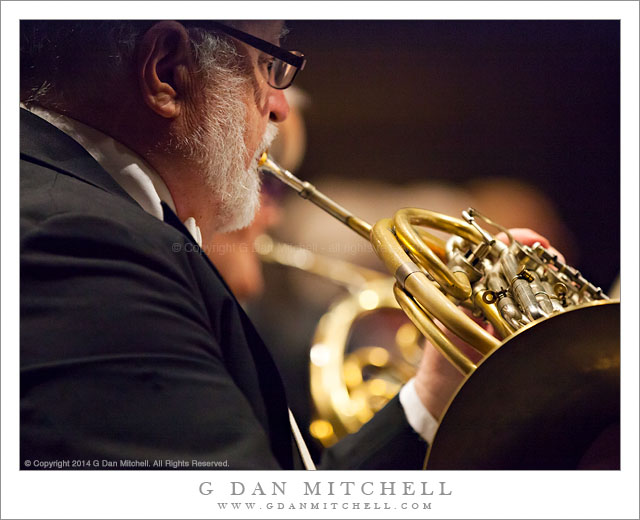
Wendell Rider, French Horn, performing with Symphony Silicon Valley
Today, another photograph of musicians. Anyone seeing a theme here yet?;-) This is a recent photograph from my three-year project photographic classical musicians. I virtually always work in low light, backstage, and during rehearsals and concerts. While working to be discreet, I often photograph through gaps in the orchestra shell, between music stands and instruments, and in very dark backstage areas.
Over time I have found some ways to accomplish this often challenging photography. I use long lenses to isolate subjects against a blurred version of the often complex backgrounds of the orchestra environment. I look for juxtapositions of performers, instruments, and perhaps other on-stage objects. I almost always shoot wide open, allowing backgrounds to blur. And much of the shooting is work of opportunity—I see a momentary opportunity and then I work quickly to capture it. Here I found that I had a decent view of the French horn section through a gap in the orchestra shell wall. A long lens allowed by to isolate the main subject and a large aperture threw the background out of focus.
G Dan Mitchell is a California photographer and visual opportunist whose subjects include the Pacific coast, redwood forests, central California oak/grasslands, the Sierra Nevada, California deserts, urban landscapes, night photography, and more. Blog | About | Flickr | Twitter | Facebook | Google+ | 500px.com | LinkedIn | Email
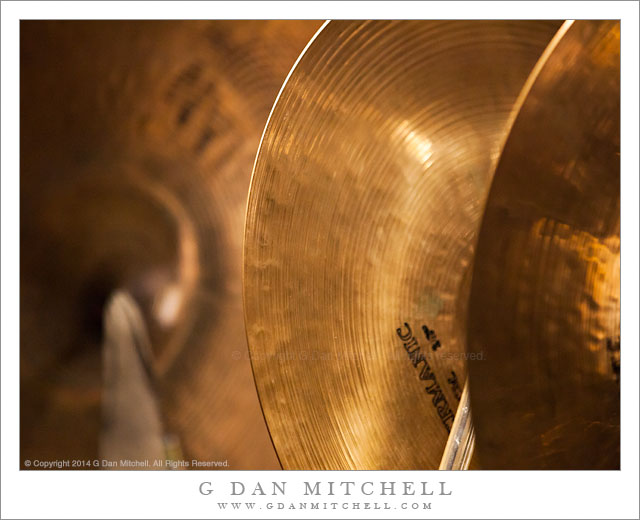
Cymbals on a rack, ready for use at a Symphony Silicon Valley rehearsal
The percussion section of a classical symphony orchestra, especially when somewhat modern music is performed, can be a rich source of photographable objects, shapes, colors, texture, and reflections. Between pieces, or during breaks, I get to stalk the stage and have free rein to wander around that find and photograph these interesting objects.
The subject here is pretty straightforward. When not being played, cymbals are kept safely (and quietly!) stashed on covered tables or in holders. Here a line-up of multiple cymbals was in racks, waiting to be picked up and played.
G Dan Mitchell is a California photographer and visual opportunist whose subjects include the Pacific coast, redwood forests, central California oak/grasslands, the Sierra Nevada, California deserts, urban landscapes, night photography, and more. Blog | About | Flickr | Twitter | Facebook | Google+ | 500px.com | LinkedIn | Email

 G Dan Mitchell is a California photographer and visual opportunist whose subjects include the Pacific coast, redwood forests, central California oak/grasslands, the Sierra Nevada, California deserts, urban landscapes, night photography, and more.