
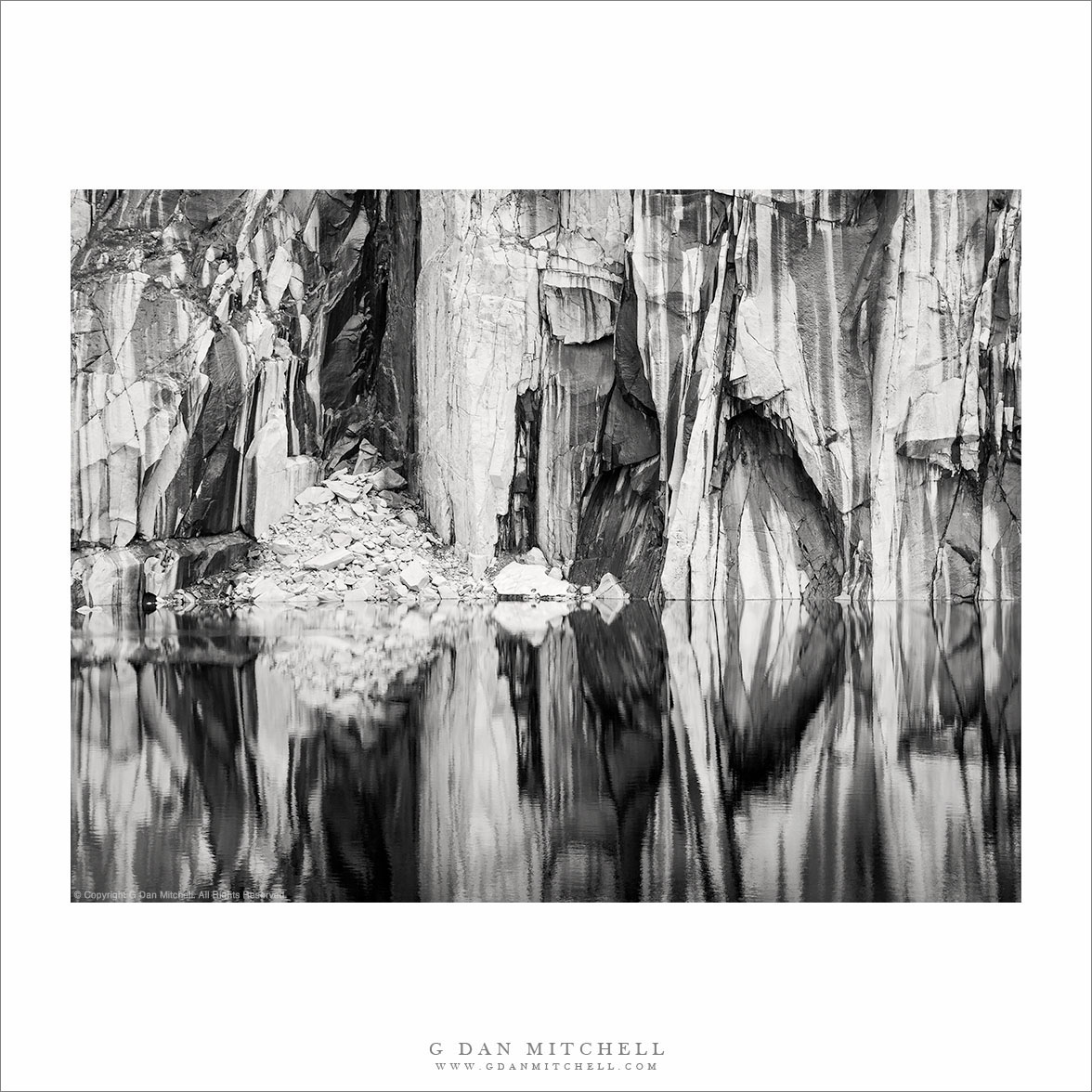
There’s a story and a lesson associated with this photograph. Explaining may take a bit more than the usual two paragraphs. (It takes five. I urge/invite you to click through and read the whole thing — and I’ll be interested in your comments.) I’ll start with the subject though. Years ago (I’ll reveal how many years below) I was on a trans-Sierra pack trip of over a week’s length with a group of backcountry friends. I had walked this route years before this trip, and there were a few places that I specifically wanted to photograph again, especially this lake. I stopped there long enough to make a few careful photographs, including one of my favorites. (That one also comes with a bit of a story and lesson.)
I made a few photographs focusing on this remarkable cliff that drops straight into the far side of the lake and on its reflection. one was a color version of this scene. I liked it… but I did not quite love it. I kept thinking that there was a more meaningful photograph there, but despite multiple attempts to find that vision, it never quite worked out as I hoped. As I said, I liked it but did not love it. (You can see the original on this page.)
Recently I have been sharing old “from the archive” photographs on my social media. I moved to new services in the last year, have been working on building a new audience, and few of the new folks have seen my earlier work. As I prepare the “archive” photos, sometimes I make minor improvements on the basis of a newer vision and/or newer technical features in the software I use. But in this case, the changes were much more profound.
As I opened the old file and worked with it a bit, it suddenly hit me that the color information in the scene just wasn’t all that interesting, but the textures and patterns and tonalities are. And that often suggests the opportunity for a monochrome version. So I gave it a try — and now I like the result much better than before.
So, how long did this photograph have to gestate before it emerged in what I think will be its final, definitive form? I made the photograph almost exactly eighteen year ago, in 2008! Yes, I think there’s a lesson in that. We don’t always “see” the potential in a photograph right after we make it. Sometimes it takes, weeks, months, years, or even decades to understand a photograph and how it works best.
COMMENT OR QUESTION? Scroll down to the comment form.
G Dan Mitchell is a California photographer and visual opportunist. His book, “California’s Fall Color: A Photographer’s Guide to Autumn in the Sierra” (Heyday Books) is available directly from him. Blog | Bluesky | Mastodon | Substack Notes | Flickr | Email
All media © Copyright G Dan Mitchell and others.
Yes, I fully agree – this scenery cries for a monochrome rendering! Admittedly I am biased in favour of b&w photographs, but I am also tired of those artifically (over-)saturated phone images that flood our visceral system. This image has so wonderful structures, an almost too perfect reflection that leaving out the colors opens up a complete new way of percieving what has been selected for that narrow framing. Wonderful!
Thank you, Marcus.
I think you hit it with the point about “structures.” There’s so much going on in this image that I think it is one of those that doesn’t immediately reveal all that it contains, and for that rests on it stands to repeated viewings. (I also think it needs to be seen large, and I plan to make a very large print of it soon.)
The “over-saturated phone image” esthetic has, unfortunately, shifted our sense of what a photograph should look like. It is the visual equivalent of putting a half cup of salsa on everything — salsa is great, but too much of a good thing? :-)