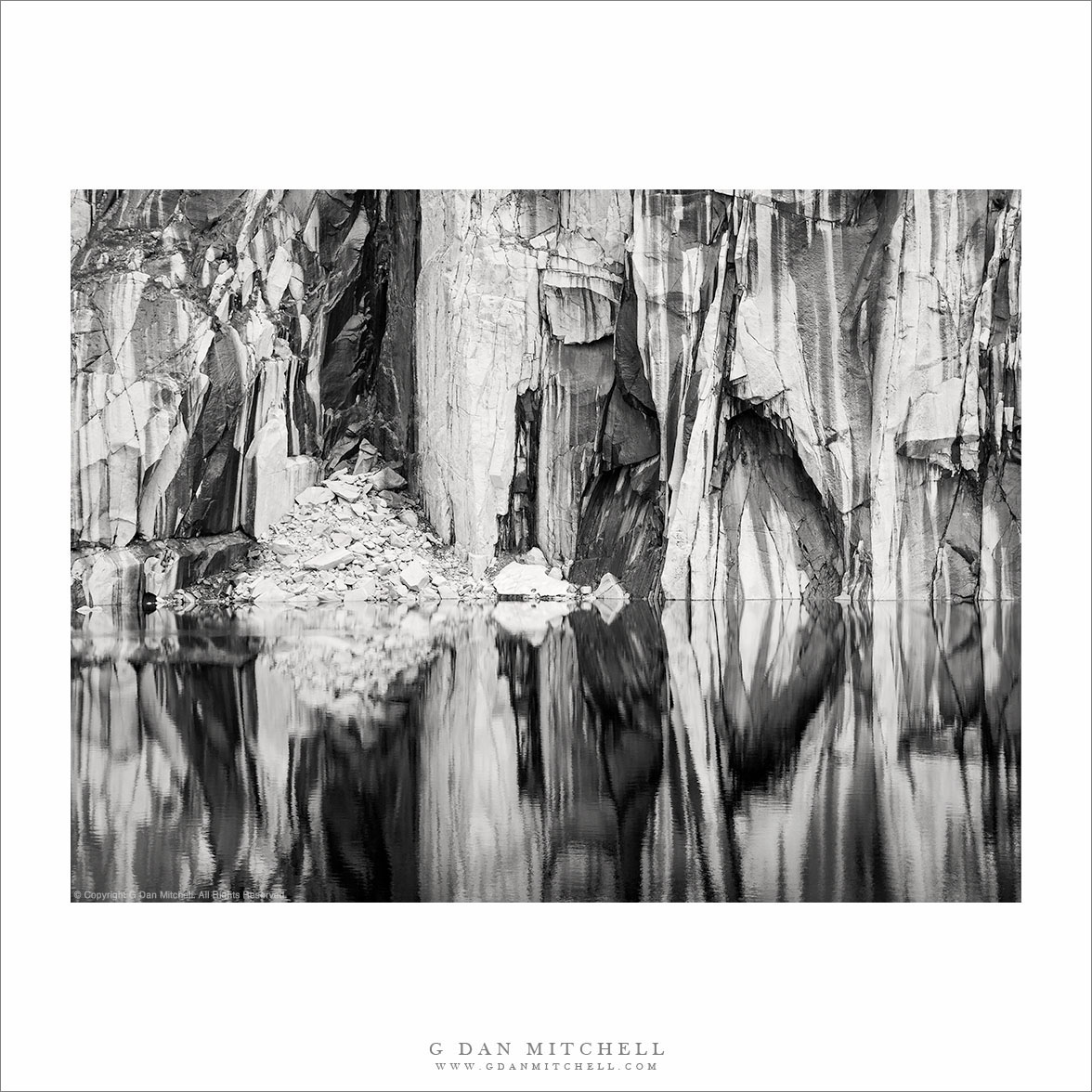
“Alpine Lake, Mirrored Reflection” — Cliff wall mirrored on the surface of a rockbound alpine lake in Sequoia National Park.
There’s a story and a lesson associated with this photograph. Explaining may take a bit more than the usual two paragraphs. (It takes five. I urge/invite you to click through and read the whole thing — and I’ll be interested in your comments.) I’ll start with the subject though. Years ago (I’ll reveal how many years below) I was on a trans-Sierra pack trip of over a week’s length with a group of backcountry friends. I had walked this route years before this trip, and there were a few places that I specifically wanted to photograph again, especially this lake. I stopped there long enough to make a few careful photographs, including one of my favorites. (That one also comes with a bit of a story and lesson.)
“Mud Patterns” — Colorful patterns formed in dry and cracked mud, Capitol Reef.
Recently I went through my archives to see just how many photographs of dried mud I have made over the years. It is a lot! There are perhaps a few dozen finished photographs of this subject that I have shared publicly. But there are scores of them sitting in my unprocessed raw file archives. This one, in fact, is one that I “discovered” during this search, and I’m now sharing it for the first time.
“Aeolian Bedforms” — Wind-caused ripples in desert sand dunes, Death Valley.
This is probably the classic notion of what a desert looks like — fields of wind-formed sand dunes stretching into the distance. In truth, such dunes typically cover only a very small fraction of the desert landscape. That’s certainly true in Death Valley National Park, where large, impressive dunes are only found in a handful of locations. We visited one of them on the final morning of our late February trip.
“Sand Patterns” — Patterns in sand dunes, Death Valley National Park.
Our main photographic targets during our late-February trip to Death Valley were Lake Manly and the impressive wildflower bloom, but we did schedule one morning visit to the sand dunes. We arrived well before sunrise when it was too dark to see our way into the dunes. Unfortunately, this was not to be a morning for grand dune photographs, since morning overcast blocked the sunlight. So instead we focused on small subjects — plants and flowers, the morning traces of the passage of wildlife, and textures of windblown sand.
I’ll break with the tradition of the these posts and write a bit about a technical photographic topic. A challenge of photographing the sand is that, unless you photograph straight down or find a suitably slanted bit of sand, depth of field can be a challenge. I sometimes employ a solution that surprisingly few photographers seem to use. I have a tilt/shift lens adapter for my landscape camera that lets me attach a medium format zoom lens and use the adapter’s movements to angle the pane of focus to match the surface of the dunes. That’s right — movements with a zoom lens!
Photographer and visual opportunist. Daily photos since 2005, plus articles, reviews, news, and ideas.
Manage Consent
To provide the best experiences, we use technologies like cookies to store and/or access device information. Consenting to these technologies will allow us to process data such as browsing behavior or unique IDs on this site. Not consenting or withdrawing consent, may adversely affect certain features and functions.
Functional
Always active
The technical storage or access is strictly necessary for the legitimate purpose of enabling the use of a specific service explicitly requested by the subscriber or user, or for the sole purpose of carrying out the transmission of a communication over an electronic communications network.
Preferences
The technical storage or access is necessary for the legitimate purpose of storing preferences that are not requested by the subscriber or user.
Statistics
The technical storage or access that is used exclusively for statistical purposes.The technical storage or access that is used exclusively for anonymous statistical purposes. Without a subpoena, voluntary compliance on the part of your Internet Service Provider, or additional records from a third party, information stored or retrieved for this purpose alone cannot usually be used to identify you.
Marketing
The technical storage or access is required to create user profiles to send advertising, or to track the user on a website or across several websites for similar marketing purposes.