“Imaginary Landscape — Fractal Veins” — An imaginary landscape based on a desert subject.
Recently I again became interested in idea of “imaginary landscapes.” I made a series of photographic images that are derived from elements of actual landscapes I have visited, but which are modified in various ways to alter their appearance. They retain some landscape-like qualities, but they do not correspond to real landscapes.
“Imaginary Floral Landscape” — An imaginary floral lenscape of receeding spring petals.
This feels like a floral version of my “imaginary landscape” photographs, in which I push the interpretation of the image significantly, to the point that I feel it is best to acknowledge what is going on. (To many photographers and flower-lovers it is obvious that this is not a “what I saw” photograph, but more a “what I imagined” photo.) The starting point was a photograph I made using a macro lens and shooting across the top of a group of flowers.
The boundary between real and imaginary in photographs is much less obvious that some observers may realize. If you know what you are looking at, it is not a secret that photographs are usually the photographers interpretation of the subject, not a simple reproduction. To be honest, this is more or less a feature of photographs — they cannot really be full, objective records of things, and some element of interpretation figures in virtually all photographs.
G Dan Mitchell is a California photographer and visual opportunist. His book, “California’s Fall Color: A Photographer’s Guide to Autumn in the Sierra” (Heyday Books) is available directly from him.
“Sand Dune Abstract” — Sand dune patterns in evening light, Death Valley.
I first photographed this specific subject in Death Valley well over a decade ago, and perhaps closer to two decades. I “discovered” it by accident while driving back from visiting an entirely different feature. I had stopped in this location to photograph other things, and as I scanned the landscape I noticed this section of almost pure sand dunes. I went here again this year at the end of February when the light on my intended subject died early, and I thought I might be able to work with the soft light in this spot.
Because I have photographed here for some time, I have watched — at times with some concern — as this location started to become another “icon” of Death Valley photography. One positive development of this, perhaps, is that the many photographs can look quite different, revealing how ambient light “paints” the landscape of the desert. (Well, OK, also revealing the role that post-production interpretation plays in such photographs.)
Leave a comment or question using the form. (If you are reading this on the home page, click the article title to see the full article and the comment form.
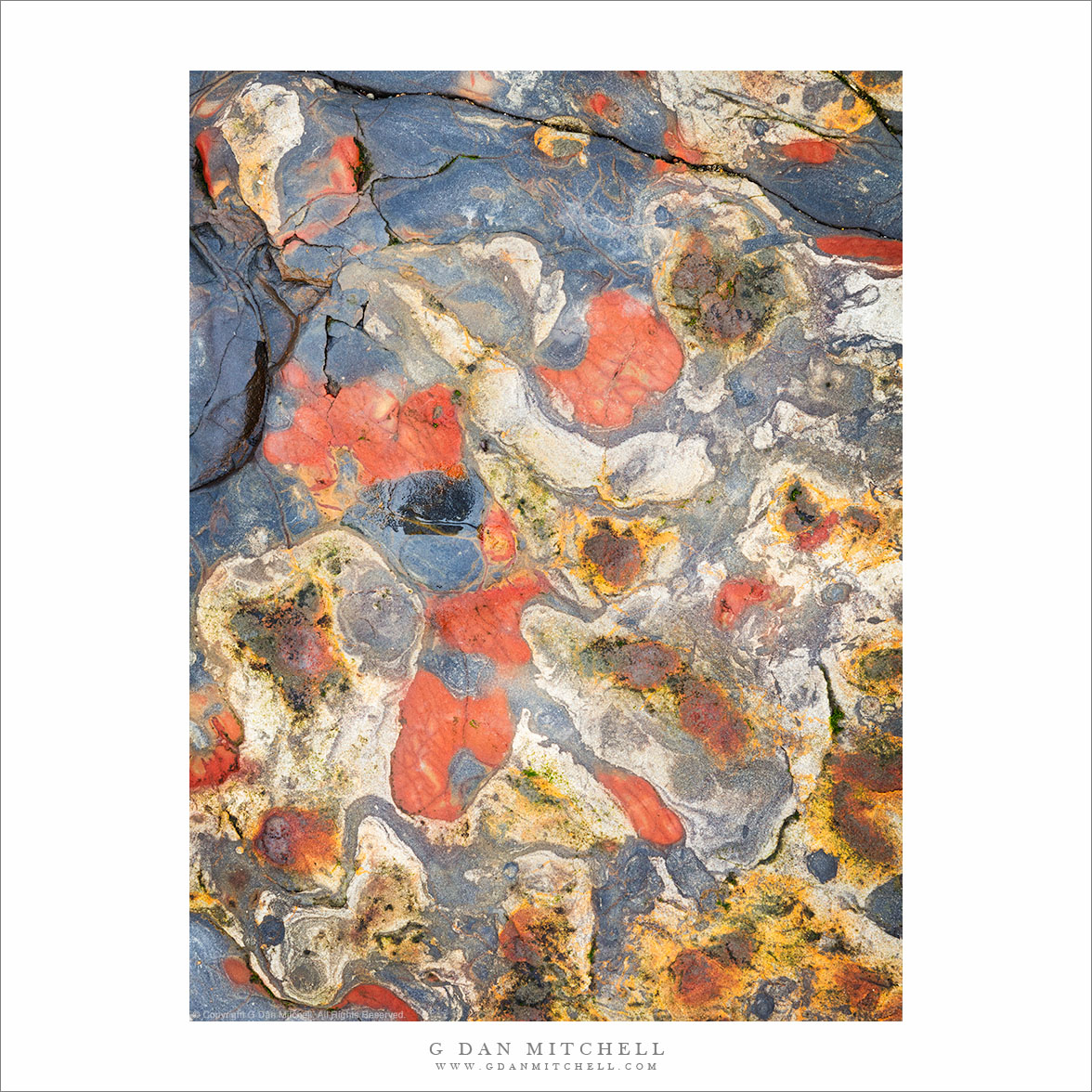
“Rock Abstraction” — An imaginary landscape of rock, Point Lobos coastline.
I feel that there is always a tension in landscape photography between showing things as they literally are, showing them as we might wish they were, and using them as departure points for more imaginative explorations of what they suggest to us. This photograph falls squarely into the latter category. As I looked at the remarkable patterns in these shoreline rocks, I thought about how I have seen similar patterns in paintings. So I decided to push reality a bit and head in the direction that those works suggested.
Once again, this photograph illustrates how I/we can find new things in old places. I made the photograph at a coastal spot that I have photographed since I was a young kid with a cheap black and white camera, imagining himself following in the footsteps of Adams and Weston — who also photographed exactly here. Decades later I still return and ind new things and new ways to see them.
G Dan Mitchell is a California photographer and visual opportunist. His book, “California’s Fall Color: A Photographer’s Guide to Autumn in the Sierra” is available from Heyday Books, Amazon, and directly from G Dan Mitchell.
Photographer and visual opportunist. Daily photos since 2005, plus articles, reviews, news, and ideas.
Manage Consent
To provide the best experiences, we use technologies like cookies to store and/or access device information. Consenting to these technologies will allow us to process data such as browsing behavior or unique IDs on this site. Not consenting or withdrawing consent, may adversely affect certain features and functions.
Functional
Always active
The technical storage or access is strictly necessary for the legitimate purpose of enabling the use of a specific service explicitly requested by the subscriber or user, or for the sole purpose of carrying out the transmission of a communication over an electronic communications network.
Preferences
The technical storage or access is necessary for the legitimate purpose of storing preferences that are not requested by the subscriber or user.
Statistics
The technical storage or access that is used exclusively for statistical purposes.The technical storage or access that is used exclusively for anonymous statistical purposes. Without a subpoena, voluntary compliance on the part of your Internet Service Provider, or additional records from a third party, information stored or retrieved for this purpose alone cannot usually be used to identify you.
Marketing
The technical storage or access is required to create user profiles to send advertising, or to track the user on a website or across several websites for similar marketing purposes.