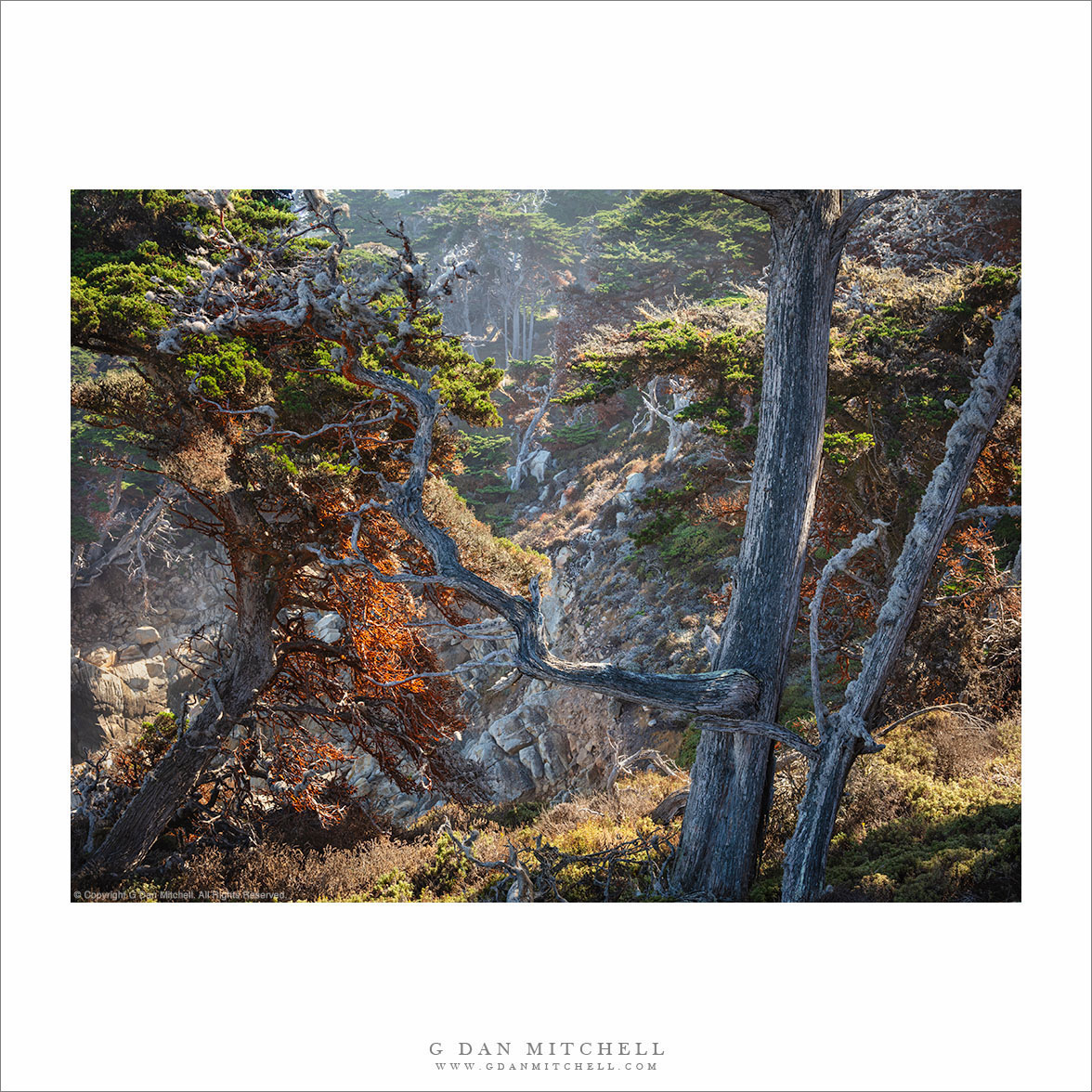
“Monterey Cypress Forest, Leaning Trees” — Monterey Cypress trees at the edge of a Point Lobos cliff on a foggy morning.
These trees grow along one of the most exposed coastal locations at Point Lobos State Reserve. Not far behind my camera position s the rugged end of a peninsula that juts out into the Pacific, exposed to waves and wind. In the other direction, beyond these trees, is a cliff that drops to a rocky, narrow bay that where surf constantly washes in and out.
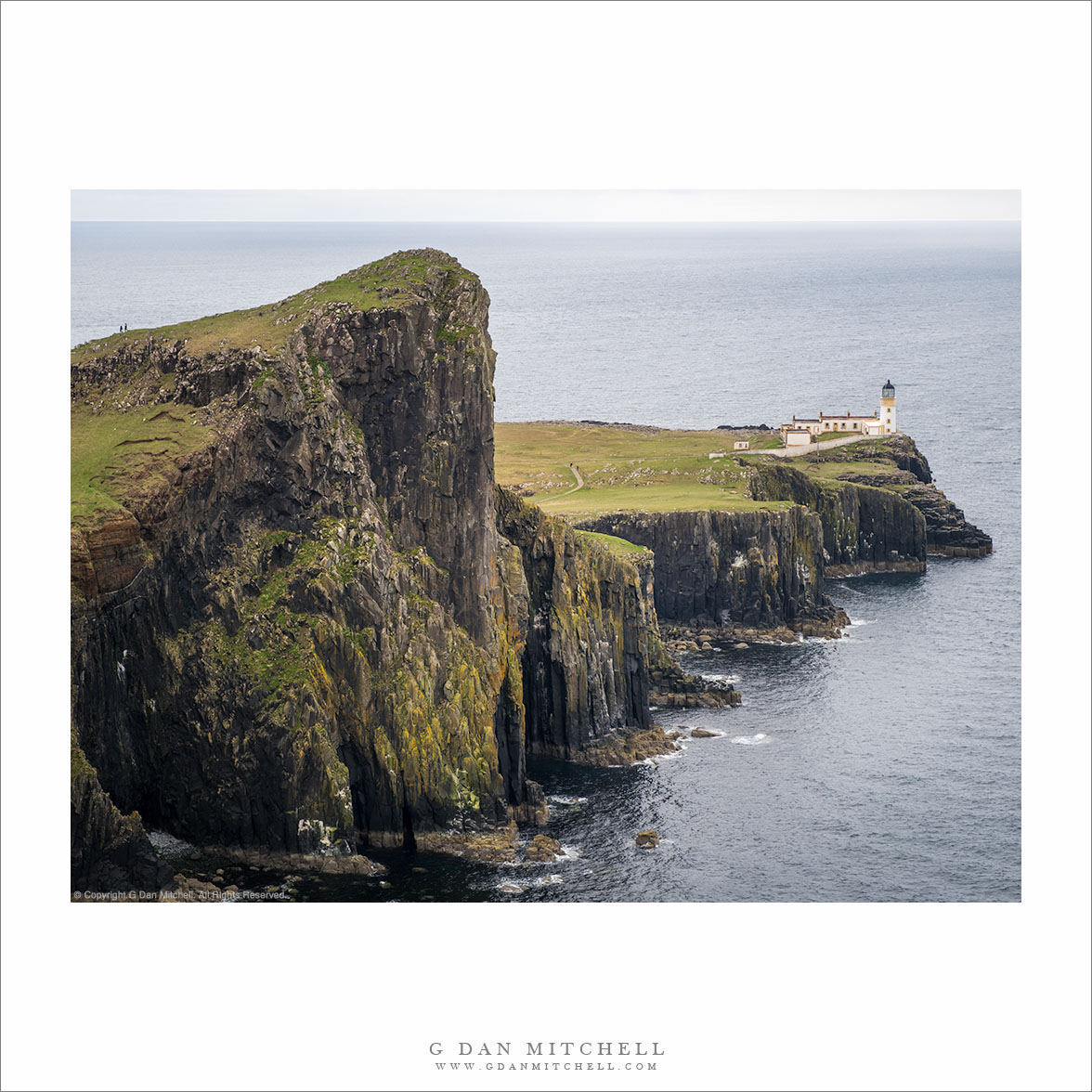
“Neist Point Lighthouse” — Neist Point and lighthouse, Isle of Skye
Our time on the Isle of Skye this past May combined visits to iconic locations. (I’m not against photographing icons that are new to me, or when conditions are extra special.) On this day we did a bit of both. Before we ended up here we had taken a long drive out to the tiny hamlet of Elgol. We returned, stopped for a quick dinner and then (the sun sets very late there in May) decided that Neist Point might be a reasonable objective.
“Panamint Valley” — View across Rainbow Canyon toward the flats of Panamint Valley.
Death Valley National Park is a huge landscape, in more ways that one. The park is huge. It is the largest park in the contiguous states. (Alaska, where everything is on a larger scale, has four larger parks.) Within the park we often are able to view huge distances — in fact, Death Valley’s visual scale reminds me of places I’ve seen in Alaska. Here we look down Rainbow Canyon and across the entire Panamint Valley (one valley west of Death Valley itself) toward more desert mountains.
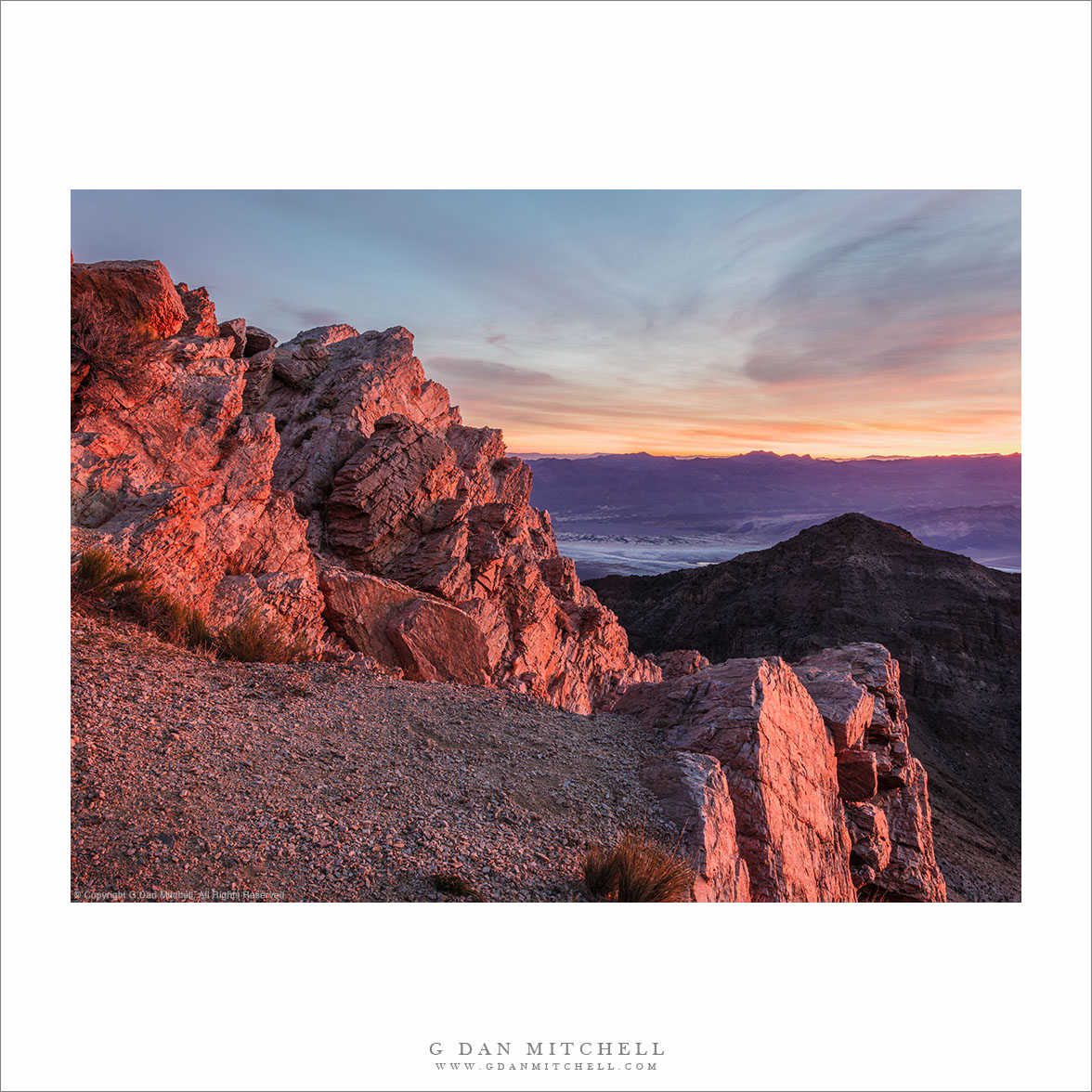
“Dawn Light” — Red dawn light on ridgetop boulders, Panamint Range.
I share this photograph as much for illustrative purposes as for its value as a photograph — it is, in part, a record of a remarkable light phenomenon that too many people never experience. Indeed, it can be difficult to rise hours before dawn, travel to a remote place in the darkness, and stand on a mountain ridge in the winter. But once you do it a few times and see what happens, you will likely be hooked.
We arrived at a high prominence in this desert mountain range in morning twilight. A band of intense red pre-dawn light glowed along the ridge of the mountains to our east, and the clouds began to pick up this color as we set up our camera gear. A moment later the first direct light from the rising sun struck these rocks, turning them blood red.
Photographer and visual opportunist. Daily photos since 2005, plus articles, reviews, news, and ideas.
Manage Consent
To provide the best experiences, we use technologies like cookies to store and/or access device information. Consenting to these technologies will allow us to process data such as browsing behavior or unique IDs on this site. Not consenting or withdrawing consent, may adversely affect certain features and functions.
Functional
Always active
The technical storage or access is strictly necessary for the legitimate purpose of enabling the use of a specific service explicitly requested by the subscriber or user, or for the sole purpose of carrying out the transmission of a communication over an electronic communications network.
Preferences
The technical storage or access is necessary for the legitimate purpose of storing preferences that are not requested by the subscriber or user.
Statistics
The technical storage or access that is used exclusively for statistical purposes.The technical storage or access that is used exclusively for anonymous statistical purposes. Without a subpoena, voluntary compliance on the part of your Internet Service Provider, or additional records from a third party, information stored or retrieved for this purpose alone cannot usually be used to identify you.
Marketing
The technical storage or access is required to create user profiles to send advertising, or to track the user on a website or across several websites for similar marketing purposes.