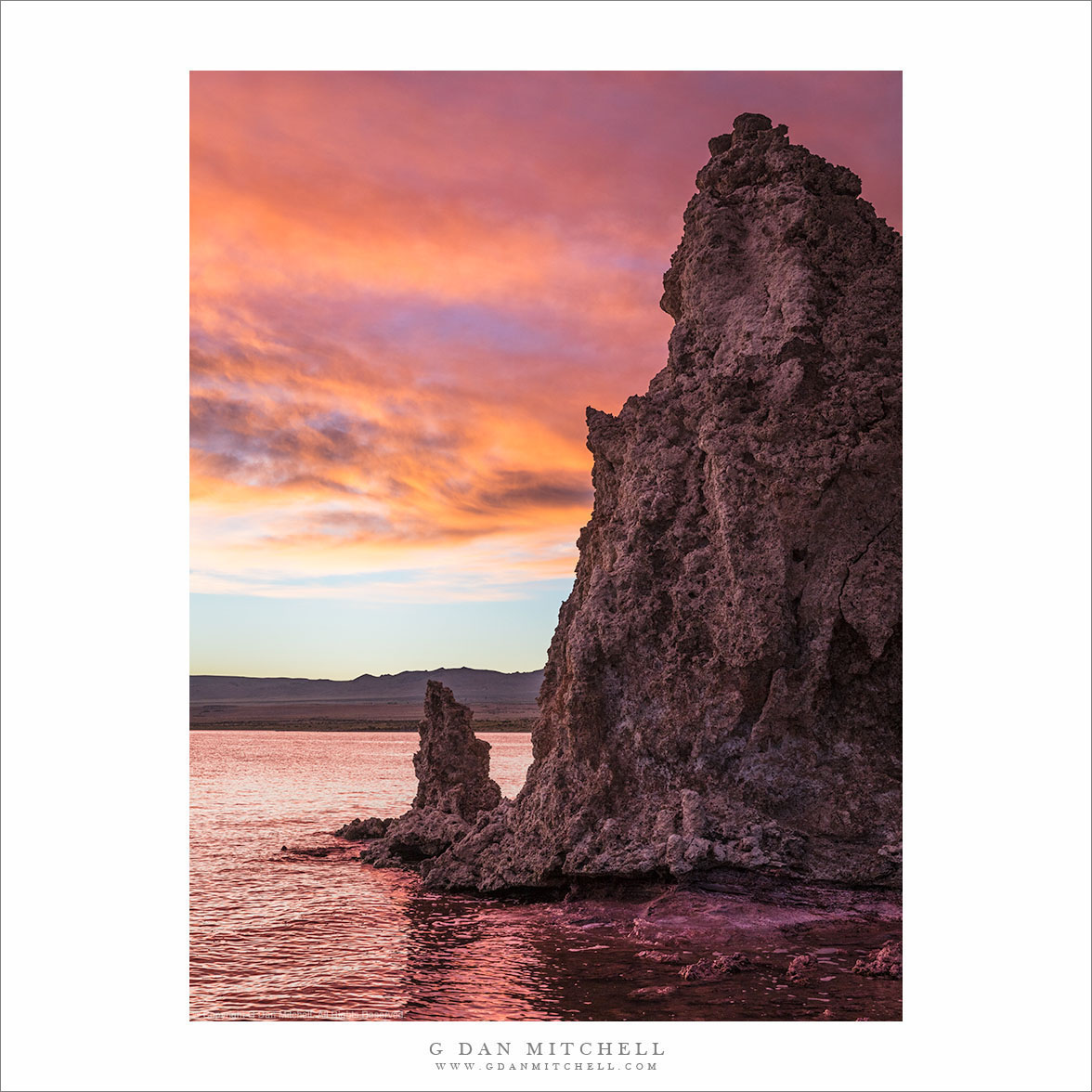
“Tufa at Dawn” — A shoreline tufa in light reflected by sunrise clouds above Mono Lake.
There is a lot to see and photographer during sunrise at Mono Lake. I was there again in late August, driving down from my Sierra campsite well before the first light. The entire process of sunrise offers photographic possibilities, from the first faint eastern light to the eventual direct sunlight on the landscape as early morning colors begin to fade. Over that entire period I worked quickly, moving from subject to subject as the light and conditions changed — focusing on everything from the sky and clouds to the tufa formations, the water, the face of the Sierra Nevada and even some birds.
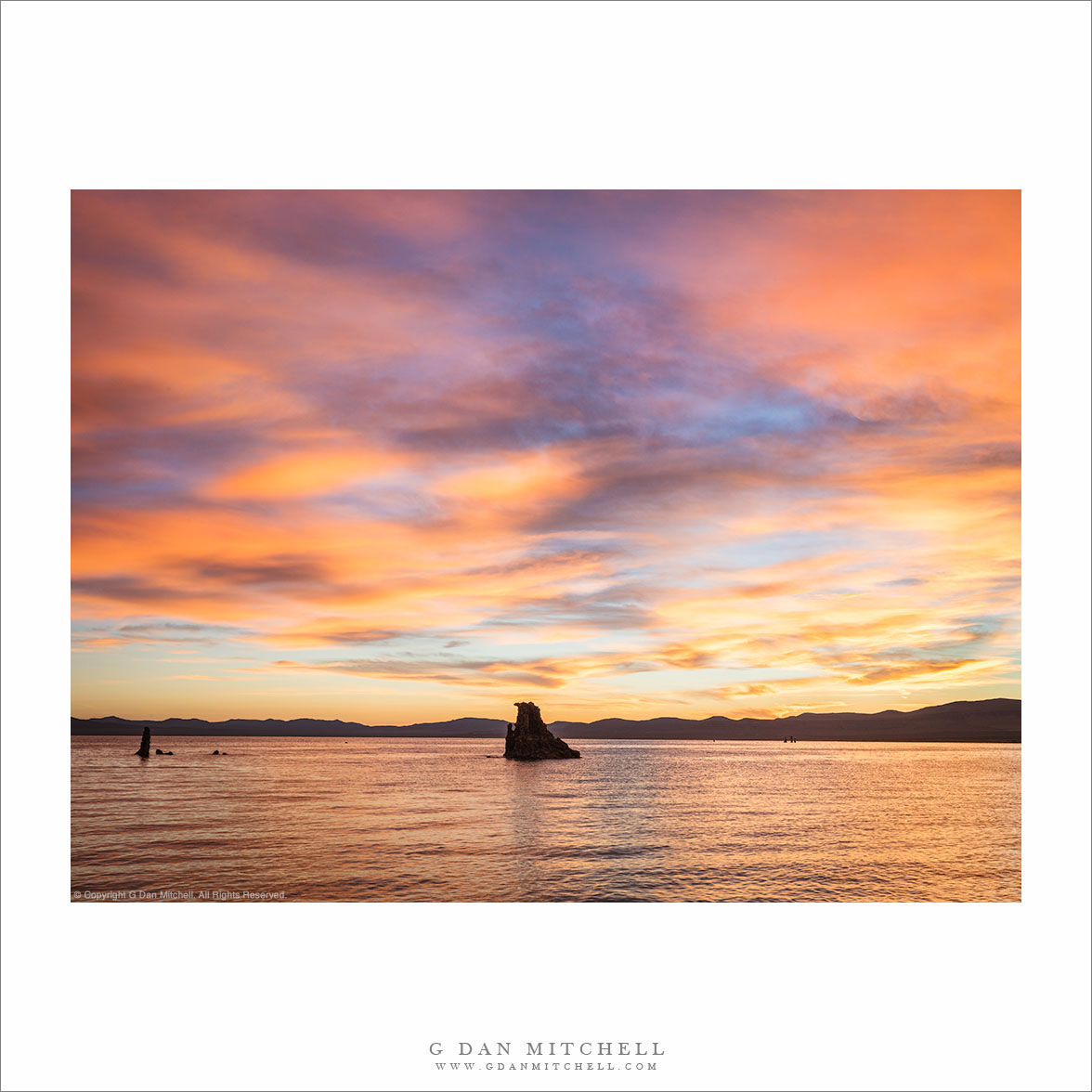
“Dawn, Mono Lake” — Mono Lake tufas under a colorful pre-sunrise sky.
In the right conditions, a Mono Lake sunrise can be spectacular. To some extent it is up to the clouds. Clouds produce the most colorful sunrises, of course, but if they are too thick or in the wrong place they can also “turn out the lights.” The ideal, I think, is for it to be clear on the eastern horizon, with scattered clouds closer to the lake. Almost anything goes in the west — some clouds there to catch the light can be good, but clear skies and the earth shadow or even dark and dramatic clouds can work.
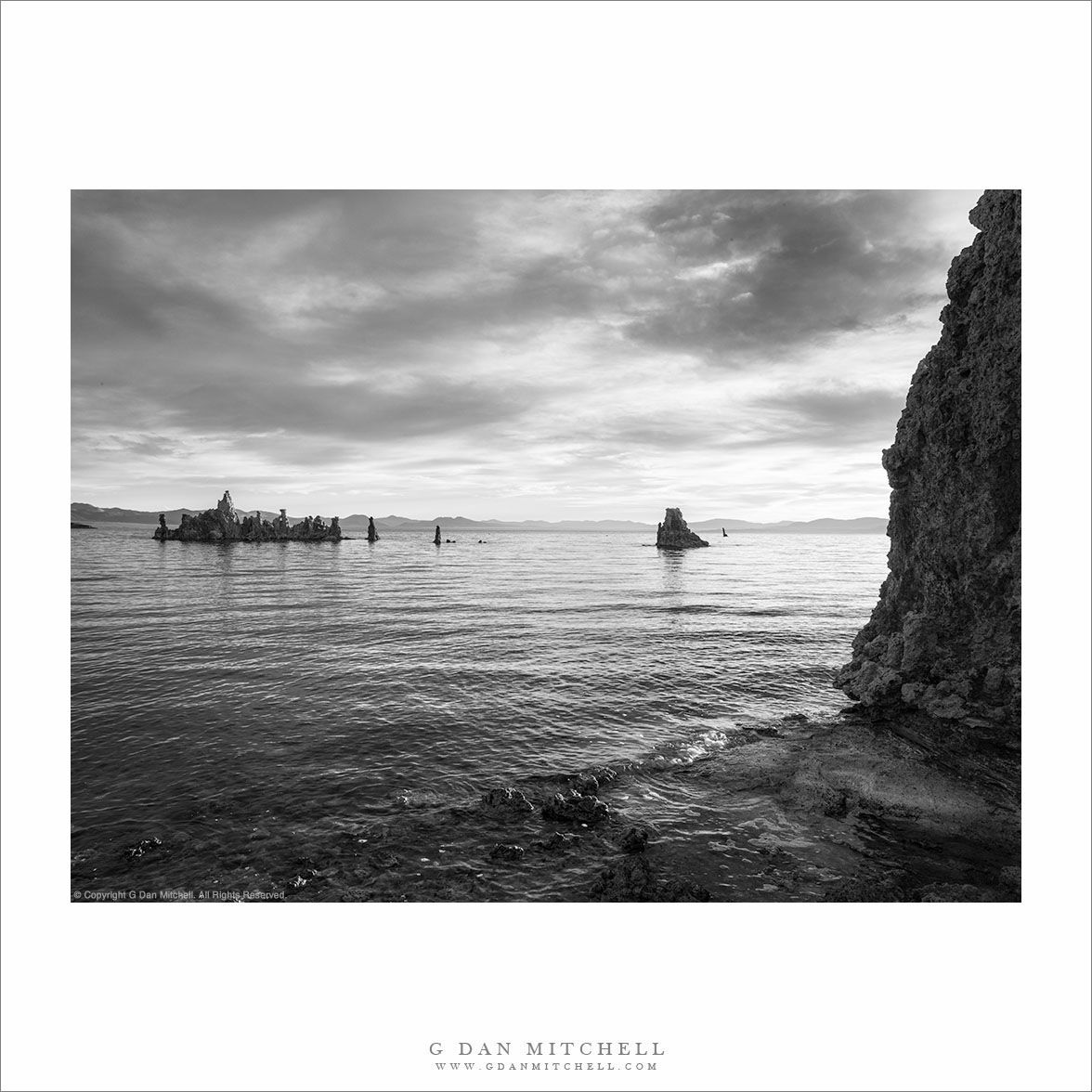
“Tufa, Dawn” — Mono Lake tufa formations under cloudy sunrise sky.
My most common way to approach Mono Lake photographically is to focus on the immense scale of the pace rather than on closer elements of the landscape. I like to set tufa towers against distant desert hills under the wide sky, or perhaps place them in front of the distant eastern face of the Sierra Nevada stretching away to the north. Initially I was doing something like that here, focusing on those offshore towers and using somewhat short focal lengths to take in the wider scene. But then I thought to include a bit of this near tower at the right side of the frame.
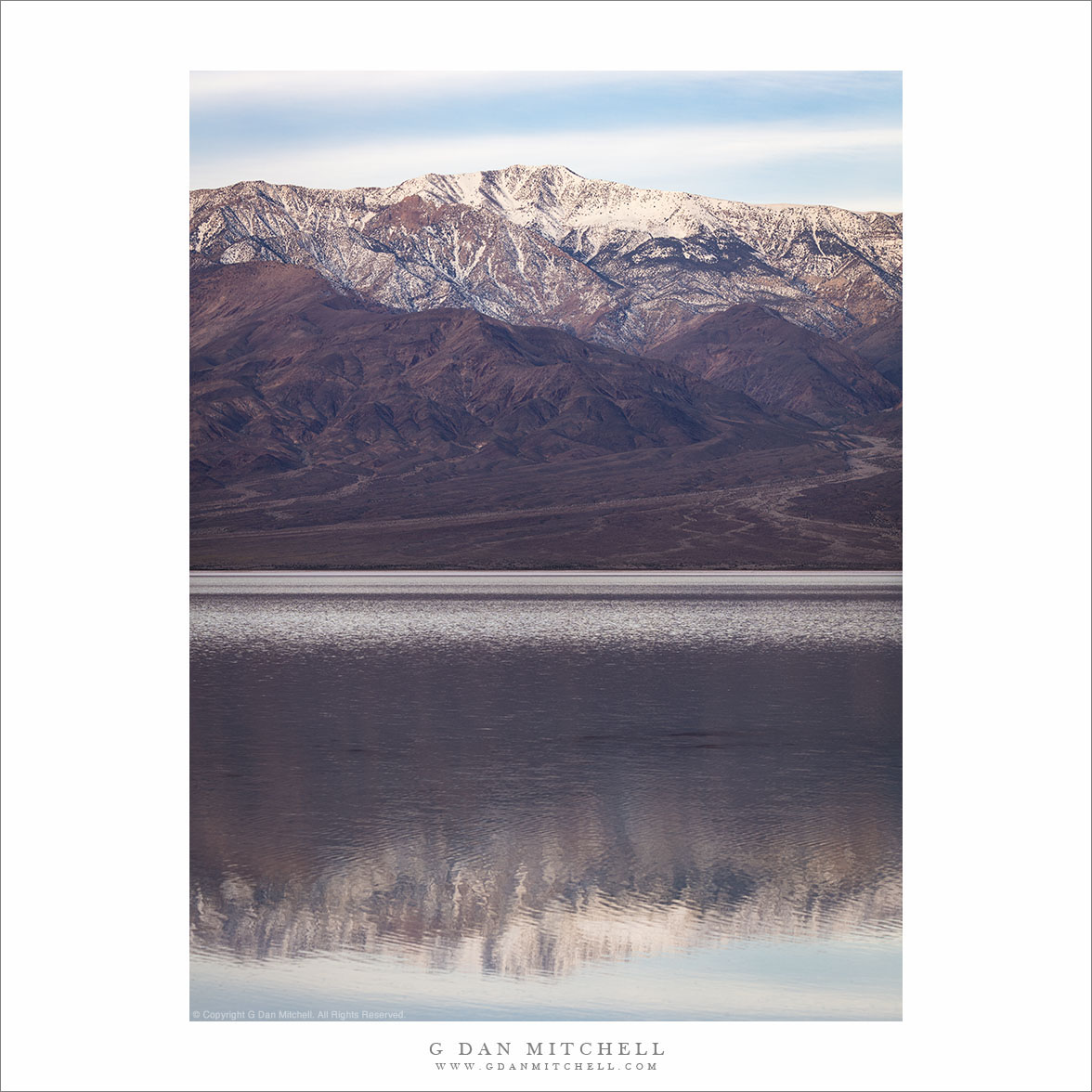
“Lake Manly and Telescope Peak, Dawn” — Dawn light on Telescope Peak above Hanaupah Canyon and the reflective waters of Lake Manly.
This photograph includes a short list of superlative features. Telescope Peak, at just over 11,000′, is the highest point in Death Valley National park. From the peak one can see the highest point in California, Mt. Whitney (in the Sierra Nevada) and the lowest point (Badwater Basin). In the photograph Badwater Basin is submerged beneath Lake Manly, which forms only in very wet years and generally evaporates quickly. Snow on Telescope Peak and the Panamint Range is not unusual in winter, but in this photograph it has reached a rather low elevation.
Photographer and visual opportunist. Daily photos since 2005, plus articles, reviews, news, and ideas.
Manage Consent
To provide the best experiences, we use technologies like cookies to store and/or access device information. Consenting to these technologies will allow us to process data such as browsing behavior or unique IDs on this site. Not consenting or withdrawing consent, may adversely affect certain features and functions.
Functional
Always active
The technical storage or access is strictly necessary for the legitimate purpose of enabling the use of a specific service explicitly requested by the subscriber or user, or for the sole purpose of carrying out the transmission of a communication over an electronic communications network.
Preferences
The technical storage or access is necessary for the legitimate purpose of storing preferences that are not requested by the subscriber or user.
Statistics
The technical storage or access that is used exclusively for statistical purposes.The technical storage or access that is used exclusively for anonymous statistical purposes. Without a subpoena, voluntary compliance on the part of your Internet Service Provider, or additional records from a third party, information stored or retrieved for this purpose alone cannot usually be used to identify you.
Marketing
The technical storage or access is required to create user profiles to send advertising, or to track the user on a website or across several websites for similar marketing purposes.