
Tag Archives: national

Monolith, Trees, Snowy Ledge

Monolith, Trees, Snowy Ledge
A band of resilient trees growing on a snow-covered ledge at the base of a granite monolith

Monolith, Trees, Snowy Ledge. Yosemite National Park, California. February 25, 2017. © Copyright 2017 G Dan Mitchell – all rights reserved.

A band of resilient trees growing on a snow-covered ledge at the base of a granite monolith

By the time this photograph appears at my website and on social media, the snow at the base of this famous monolith should be long gone — having melted, flowed down in rivulets to join the rushing Merced River, crossed into California’s Central Valley, perhaps reached the San Francisco Bay, and even made it out into the Pacific Ocean.

These trees, growing on a narrow ledge at the base of one of Yosemite’s most famous and visible granite faces, always draw my attention. Their location is impressive, but so is the fact that they have managed to grow relatively straight and tall while located in a world of rock, most of which came from (and continues to come from!) weathering of the giant monolith above. Winter snows highlight their dark forms more clearly.


G Dan Mitchell is a California photographer and visual opportunist. His book, “California’s Fall Color: A Photographer’s Guide to Autumn in the Sierra” is available from Heyday Books and Amazon.
Blog | About | Flickr | Twitter | FacebookGoogle+ | LinkedIn | Email


All media © Copyright G Dan Mitchell and others as indicated. Any use requires advance permission from G Dan Mitchell.
Panamint Valley and Mountains

Panamint Valley and Mountains
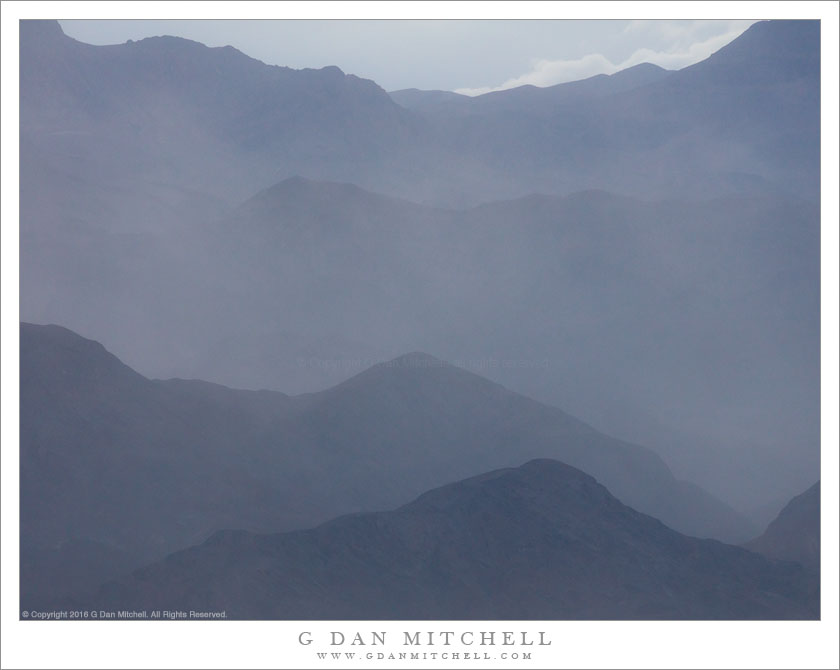
Looking into Panamint Valley and toward the Panamint Mountain Range

Panamint Valley and Mountains. Death Valley National Park, California. April 7, 2017. © Copyright 2017 G Dan Mitchell – all rights reserved.

Looking into Panamint Valley and toward the Panamint Mountain Range

When most people think of Death Valley they probably think of incredibly hot desert conditions. Those conditions are real, and are among the reasons that I do not visit the place during the warmer times of the year. But the conditions are quite a bit more varied than that reputation would suggest. I have been snowed on in Death Valley — on one memorable occasion photographic desert wildflowers in a snow storm! — and I have encountered temperatures ranging from over 100 degrees to below freezing. The variations are related to seasons (there are some very cold places here in the winter!) and to elevation, which ranges from below sea level to over 11,000′.

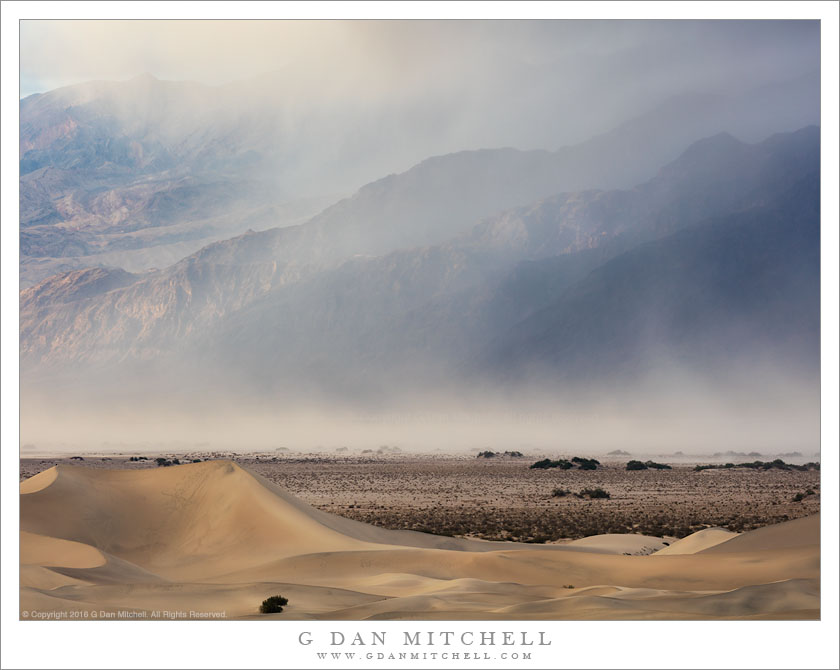
This photograph captures a range of those conditions in one image. It was a pleasantly warm, though cloudy, day as I left the park. The winds were howling down below in Panamint Valley, where a dust storm was beginning to kick up. Winter snow was still thick on the highest peaks of the Panamint range, and an incoming storm was developing and promising more precipitation.


G Dan Mitchell is a California photographer and visual opportunist. His book, “California’s Fall Color: A Photographer’s Guide to Autumn in the Sierra” is available from Heyday Books and Amazon.
Blog | About | Flickr | Twitter | FacebookGoogle+ | LinkedIn | Email


All media © Copyright G Dan Mitchell and others as indicated. Any use requires advance permission from G Dan Mitchell.
Finding Grand Staircase-Escalante

Two decades after agreements between Utah and federal government to protect this national monument for all Americans in perpetuity, Grand Staircase-Escalante National Monument is under threat from an administration that wants us to overlook its precious qualities and forget the hard-fought agreements (many of which benefit Utah) that let to its creation.


Some will tell you that places like Escalante-Grand Staircase National Monument are “empty” lands, and I can understand why a person might assume so — perhaps a first-time visitor or possibly a person who has never been there and is skeptical about what others say about the place.

I came to the red rock country rather late myself. I had decades in “my Sierra” under my belt, and it was hard to see how this Utah landscape could compare to the rocky heights,meadows, and forests I knew, especially since my only experience with Utah had come when I was very young and my family drove across the state past the Great Salt Lake on the way to someplace else.

Canyon Reflections
Canyon Reflections

But friends insisted, “You have to go to Utah!” Eventually I went, hitting the big national parks, justifiably famous for deep canyons, red rock pinnacles, domes, and more. I even passed through Grand Staircase-Escalante National Monument, driving through the town of Escalante — I don’t recall stopping — on my way to one of those other places, unaware of and uninterested in what might be in the “empty” place outside the town.

Dry Mud and Sand
Dry, cracked mud on top of red sand under reflected canyon light, Grand Staircase-Escalante National Monument

Although I missed many things, at least I knew that I wanted to come back to Southern Utah.

Not long afterwards, a photographer friend suggested we go there in the fall and explore some places that he and his friends know. He has photographed here for decades, so I welcomed the chance to learn about places off the beaten track. We started in one of those big national parks, but then we headed to Kanab, and from there we decided to explore a few less known locations.

Slot Canyon Tree - A box elder tree stands against the vertical sandstone walls of a Utah slot canyon
A box elder tree stands against the vertical sandstone walls of a Utah slot canyon

One morning we headed up a road into Grand Staircase-Escalante National Monument. There was the camaraderie of being on the road with friends, along with the expectation that I would “discover” interesting things. However, as we headed up this gravel track, I found the visual impact of the scene was, to be honest, less than stunning. It seemed like, dare I admit it, an “empty” landscape — dry, relatively flat, no rocky peaks, and on that day a boring sky.

Miles up the road we pulled out and parked along a short nondescript spur, dusty and surrounded by brush. (Stopping at nondescript places would eventually become something to look forward to in this country!) I couldn’t see a thing that suggested a photograph, but we loaded up and dropped down a hill to a small creek. This was to be, finally, my first real introduction to canyon country.

Striped Rock, Grass, and Sand

I’m in my element in the Sierra, where most everything is, by now, second nature. I was distinctly not in my element here, and almost everything was new. We followed the shallow stream, sometimes walking on soft and wet sand, at times crossing drier ground between meanders and passing beneath cottonwoods, and often just wading straight up the creek. Rock walls began to rise on either side of the creek, and before long we were in a fairly narrow canyon. In places brush grew from cracks in the red rock, lit by reflected light bouncing down the canyon walls from above. The gentle sound of the creek was a constant accompaniment. I began to notice small things — some reflecting mud, a riffle reflecting light from canyon walls and sky, a few leaves lying on red rock, grass bent by passing water, reddish sand, rock strata offset by a crack, the texture of wet sand — and each one warranted a pause to photograph.

Not all places worth protecting qualify on the basis of monumental, stupendous features. Saving those is easy, since anyone can see they are spectacular. (OK, almost anyone.) But just because a landscape like that of Grand Staircase-Escalante reveals itself gradually and more quietly and over a longer period of time, it and the “empty space” it occupies are no less precious. In fact, because this beauty is more fragile and less obvious, I would argue that it may be even more precious.


G Dan Mitchell is a California photographer and visual opportunist. His book, “California’s Fall Color: A Photographer’s Guide to Autumn in the Sierra” is available from Heyday Books and Amazon.
Blog | About | Flickr | Twitter | FacebookGoogle+ | LinkedIn | Email


All media © Copyright G Dan Mitchell and others as indicated. Any use requires advance permission from G Dan Mitchell.
Evening Shadows, Death Valley

Evening Shadows, Death Valley
The evening view down Trail Canyon, across Death Valley, and to the Black Mountains

Evening Shadows, Death Valley. Death Valley National Park, California. April 3, 2017. © Copyright 2017 G Dan Mitchell – all rights reserved.

The evening view down Trail Canyon, across Death Valley, and to the Black Mountains

The first day of any trip to Death Valley is often a long one for me. Typically it begins with a very early departure from the San Francisco Bay Area for the long drive down the Central Valley, east over Tehachapi Pass and then back to the north to reach the park. This year’s journey to the park was even longer since I took a first-day detour and briefly joined friends on the Carrizo Plain for an evening and a morning of wildflower photography. But the time I was on the road the second day it was mid-morning, and I arrived in Death Valley in the mid-afternoon to find winds and dust kicking up in the Valley. Not looking forward to camping in those conditions, I reconsidered and headed up to Wild Rose Canyon, where the mountains can provide some shelter.

I got there and found plenty of campsites. I grabbed one and just sat around for a while, recuperating from too much time behind the wheel. However, I knew that I wanted to do some photography on this first evening, so I worked up the energy to rise from my camp chair and head out to a favorite spot along the ridge of the Panamint Range. Often my Death Valley visits combine return visits to places I know well and want to continue to explore photographically with visits to places I haven’t been before. This spot is a very familiar one by now, and it seemed like and almost sure bet for this first evening. It was hazy — remember the wind and dust I just mentioned? — but as the color of the light warmed near the end of the day the landscape’s features became a bit more visible. This photograph looks across Trail Canyon in the foreground, with the late-day shadows already concealing the features of the ridge, toward the main portion of Death Valley, with its large salt flats. Beyond lie the Black Mountains and the southern boundary of the park, with further mountains just barely visible through the distant haze.


G Dan Mitchell is a California photographer and visual opportunist. His book, “California’s Fall Color: A Photographer’s Guide to Autumn in the Sierra” is available from Heyday Books and Amazon.
Blog | About | Flickr | Twitter | FacebookGoogle+ | LinkedIn | Email


All media © Copyright G Dan Mitchell and others as indicated. Any use requires advance permission from G Dan Mitchell.