
Tag Archives: photography

Ship Yard Crane, Night Sky

Ship Yard Crane, Night Sky

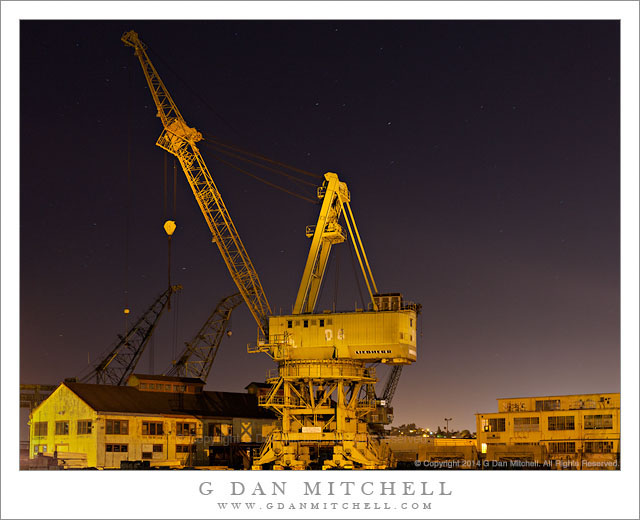
Ship Yard Crane, Night Sky. Mare Island Naval Ship Yard, Vallejo, California. April 5, 2014. © Copyright 2014 G Dan Mitchell – all rights reserved.

A gigantic ship yard crane extends high into the night sky, Mare Island Naval Ship Yard, Vallejo, California

For many of us, these gigantic cranes, towering above the historic ship yard buildings and docks, are the iconic structures of the Mare Island Naval Ship Yard near Vallejo, California. The facility has been here since the 1800s, when it was the first naval ship yard on the west coast of the United States, and its history is quite remarkable. I won’t even begin to try to recount it here since a) it is so extensive and b) I’m far from an expert! In the 1990s it was decommissioned and since that time parts of the facility have fallen into ruin, others have been maintained in more or less their condition at that time, and some have been converted to other uses ranging from industrial to housing.

I have photographed here at night for about a decade. It used to be that these towering structures were mostly just parked in somewhat inaccessible locations behind fences along the waterfront. (The folks I photograph with here have a policy of not going into areas that are off-limits, and this had led to generally very good relations with the folks who oversee the place.) More recently the dry dock facility has been put back to use to dismantle very old ships from the “mothball fleet” that had been moored nearby, and now when I visit I often find the cranes have moved and may even be in more accessible locations. The first thing that struck me on this night’s visit was the effect of the security lights playing over the structure—and the fact that the lights are still the older and very colorful lights rather than the newer, more energy-efficient, and very boring LED lighting!

G Dan Mitchell is a California photographer and visual opportunist whose subjects include the Pacific coast, redwood forests, central California oak/grasslands, the Sierra Nevada, California deserts, urban landscapes, night photography, and more.
Blog | About | Flickr | Twitter | FacebookGoogle+ | 500px.com | LinkedIn | Email

Text, photographs, and other media are © Copyright G Dan Mitchell (or others when indicated) and are not in the public domain and may not be used on websites, blogs, or in other media without advance permission from G Dan Mitchell.
Wall, After Rain, Night

Wall, After Rain, Night

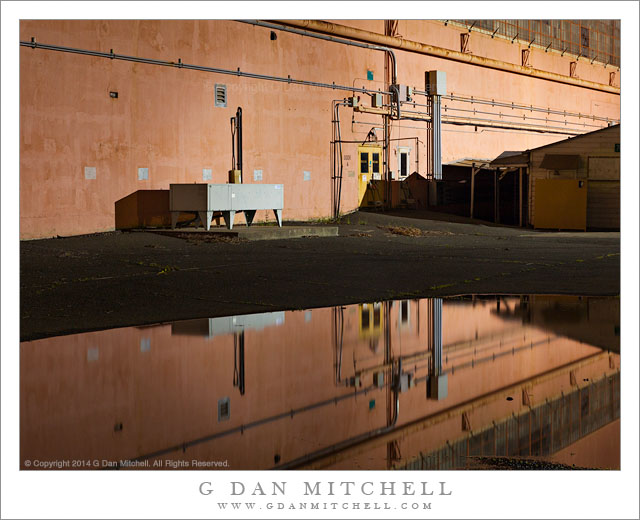
Wall, After Rain, Night. Mare Island Naval Ship Yard, Vallejo, California. April 5, 2014. Copyright 2014 G Dan Mitchell – all rights reserved.

Night photograph of the walls of an industrial building reflected in a pool of rainwater, Mare Island Naval Ship Yard

Recently I returned to the Mare Island Naval Ship Yard with my friends from The Nocturnes, a group of folks who focus on night photography. The Nocturnes have been photographing there for many years and the group forms a core of San Francisco Bay Area night photographers. Mare Island has become something of a mecca for night photography in the area, to the point that you can often find photographers shooting there in the dark and so that certain images from the location have achieved an almost iconic status. I first photographed there about a decade ago, and I’ve gone back at least a couple of times each year, to the point that I now have quite a few images of the place.

Having shot there so much, the way I approach the subject has evolved. At first, like anyone else getting to know the place, I focused on the well-known shipbuilding machinery—steel towers and cranes, dry docks, and so forth. Eventually, I began to look for other subjects, and I also began to understand the patterns of the place. Shooting on a full moon night is one thing, while shooting on a completely dark night another. Clear skies bring different opportunities than clouds. (I’m still waiting for a foggy night there!) More recently there have been changes to the area lighting on the island. The lighting is part of what has made photography there so interesting. It includes a wild range of sources—sodium vapor, mercury, fluorescent, tungsten, moonlight, and more—and sometimes turns otherwise bland structures into brilliantly colorful subjects. (Or at least it did. Now the older, colorful lighting is gradually being replaced with sun-white LED lights!) The weather is a major player, and it had rained the week beforehand. Because of this I was on the lookout for puddles and pools that might reflect the images of Mare Island structures, and here I found a very large puddle right in front of the wall of this large building.

G Dan Mitchell is a California photographer and visual opportunist whose subjects include the Pacific coast, redwood forests, central California oak/grasslands, the Sierra Nevada, California deserts, urban landscapes, night photography, and more.
Blog | About | Flickr | Twitter | FacebookGoogle+ | 500px.com | LinkedIn | Email

Text, photographs, and other media are © Copyright G Dan Mitchell (or others when indicated) and are not in the public domain and may not be used on websites, blogs, or in other media without advance permission from G Dan Mitchell.

Stairs and Green Windows, Night

Stairs and Green Windows, Night

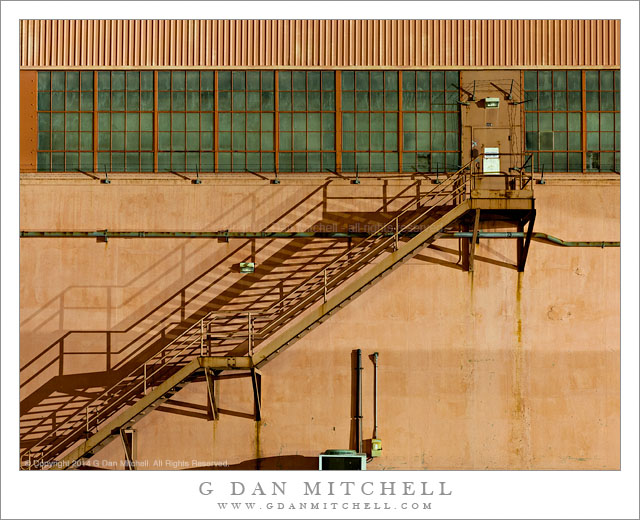
Stairs and Green Windows, Night. Mare Island Naval Ship Yard, Vallejo, California. April 5, 2014. © Copyright 2014 G Dan Mitchell – all rights reserved.

An industrial building with green windows and a shadow-casting staircase, Mare Island Naval Ship Yard

The lighting is part of what has made photography there so interesting. It includes a wild range of sources—sodium vapor, mercury, fluorescent, tungsten, moonlight, and more—and sometimes turns otherwise bland structures into brilliantly colorful subjects. More recently there have been changes to the area lighting on the island. Now the older, colorful lighting is gradually being replaced with sun-white LED lights!) While I have to agree with the goal of increased energy efficiency, many of us mourn the loss of those old, colorful light sources. The LEDs can produce light that looks almost like daylight in some situations!

The first thing that brought me to the general area of this photograph was a pool of bright light in front of it that I saw coming from a very bright light across the roadway. As I approached I saw the interesting old external staircase, a subject that I often find interesting at Mare Island, and the complex pattern of shadows cast by the lights. I’m also a fan of the many large banks of windows in the buildings on the island. I’ve always assumed that the construction must have included so much glass so as to provide better interior light for these very large shop buildings. These windows are somewhat opaque, perhaps at least partially from age, and the lighter objects inside are only seen faintly through the glass.

G Dan Mitchell is a California photographer and visual opportunist whose subjects include the Pacific coast, redwood forests, central California oak/grasslands, the Sierra Nevada, California deserts, urban landscapes, night photography, and more.
Blog | About | Flickr | Twitter | FacebookGoogle+ | 500px.com | LinkedIn | Email

Text, photographs, and other media are © Copyright G Dan Mitchell (or others when indicated) and are not in the public domain and may not be used on websites, blogs, or in other media without advance permission from G Dan Mitchell.

Photographic Myths and Platitudes: No Post-Processing!

(The following is another (more or less stream of consciousness) post that I wrote in reply to a comment I read somewhere else, in this case suggesting that photographic history implies that post-processing or manipulating photographs after the shutter has been clicked is ethically questionable and should be avoided. I’ll start with a modified version of the message I saw.)

…it is invalid to claim that Adams was a modern photoshoppe[r]… 

I… recommend to every beginner to do film… to develop a better feeling for composition… The most difficult in digital is to restrict yourself to [taking] a limited number of photos… in the beginning…

…I want to leave my photos as natural looking as possible…

This is an important conversation, for the beginner and for people who have been making photographs for a long time.

When people make pronouncements about how photography is supposed to be done or has been done based on notions about what great photographers do or have done, it is important to check those notions against reality. In photography there is a frequent mantra about “no post processing” and “get it right in camera” that has been, in my view, perverted to suggest that photographs are created in certain ways that do not correspond to reality – and worse, that other photographers should adhere to these false “rules.” It obviously is important to develop an eye for composition and an ability to operate a camera, but that is most certainly not the end of it, nor is there much of any evidence to indicate that great photographers have felt that photography is limited to what happens in the camera.

Did Adams ever make a “bad” negative look good in post? That depends on what you think of as bad. I’m can’t think of photographs that were poorly composed and where post-processing compensated for this. (However, there are some negatives that were damaged in the fire at the Yosemite studio very early on, and in which the composition is affected by this. I’m pretty certain that “Monolith” was burned along its top edge, which is partly responsible for the crop with which we are familiar today.)

Adams did, by the reports that I have heard first hand from people who knew him, make a good number of banal and boring exposures. In fact, like photographers today, he made far, far more uninteresting and forgettable photographs than great ones. His famous statement about a dozen successful photographs in a year being a good crop is a partial acknowledgment of this truth about photography.

Some of Adams’ most famous, most successful, and most universally admired photographs would have been forgettable without extensive work in post. It still surprises me how many photographers don’t know this and, in fact, believe that the opposite is the case. A number of other photographers who knew and worked with him regularly point this out in their presentation on Adams. One of their favorite and most compelling examples is the iconic “Clearing Winter Storm” photograph of Yosemite Valley. There are three powerful pieces of evidence in this case: the straight prints of the negative (which has been printed by others), Adams’ own shorthand instructions for his extensive dodging and burning of the image when producing prints, and the profoundly different appearance of the print we all know, in which clouds that were almost uniformly near white become a dramatic mixture of very contrasting tones. Further, Adams made a number of exposures of this exact composition – most of which are not as spectacular – but he selected one from which to create the brilliant print in post that became so famous. Continue reading Photographic Myths and Platitudes: No Post-Processing!