Rajan emailed to say that he is heading to Death Valley soon to do some photography, including some at the Racetrack, and to ask a question about shooting at iconic Zabriskie Point:
“… if I wanted to get the details of the folds at Zabriskie point, would the 300mm f/4 work or would it be too close? If not, would the 70-200mm f/2.8 offer a better zoom out?”
I thought I’d share my response here so that others who might be interested can see the answer as well.
Zabriskie Points is, indeed, an icon. It has been photographed a few gazillion times. But if you are going to Death Valley for the first time, I would be the last person to tell you not to shoot there. Zabriskie Point is iconic for good reason, and being there between the pre-dawn first light and an hour or so after sunrise is an experience not to be missed – especially on a morning when sunrise light comes in beneath clouds and there is still snow on the summits of the Panamint Range across the Valley.
Even though I’ve photographed there a number of times, I still return. But my approach to this subject has changed, mainly in that I spend little or no time shooting the familiar Manley Beacon view. Instead, I like to use a long lens and watch carefully for interesting patterns, textures, and forms in the nearby eroded folds as the light continuously changes as the day begins. The half dozen or so photographs of the Zabriskie area from my most recent trip that please me the most focus on details of these formations. And this plays right into Rajan’s question.
I shoot a full frame DSLR, and almost all of the recent photographs were made with a 70-200mm zoom, most often shot at or near the longest focal length. For these sorts of shots I could have made use of a slightly longer lens – perhaps the 300mm prime or possibly my 100-400mm zoom. If I had a 200mm prime I could have done quite a bit of interesting work with that as well.
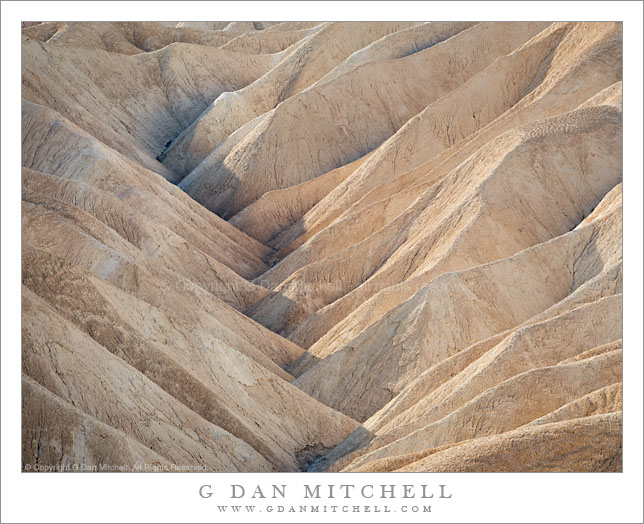
Gully, Morning Light, Zabriskie Point. Death Valley National Park, California. April 3, 2009. © Copyright G Dan Mitchell – all rights reserved.
With that in mind, if you shoot a cropped sensor camera and are thinking about photographs somewhat like mine (check my posts from the past couple of weeks for some examples) the 70-200mm zoom should work quite nicely. While the 300mm could be useful, if I were shooting a cropped sensor body I don’t think I would need it, given the smaller angle of view from these cameras at a given focal length.
I’ll offer a few other suggestions:
- Arrive quite early. I usually arrive well before dawn when it is still rather dark. I want plenty of time to get myself into position and to get my gear set up and ready. If you get there when the light is good you will have already missed some great opportunities.
- Don’t focus exclusively on the very impressive show in front of you, but also scan to your left and right and even behind you.
- Plan your shooting relative to the progression of the light from the rising sun across the scene. The first dawn light will strike the peaks of the Panamints and then spread across most of the range. Then it starts to work its way across the Valley while the nearby formations remain in shadow. Next the light will begin to hit the nearby ridges to your right and then Manley Beacon. (In my view, the best light on Manley Beacon lasts a very short time, so if you plan to photograph it be ready. Eventually the light will begin to do its magic on the folded, curved eroded formations below Zabriskie – and this stage lasts the longest of all and, I think, provides the greatest variety of subjects.
- During this last part of “the show” I like to shoot the details of the folds with a longer lens. While you’ll naturally be focusing your attention in the direction of Death Valley, start paying a lot of attention to what is happening to your left – the tops of the curved ridges start to pick up some very wonderful light.
- Don’t leave too soon. Long after many of the dawn photographers have left – no doubt heading back to Furnace Creek for a nice breakfast and coffee – interesting stuff continues to happen on the eroded folds and gullies. Brighter light reflects back into shaded gullies, better light penetrates down into the lower sections of the washes, tops of folds catch angling light, and so forth.
Good luck with your trip, Rajan!