
Category Archives: Photographs: Wildlife

Bubble-Feeding Humpback Whales

Bubble-Feeding Humpback Whales
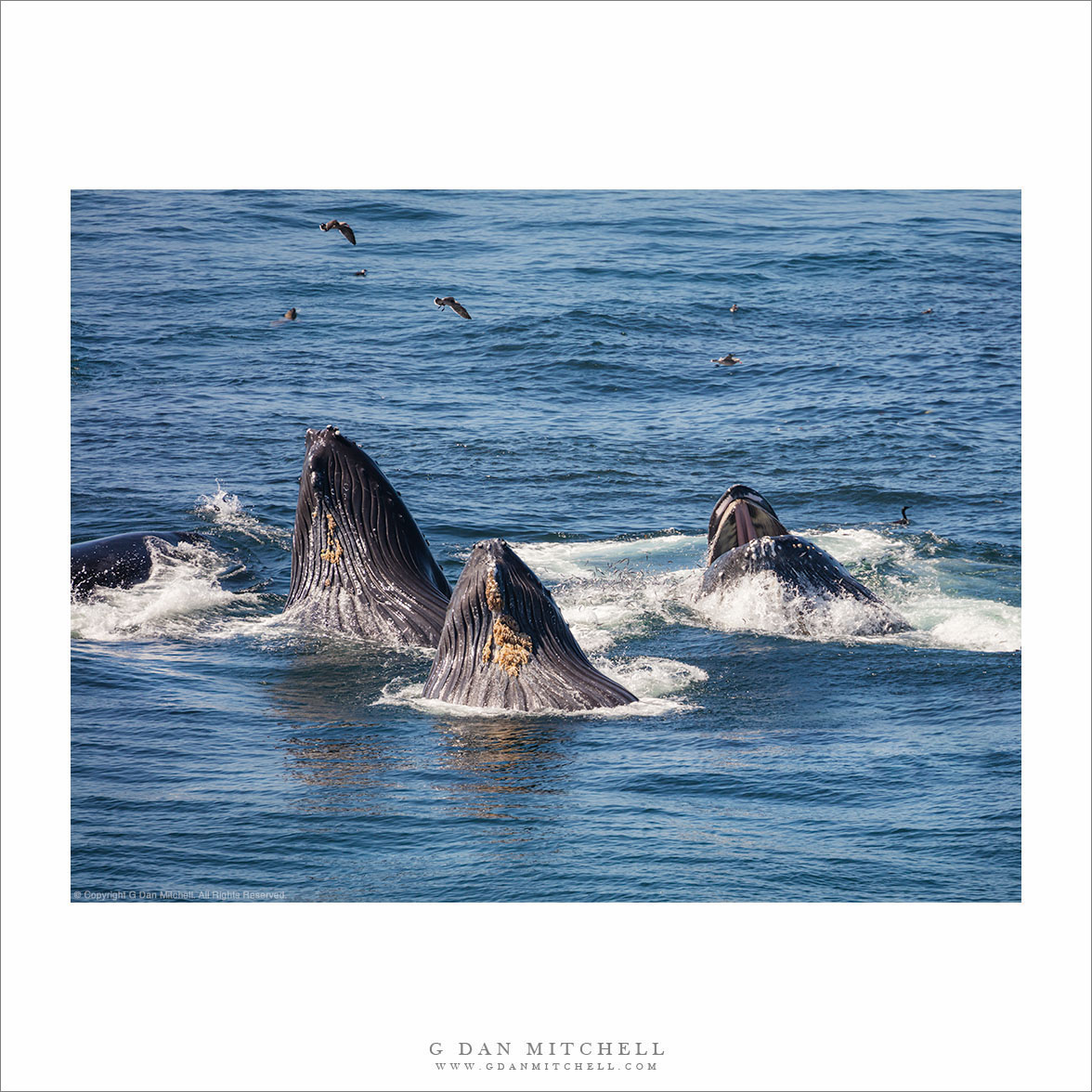
“Bubble-Feeding Humpback Whales” — Bubble-feeding humpback whales break the surface at Point Lobos State Reserve, California

I had the morning free, so I got up early and did the counter-commute drive down to Point Lobos, where whales had been spotted very close to these shoreline during the past week or so. I soon spotted huge groups of sea birds feeding above slightly turbulent water, a reliable indicator of where whales may appear. I headed to a high bluff with a panoramic view and almost immediately spotted whales. As the fish (anchovies?) moved closer to the shore, the birds followed, and soon whales (and dolphins and seal lions) also appeared.

I’m far from an expert on marine mammals, but I’m learning! This past year or so has provided some wonderful opportunities. I have long known about gray whale migrations in the area, but I learned that while the grays tend to move past on their way to places north or south, the humpback whales follow the food and will hang out in one area when there is food available.. as it currently is. I also learned about their remarkable group “bubble-feeding” behavior, where they team up and use remarkable strategies to corral fish. Some of them will apparently surround a school of fish. Then another whale goes beneath the school and emits a tremendously loud sound that sends the fish upwards. Meanwhile, another whale circles and blows bubbles into the water. The climax comes when the whole group may suddenly burst vertically through the surface of the water, full “throats” and mouths extended and full of water and fish.


G Dan Mitchell is a California photographer and visual opportunist. His book, “California’s Fall Color: A Photographer’s Guide to Autumn in the Sierra” (Heyday Books) is available directly from him.

G Dan Mitchell: Blog | Bluesky | Mastodon | Substack Notes | Flickr | Email


All media © Copyright G Dan Mitchell and others as indicated. Any use requires advance permission from G Dan Mitchell.
Sleeping Elephant Seal

Sleeping Elephant Seal
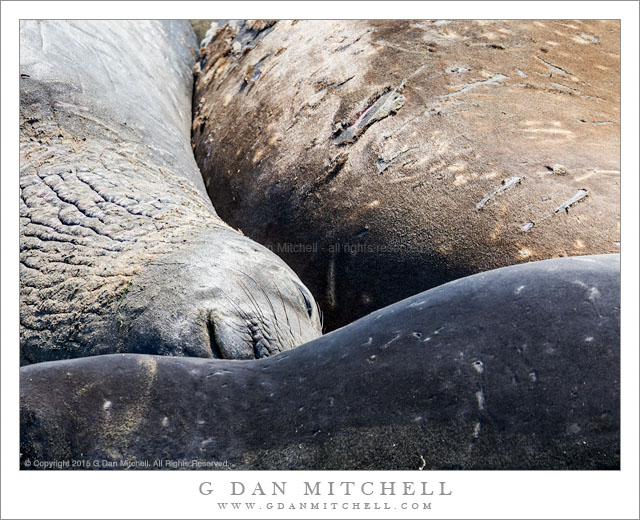
An elephant seal sleeps among its kin on a California beach

Sleeping Elephant Seal. California Coast. July 20, 2015. © Copyright 2015 G Dan Mitchell – all rights reserved.

An elephant seal sleeps among its kin on a California beach

Traveling up and down the California coast, it is hard to avoid eventually encountering the elephant seals. Historically they were once very common along this coastline, and their numbers have recovered considerably in recent decades. There are now several places where they are very accessible, and in large numbers — if you ever do the Big Sur Pacific Coast Highway you will certainly encounter at least one such area. In fact, that’s what we were doing on this July trip. We were mainly there to photograph landscapes and seascapes, but that didn’t prevent us from making a photographic detour to photograph these animals.

Here the coast highway comes very close to an elephant seal rookery, and the animals are more accessible than in any other location that I’m aware of. (At others you must walk long distances, and in some places they have hauled up on beaches so isolated that you can only watch from a great distance.) At first I was fascinated by their sparring and other more active things they do. The more I have photographed them, the more I have looked for and sometimes found ways to photograph them even when they are not active — and this specimen, sleeping among others of its herd, is anything but active!


G Dan Mitchell is a California photographer and visual opportunist. His book, “California’s Fall Color: A Photographer’s Guide to Autumn in the Sierra” is available from Heyday Books and Amazon.
Blog | About | Flickr | Twitter | FacebookGoogle+ | 500px.com | LinkedIn | Email


All media © Copyright G Dan Mitchell and others as indicated. Any use requires advance permission from G Dan Mitchell.
The Landing

The Landing
“The Landing” — A brown pelican joins the flock on a rock along the Pacific coast of California

This photograph has appeared here at my website and in subsequent social media posts already, but merely as an example in a post I shared about some slightly technical matters related to a camera I use. (More on that in a moment.) Since I feel like the photograph stands not only as an example of how a lens and a camera work, but also as a photograph, this time I’m sharing it for the latter reason. We had spent a couple of days in the Monterey and Big Sur area, photographing along that spectacular coastline, and now we were headed home. We decided to work our say north along the coast, eventually turning inland just south of San Francisco.

Just before that homeward turn we passed a small, rocky island just a few yards off the actual coast, and I realized that it was covered with many scores of brown pelicans. I love photographing these birds, and it is somewhat unusual to see so many in one place, so we stopped and walked out to the bluff to make some photographs. The light was challenging since it was coming from almost directly behind the birds — but in this case that worked well as there is a light fringe around the bird, some light comes through its wing feathers, and additional light reflects back up from surf and rocks as this pelican lands. Oh, and that technical article? I made this photograph with a pretty unusual “birding” setup — the 50.6MP Canon EOS 5Ds R with a 100-400mm zoom lens with a 1.4x teleconverter attached!


G Dan Mitchell is a California photographer and visual opportunist. His book, “California’s Fall Color: A Photographer’s Guide to Autumn in the Sierra” (Heyday Books) is available directly from him.

G Dan Mitchell: Blog | Bluesky | Mastodon | Substack Notes | Flickr | Email


All media © Copyright G Dan Mitchell and others as indicated. Any use requires advance permission from G Dan Mitchell.
The Landing

The Landing
“The Landing” — A brown pelican joins the flock on a rock along the Pacific coast of California

California’s brown pelicans are probably my favorite coastal birds, and I love to photograph them — from bluff tops which they pass as the coast along on Pacific winds, to the ocean as they skim just above the water, to places where they can be found resting between flights. These are large birds, with an almost prehistoric appearance, especially when a group of them floats by in a row, sometimes hardly moving at all. We spent a couple of days on the coast in mid-July, and on the last day as we headed home we passed a small, rocky island just of the shoreline. When we saw that it was covered with scores of these birds, so many that some had to land nearby instead of on the island, we grabbed our equipment and spent some time photographing them. I had tracked this pelican on its inbound flight. Most of them came from my right, passed the island, then turned to face into the wind before landing.

This photo also serves as a bit of a technical test, too. I made the photograph with my new Canon 5Ds R, using the EF 100-400mm f/4.5-f/5.6L IS II lens. To get a bit more “reach,” I added a 1.4x tele-extender, which made the longest focal length 560mm. Since this wasn’t possible on my previous camera (which could only autofocus at f/5.6, not the f/8 aperture produced by using the converter), I was interested to see how well this would work — would image quality be sharp enough and would the lens/extender combination focus quickly and accurately enough. In fact, it did work. Quite well, actually.


G Dan Mitchell is a California photographer and visual opportunist. His book, “California’s Fall Color: A Photographer’s Guide to Autumn in the Sierra” (Heyday Books) is available directly from him.

G Dan Mitchell: Blog | Bluesky | Mastodon | Substack Notes | Flickr | Email


All media © Copyright G Dan Mitchell and others as indicated. Any use requires advance permission from G Dan Mitchell.