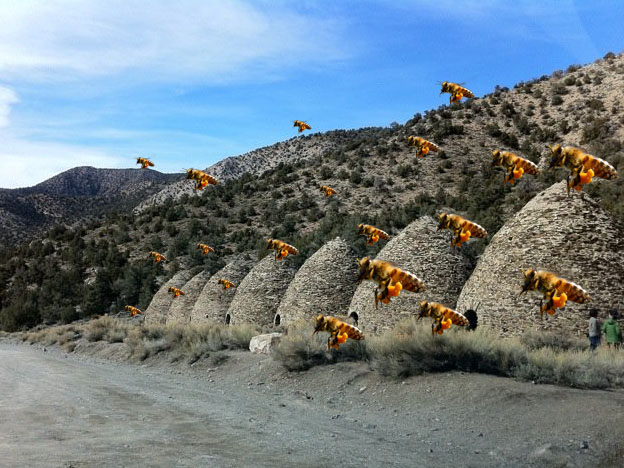
At about this time every spring, winter begins to fade high in the Panamint Range of Death Valley National Park. (For those who may not know, the peaks of the Panamint Range reach to over 11,000′ and are regularly cloaked in snow during the winter months.) As the warmth returns, the hills begin to green up and wildlife emerges once again. On just the right day in early April, the bees come back to life and emerge into the spring sun.
IMPORTANT: Read on for an important update to this April Fool’s Day 2011 that I have posted near the bottom of the page below the original story.
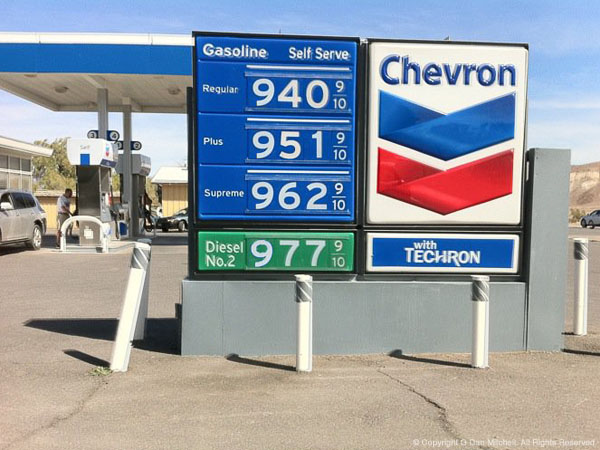
Gas Station Sign, Death Valley
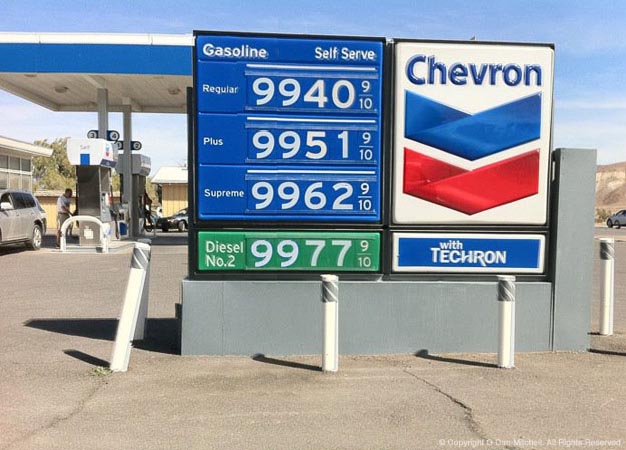
From a quick iPhone snap as I drove through this part of Death Valley a few days ago. Sometimes it seems like only thing higher than the temperature in Death Valley is the price of gasoline. I tell you, after putting 30 gallons in the Hummer, it will be a long time before I can afford to take another vacation!
NOTE: This photo apparently “went viral” recently, on disinformation posts on social media claiming that this is the price of gas in California today. LOL. I have a bit more to say about that below in an “update” and in the comments section.
If you enjoyed this (hint!) April Fool’s Day post, you might enjoy these, too:
And, of course, the rest of this site features years of my photography, along with articles and stories on photography-related subjects.
And, more fun with Photoshop…
UPDATE 3/10/22: Because the image in this post was ripped off by disinformation posters on social media and used as a fake news meme… I need to give readers the full truth. (Sadly, it does kind of wreck the original April Fool’s joke, but here we are.)
In early 2011 I was in Death Valley to make photographs. I passed by this gas station at Furnace Creek, which is known for having some of the highest posted gas prices in the country. (Smart visitors get their gas for much less at nearby Stovepipe Wells or to the east of the park in Nevada, where it is way cheaper.)
For several years I had been doing an April Fool’s Day post that includes some preposterous story. (See links in the story below.) It occurred to me that I could do one this year (2011) by photographing the sign and Photoshopping preposterous gas prices in place of the actual prices. I don’t actually recall the real prices at the time, but they were probably in the $3-something range. So I pulled over and made an iPhone snap of the sign. (Some wonder: Did I buy gas here. Are you crazy! No! See the previous paragraph. And, no, I do not own a Hummer. ;-)
Conveniently, the “6” on the price for “Supreme” was easy to invert, so I used it to create a “9” that I photoshopped in for the dollar amount. And on April Fool’s Day 2011 I posted the image and the text you’ll find lower on this page. There were several obvious hints in the story about its April Fool’s Day trickery, though I did manage to fool a few folks.
That was the last I thought of it until (I think) 2019 when someone contacted me to point out that the image had been ripped off and posted by alt-right conspiracy theory disinformation social media accounts as “evidence” of the outrageous prices for gas in California. Yeah, our prices are higher than the national average, but not this high! Several media outlets contacted me about it, and if you look around you might still be able to find a few of the stories in which I debunked the claim and pointed to this old post.
So, if you see this “photograph” somewhere online along with claims about the high prices of gas, let them know it is fake and point them here for the truth. ;-)
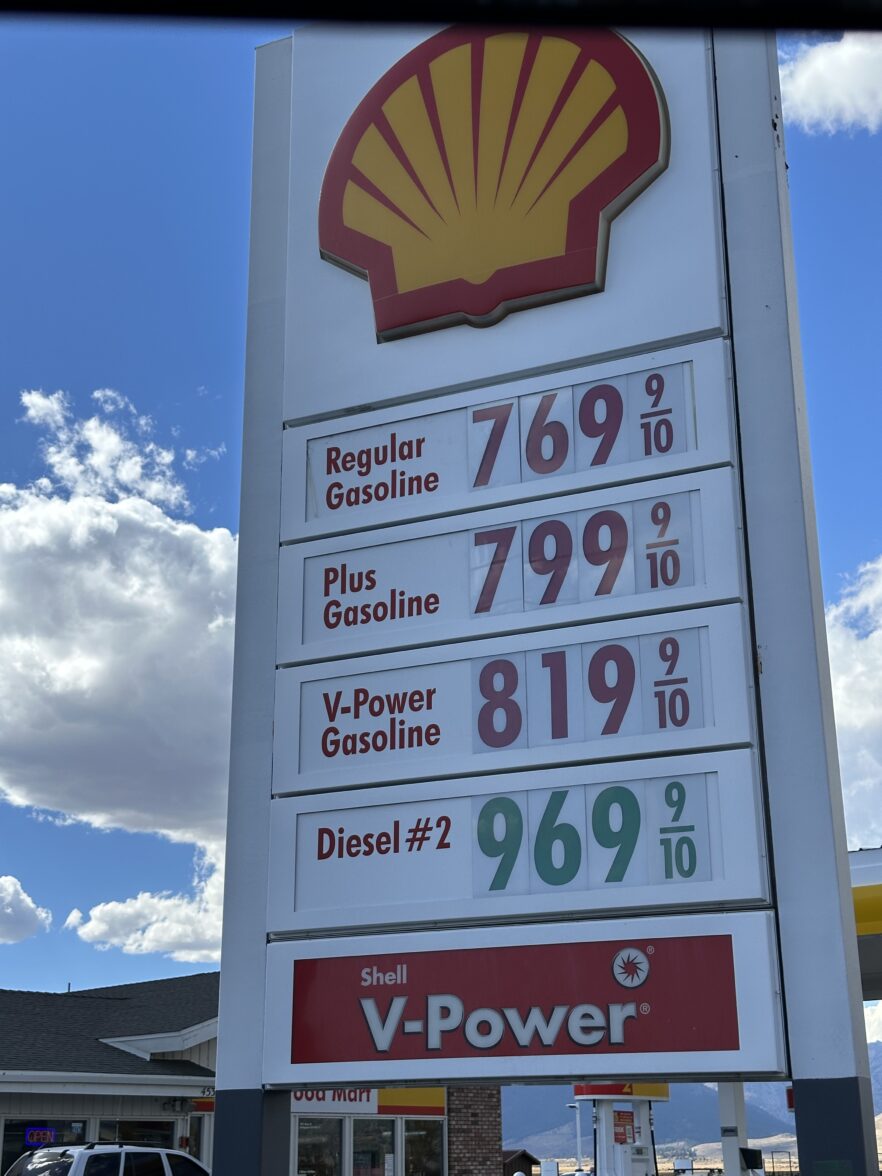
Update 10/10/26
Have you noticed in the past few years that things that no one would have believed would ever happen in America have happened regularly, to the point that nothing now shocks us and we simply acquiesce?
The following photograph is NOT photoshopped. The numbers on the April Fools Day photoshop image seemed too ridiculous to believe back then, you’d better believe this new one. The image was captured in Eastern California and prices like it are currently seen up and down that part of the state.
COMMENT OR QUESTION? Scroll down to the comment form.
We have all seen the lengthy discussions about “which lens is sharpest.” While the ability of a lens to resolve detail is certainly important, it is not the only thing that is important. And in many cases, knowing which is the sharpest lens is not as important as know which among a number of sharp alternatives best suits your needs. I stumbled into another discussion of this topic online today and posted the following as my contribution. (Slightly edited here from the original post.)
Folks sometimes allow themselves to become completely distracted by “sharpness” to the point that they overlook a whole bunch of other important issues in their quest to find the holy grail of “sharp.” This can become the equivalent to realizing that good tires are important on a car, and then deciding to buy a particular car because it comes with the “best” tires… but is too big to fit in your garage, costs twice your annual income, has a terrible repair record, needs a tune-up every 750 miles, and only comes in a color your spouse hates.
For a few people doing certain types of very critical work, printing very large, working slowly and methodically, and willing to forego the compensatory advantages of other lens options, lenses like the excellent TS models, lenses from another manufacturer that only work with adapters, classic primes, and so forth might make some sense.
But just because a lens might measure a bit better to some extent in one of the areas that is measurable (e. g. “sharpness”), it does not necessarily follow that it is a better lens, nor that alternatives that may measure differently in sharpness – but are very nearly as good – will not also be excellent performers. It is also not true that these specialized lenses are required to produce large and effective prints.
It is interesting to watch people go through a process that may look something like the following at times, as they…
1. decide they need a sharper kens.
2. research lens sharpness.
3. consider only sharpness and overlook or dismiss other issues, including those mentioned in the sources analyzing sharpness.
4. decide that some lens is the “sharpest” – frequently some expensive prime, the most expensive zoom they can find, an alternative brand, a specialized TS, etc.
4.5. lust after said lens for some period. The excitement builds…
5. purchase the aforementioned Really Really Sharp Lens.
6. use the new lens and glory in it’s pure Divinely Sharp Wonderfulness, thereby confirming their wise choice.
7. share their wonder with others.
8. make more photographs, and eventually come to find out that a) in real photography the sharpness difference is rarely visible, b) there are downsides to using the sharper lens, c) the downsides sometimes compromise or lose the shot, and d) in many cases their previous “less sharp” lens proves just as useful and effective.
9. note that the new super Super Lens, while useful, begins to spend more time in the bag, and…
10. learn an important lesson or two about Lens Lust… or else repeat the cycle with a different WonderLens. :-)
To be clear, I’m not suggesting that sharpness is unimportant. I’m just encouraging people to keep things in perspective.
1. Use a camera. The most important and basic tool of the landscape photographer is the camera. Using a camera greatly simplifies the process of capturing photographic images, and without one you’ll likely feel a bit lost. You may have noticed that pretty much all great landscape photographers use a camera – some use more than one! – so take a cue from the pros and make sure you have a camera, too!
2. Get a lens. Having a lens makes your camera much more useful. While a camera is critical to your work as a landscape photographer, without a lens the usefulness of the camera is greatly diminished. For this reason, virtually all successful landscape photographers end up, sooner or later, getting a lens to use with their camera. You’ll definitely want one, too – just like the pros! (Some cameras come with a lens built in – what a useful idea!)
3. Remove your lens cap. How many photographers can tell stories of forgetting to remove the lens cap before making a photograph, only to discover that the results were not what they had hoped for? But you don’t have to learn the hard way! Practice removing your lens cap at home – that way, when you are in the field you will have developed “photographer’s instincts” that will ensure that you remove the lens cap. (The good news is that with digital cameras you don’t have to worry about whether you loaded the film – but don’t forget your memory card!)
4. Photograph interesting things. Although it isn’t universally true, you will probably get more interesting photographs if you photograph interesting things. There are many things in the world, and not all of them are interesting. Look for the interesting things and photograph them. Look around – it is an interesting thing to do! Interesting, yes?
5. Pick the right brand. There are many brands of photographic equipment out there – cameras, lenses, filters, bags, you name it. Picking the wrong brand may hamper your photography; pick the right brand and you may not hamper your photography so much. So be sure to pick the right brand. If you aren’t sure which brand is best, talk to photographers – any one of them can tell you which is best… and why!
6. Light is important. Without light it would be pretty much impossible to make photographs, at least the typical landscape photographs. So if you plan to make typical photographs, look for scenes that are illuminated by… light! Light is your friend. Seek out light and when you see it make photographs. Think about it… how many of the photographers you admire work without light? So, do what the pros do – use light!
7. Pick the right subject. Pick the wrong subject and your photograph won’t be what you wanted it to be, so be sure to photograph the right subject. Seek it out and when you see the right subject make a photograph. Perhaps make several. There are so many subjects in the world that finding the right one can be a challenge, so be sure to apply yourself carefully to this task.
8. Colors are important. Unless you are making black and white photographs – in which case the only important colors are black and white. You’ll want to pay careful attention to color. The most important advice is to focus on color in your color photographs – just like the pros!
9. Focus on what is most important. Some people think that mastering technical issues is the most important thing. Others think that having the right equipment is critical. Some claim that the artistic quality of the photograph is important. (Don’t forget – color is important, too!) Before you make great photographs you’ll have to decide which is the most important in your work. Don’t waste your time being a generalist and trying to do everything – pick one and focus on it! Successful photographers develop a speciality and stick to it. And don’t forget the rule of thirds!
10. Find good locations. There are many popular spots to make photographs, and you can make photographs just like the pros if you seek out these locations and shoot there, too. You’ll have to be attentive, since these spots are easy to miss if you are talking on your cell phone as you drive past them. Some telltale hints include parking lots full of cars and lines of people with tripods. Stop and make a photograph – there is always room for one more tripod! You can probably make one that looks just like those that the other photographers are making! (Hint: You can also visit online photography sites ahead of time – both to find the locations and to save yourself from spending too much time searching for compositions when you actually get there. Your time is precious!)
Good luck!
(I probably should have saved this for April 1, but I couldn’t wait… :-)
Photographer and visual opportunist. Daily photos since 2005, plus articles, reviews, news, and ideas.
Manage Consent
To provide the best experiences, we use technologies like cookies to store and/or access device information. Consenting to these technologies will allow us to process data such as browsing behavior or unique IDs on this site. Not consenting or withdrawing consent, may adversely affect certain features and functions.
Functional
Always active
The technical storage or access is strictly necessary for the legitimate purpose of enabling the use of a specific service explicitly requested by the subscriber or user, or for the sole purpose of carrying out the transmission of a communication over an electronic communications network.
Preferences
The technical storage or access is necessary for the legitimate purpose of storing preferences that are not requested by the subscriber or user.
Statistics
The technical storage or access that is used exclusively for statistical purposes.The technical storage or access that is used exclusively for anonymous statistical purposes. Without a subpoena, voluntary compliance on the part of your Internet Service Provider, or additional records from a third party, information stored or retrieved for this purpose alone cannot usually be used to identify you.
Marketing
The technical storage or access is required to create user profiles to send advertising, or to track the user on a website or across several websites for similar marketing purposes.