
Tag Archives: aspen

Aspen Update 10/17/11

I’m back from my second trip to the eastern Sierra in as many weeks, and I’d like to share a bit of what I observed.

A week ago I visited and/or photographed several areas including Bishop Creek, Rock Creek, McGee Creek, a few areas around Mammoth Lakes, and Lee Vining Canyon. I also got reports from others who were there at the same time, and their reports tended to be in line with what I saw that week, namely that the trees that had been turning were interrupted by the early winter-like storm, dropping leaves or turning brown/black, and that lower elevation trees were mostly still green. At that time my hunch was that not much more was going to happen up high, but that the many green trees would provide color over the following couple of weeks.

This week I visited the portion of Bishop Creek in the South Lake drainage, areas on and near Glacier Lodge Road, the north section of the June Lakes loop near Parker Lake, Lee Vining Canyon, and Conway Summit. This visit confirmed some of my expectations from the previous week but also offered some surprises.

  • The thought that the loss of higher elevation leaves might mean that they were done for the season turned out to be not quite correct. This week I saw a surprising amount of color up high. In many places along the eastern escarpment I saw groves of brightly color trees marching right up many ridges.
  • Although I did not return to North Lake, I even heard reports that it had improved. (Though the person sharing the report pointed out that this would likely not be an exceptional year there.)
  • The color of the middle and lower level trees seems to be progressing very quickly. I was expecting middle elevation trees to turn by this week, but I was surprised by how low the color extended. If forced to make a prediction, I might guess that the season is going to run its course a bit faster than usual this year. (Stable weather this week – especially if the winds are light – might sustain things a bit longer.)

I feel like every aspen season has its own “personality” – whether it starts gradually or suddenly, early or a bit later, whether it is interrupted by weather events, and how long it lasts. The personality of this year’s eastern Sierra aspen season seems to include the storm that interrupted the early color up high, followed by a very rapid development of color about a week later.

I need to offer a few disclaimers. First, I only visited a small percentage of the places where aspen color may be found in a typical season. Second, while I can make some guesses about how things will evolve going forward, no one really knows. Third, if you are going to head out there to photograph the aspens this season, I urge you to check others sources of information on the conditions before you go.
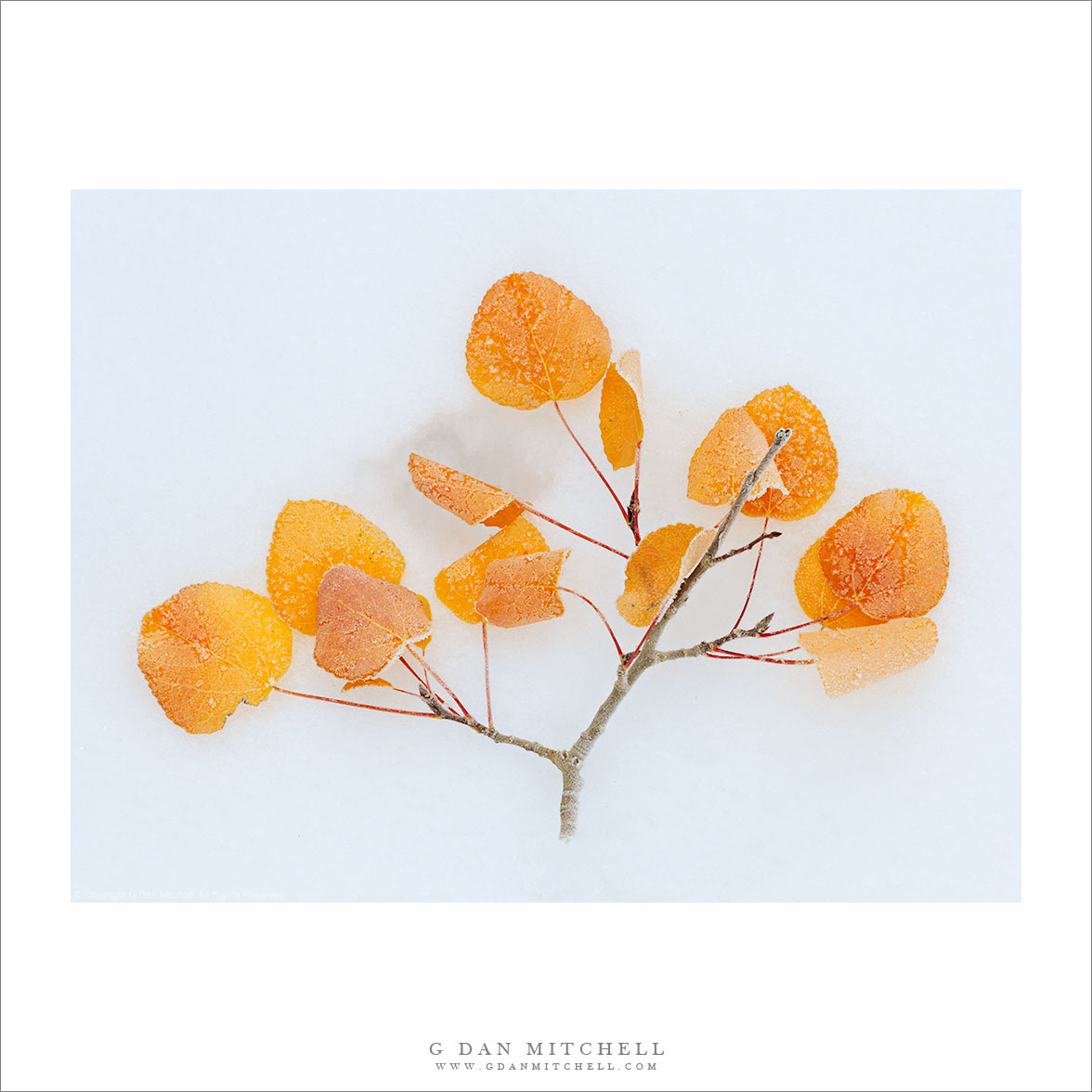
Fallen Aspen Branch, Snow

Fallen Aspen Branch, Snow
“Fallen Aspen Branch, Snow” — A small aspen tree branch blown down by an early fall storm rests on snow, North Lake, California.

Time to share aspen photos again! Each fall when the aspens change colors I head to the eastern Sierra to go aspen hunting! I made my first foray of the season this past weekend. I visited a number of the usual places – Bishop Creek, McGee Creek, Rock Creek, and Lee Vining Canyon. I’ve come to think that every aspen color season has a personality, defined by how and when and with what intensity the color appears, along with the related issues of the changing weather.

This year I think (from what I’ve heard) that the higher elevation trees were just changing colors about a week ago… before a strong early season storm came across the Sierra, dropping temperatures and quite a bit of snow. Over the weekend I saw up to about one foot of snow in places, which is an unusual amount for so early in the season. The aspen color was not exactly astonishing, and I think that the weather may be at least partially to blame. It seems that many of the mature colorful leaves were knocked down by the storm, and others that might now be colorful instead turned black and brown. While there was some interesting color, in many places I saw trees with leaves missing or trees that were almost fully still green.

The good news to take away from this is that since the lower elevation trees are still very green, there should be some fine aspen color very soon.

But I’ve often thought that a single leaf can be enough to make a photograph, and sometimes the single leaf can make a more effective image than a huge, colorful grove spanning many acres. So when I find that the color isn’t what I expected, one response is simply to look harder. As I walked along the road that passes North Lake, many of the subjects that I might have expected to photograph were nowhere to be seen. There were not large, spectacularly colorful trees. There was quite a bit of snow on the ground. So I looked harder… and one of the subjects I noticed was this single, small branch full of intensely colorful leaves lying on the snow.


Leave a comment or question using the form. (Click the title to see the full article and to comment if you are viewing it on the home page.)

G Dan Mitchell is a California photographer and visual opportunist. His book, “California’s Fall Color: A Photographer’s Guide to Autumn in the Sierra” (Heyday Books) is available directly from him. Blog | Bluesky | Mastodon | Substack Notes | Flickr | Email


All media © Copyright G Dan Mitchell and others.

Searching for Aspen Color in the Eastern Sierra Nevada – The Show Starts Soon!

At about this time each year my thoughts turn to the phenomenal aspen color in the eastern Sierra. I seek out and photograph these trees every fall. I shared some hints in a couple of blog articles from recent seasons – links below:

Each season is unique – starting at different times and developing in various ways that seem to depend upon how the previous winter-summer weather evolved, elevation, north/south position with the range, and other imponderables that seem beyond prediction.

While many signs of the seasonal change are already visible, the real show typically begins at the very end of September in a few places and really gets going around the beginning of October. I tend to regard the first half of the month as being “prime time” for eastern Sierra aspen color, though the season can end earlier if the weather blows down a lot of leaves or a cold snap turns them brown, or it can last longer for those who follow the color transition all the way down into Owens Valley and other low areas. (Note: While there are some colorful trees west of the Sierra crest, they are not nearly as numerous or accessible as those on the east side.)

(Feel free to share!)

G Dan Mitchell Photography
About | Flickr | Twitter | FacebookGoogle+ | 500px.com | LinkedIn | Email

Text, photographs, and other media are © Copyright G Dan Mitchell (or others when indicated) and are not in the public domain and may not be used on websites, blogs, or in other media without advance permission from G Dan Mitchell.

The Impossible Trip: Yosemite in Seven Hours?

That was the question that someone posed today in a photography forum I read:

We will be visiting Yosemite for approximately 7-8 hours one day the 2nd week of October as part of a weeklong trip to Tahoe (we live on the East Coast). I have been to Yosemite before (many years ago), she has not. Although we know it would take much more time to truly experience Yosemite this is the maximum time we can spend so we are looking for the top spots so we can make the most of the short time we have there.

(There was a bit more that I haven’t included here – the poster also would be staying in Mariposa the night before, and needed to drive across Tioga Pass and be in Tahoe that evening… and wanted to do photography along the way!)

Having visited the park for decades, and for an amount of time perhaps totaling well over a year altogether, and still getting to know the place, my first reaction was to ignore the question or respond with a wise-crack one-liner. Frankly, I don’t think it is really possible to do real photography of “the park” during a seven-hour visit. (With careful planning it would be possible to photograph a subject or two perhaps, but that is a different issue.) In any case, I suppressed my instinct to respond along the lines of “are you kidding!?” and instead tried to provide a realistic outline of what this experience might entail. While I’m spoiled, living only hours from the park, I do understand that others may find themselves in the area and not want to miss at least having a brief experience with such a place. And perhaps the way-too-brief visit might be enough to encourage such visitors to find a way to return for a longer visit.

So, with all of that in mind, here is what I wrote, slightly modified for this post:

You are asking quite a lot here… for a seven hour visit that will include at least 3-4 hours of driving… from Mariposa, into and around the Valley, and then up and over Tioga Pass… plus leaving enough time for the remaining hours-long drive to Tahoe.

Too bad, I’m afraid.

To be honest, the odds that you’ll be able to do much beyond “record-my-quick-visit” photography in the park are slender given the amount of time you’ll be there, your tight schedule, and the fact that you’ll be there mostly during the “blah light” time of day. To some extent, I’m inclined to recommend that you not make photography your primary goal – one reason being that trying to “get those photographs” will distract you even more from you brief opportunity to actually see and experience the place a bit. I photograph in the park frequently, so I know where and how to shoot, and I would not try to do real photography under the conditions you describe.

Having said all of that, the broad outlines of your visit must be: Continue reading The Impossible Trip: Yosemite in Seven Hours?