Tag Archives: book

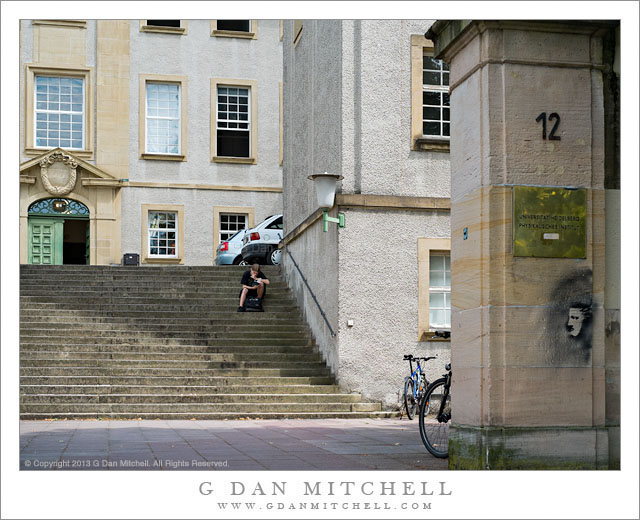
Reading on the Steps

Reading on the Steps

Reading on the Steps. Heidelberg, Germany. July 11, 2013. © Copyright 2013 G Dan Mitchell – all rights reserved.

A student studies a book on steps at the Physikalisches Institut of Heidelberg University, Germany

On our several walks to and along the Heidelberg Philosophen Weg, we passed by this university building, so I finally stopped for a moment and made a few photographs. The main building looks like an academic structure of some sort, so I had made a guess as to what this place was before I found the sign. One student reads on the steps, and a few of the ubiquitous bicycles are parked nearby. Also ubiquitous is the bit of political graffiti – found in many places near the University buildings, and often relatively small compared to the stuff we frequently see here in the US.

Yes, in a general sense, another postcard photograph. :-)

G Dan Mitchell is a California photographer and visual opportunist whose subjects include the Pacific coast, redwood forests, central California oak/grasslands, the Sierra Nevada, California deserts, urban landscapes, night photography, and more.
Blog | About | Flickr | Twitter | FacebookGoogle+ | 500px.com | LinkedIn | Email

Text, photographs, and other media are © Copyright G Dan Mitchell (or others when indicated) and are not in the public domain and may not be used on websites, blogs, or in other media without advance permission from G Dan Mitchell.

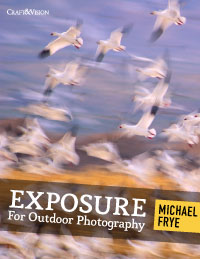
Exposure for Outdoor Photography, by Michael Frye

Exposure for Outdoor Photography by Michael Frye

Craft and Vision has just released Michael Frye’s new ebook, Exposure for Outdoor Photography. The book seems to be directed at the many folks who own DSLRs or non-DSLR cameras and are striving to advance beyond the point and shoot approach to their photography. The book takes a straightforward approach to some of the most important topics related to exposure. It begins with a basic description of, well, the basics of exposure – shutter speed, aperture, and ISO and some of the important terminology and concepts related to these factors. Michael keeps the level of detail to a minimum, but the basics are all there, including an explanation of the how and why of using the histogram display – which is probably just about exactly the right approach for his intended audience.

After getting the basics out of the way, the book moves to a series of ten “cases studies,” each of which uses one of his photographs to explore a particular aspect of exposure. The subjects of the case studies include using the histogram, dealing with both large and small depth of field, freezing motion or controlling motion blur, the tradeoffs of moving to higher ISO, recovering highlights in bright scenes, how to handle extremely bright highlights such as direct sun, and a nod to the zone system (in very simplified form) and HDR and exposure blending concepts. Rather than presenting the concepts in theoretical form, he uses his one photographs to provide practical examples for the case studies.

There are a number of things I appreciate about the book, and I think many readers may also agree:

  1. Rather than presenting rules that you must follow, Michael presents the concepts and explains/demonstrates the effects of some of the choice under discussion. He is careful to point out that there usually is no “perfect” exposure, and that there are different ways to get the result you have in mind. (Near the end of the book he even provides some examples of photographs that intentionally “violate” the exposure rules.)
  2. He strikes a good balance between too little and too much detail. He avoids the pitfalls of trying to make things so simple that they end up being simple-minded and of trying to cover all possibilities to the extent that many readers simply end up confused. This is probably an ideal balance for photographers who are taking first steps towards fuller understanding and control of exposure in their photographs.
  3. The case study photographs effectively illustrate the concepts that he covers. In addition, many of them are just plain fine photographs. (Two of my favorites are the Tuolumne Meadows photograph and one of geese in beautiful morning light.)

The ebook concept seems to be catching on quickly and there are plenty of good reasons for this. The visual quality of the text and illustrations is excellent. The books can be read on a laptop or a tablet. They are easy to purchase, and the cost is very low.

The book is now available from site affiliate Craft And Vision, and I understand that there may be a discount price during the first few days of availability.

G Dan Mitchell is a California photographer whose subjects include the Pacific coast, redwood forests, central California oak/grasslands, the Sierra Nevada, California deserts, urban landscapes, night photography, and more.
Blog | About | Flickr | Twitter | FacebookGoogle+ | 500px.com | LinkedIn | Email

Text, photographs, and other media are © Copyright G Dan Mitchell (or others when indicated) and are not in the public domain and may not be used on websites, blogs, or in other media without advance permission from G Dan Mitchell.

Review: “Light & Land” by Michael Frye

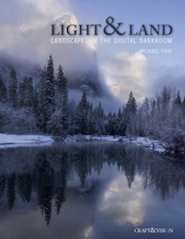
Over the past few weeks I have had the chance to go through Michael Frye’s new ebook, “Light and Land: Landscapes in the Digital Darkroom.” Many are no doubt already aware of Michael’s reputation from his photography, his workshops, and his other publications including his “Photographer’s Guide to Yosemite” and “Digital Landscape Photography: In The Footsteps of Ansel Adams and the Masters.” I have the .pdf version of “Light and Land”, and I understand that an iPad app version may also be available.

Light and Land - Michael Frye

It is typical for photographic “how to” books to focus on specific techniques, and to be organized around a presentation of these techniques – perhaps with a section on curves, a section on black and white conversion, and so forth. This approach has its place, especially for certain types of learners and at certain points in the learning process. It is important to understand the basic techniques and operations that are available in the “digital darkroom” of such programs as Photoshop, Lightroom and so forth. That said, the bigger and more important issue is how to call upon these techniques creatively and effectively and appropriately in order to make photographs. Not all “how to” books do an effective job of illustrating this.

Michael’s “Light & Land” takes a different approach, and one that more accurately and realistically reflects the thought process of a photographer who is calling upon this arsenal of techniques in the service of creating beautiful photographs.  He writes:

“The digital darkroom gives us tremendous control over our images. We can make them lighter, darker, add contrast, change the color balance, increase saturation, turn a color photograph into black and white, remove telephone poles, blend exposures with HDR, combine ten images to capture infinite depth of field, or put a winged elephant in the sky.

But what do we do with these choices?” Continue reading Review: “Light & Land” by Michael Frye

SF Gate Reviews ‘First Light – Five Photographers Explore Yosemite’s Wilderness’

I see that Carl Nolte has offered a review of “First Light – Five Photographers Explore Yosemite’s Wilderness,” a book featuring the work of Charles Cramer, Karl Kroeber, Scot Miller, Mike Osborne and Keith S. Walklet.

If you are a Yosemite aficionado, someone who loves the Sierra back-country, or a lover of great landscape photography, I recommend this book. The five photographers have a tremendous amount of experience in the Yosemite back-country, and all five are talented and highly-regarded photographers in their own right. (I’ve been fortunate enough to spend a bit of time with them “on location” in recent years.)


G Dan Mitchell is a California photographer and visual opportunist. His book, “California’s Fall Color: A Photographer’s Guide to Autumn in the Sierra” (Heyday Books) is available directly from him.

G Dan Mitchell: Blog | Bluesky | Mastodon | Substack Notes | Flickr | Email


All media © Copyright G Dan Mitchell and others as indicated. Any use requires advance permission from G Dan Mitchell.