
Tag Archives: camera

Photography and Gear Fetishes (Another Adapted Forum Post)

Earlier this week I dropped in on a photography forum in which the OP (original poster) suggested that the causal correlation between buying Really Expensive Gear and producing better photographs was weak. Oh, yeah!

Here is a slightly adapted version of my contribution to that discussion:

I’ve thought quite a bit about why so many “photography enthusiasts” seem to be much more interested in acquiring photography gear than in making photographs. Reasons might include:

1. Equipment is necessary in order to make photographs, so acquiring some is not unimportant.
2. Because it is, frankly, easier to write about gear in definitive (or seemingly definitive) ways than to write competently about photographs, there is much more written about gear – and newbies should be forgiven for having a false impression that the gear one has is more important than the photographs one makes.
3. Almost all of us do find the equipment fascinating to some extent. Some grow past this, but for some it ends up being more about possessing expensive and supposedly high-end stuff than anything else. (Photography is not the only area where this occurs.)
4. Because people more often encounter photographers when they are operating cameras than when they are exhibiting photographs, they associate the gear with the activity more than they associate photographs with it.
5. Some want to look like (what they imagine) professional photographers (look like).
6. Some are told, before they have enough experience to question it, that they must have “the best” gear if they are going to make photographs. I’ve actually seen rank beginners struggling with $6000 bodies and sets of L primes or big white telephotos… for their family vacations.
7. Some love to shop.

[The OP’s] notion that the causal correlation between expensive gear and photographic skill or quality is weak is one that I would agree with.

I think that a “cure” for the counter-productive obsession with gear at the expense of photographs may be to do everything in your power to focus on photographs – not photography, not cameras, not lenses, etc. If you are not or do not become passionate about producing photographs, then you might want to consider a different hobby. :-)

G Dan Mitchell Photography | Flickr | Twitter (follow me) | Facebook (“Like” my page) | LinkedIn | Email
Text, photographs, and other media are © Copyright G Dan Mitchell (or others when indicated) and are not in the public domain and may not be used on websites, blogs, or in other media without advance permission from G Dan Mitchell.
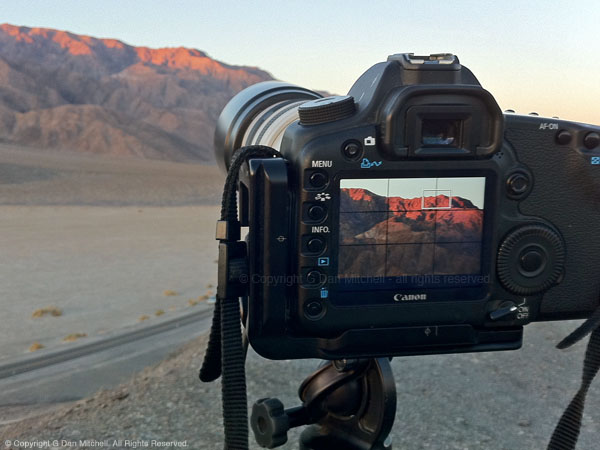
What the Camera Sees

What the Camera Sees

What the Camera Sees. Death Valley National Park, California. March 31, 2011. © Copyright G Dan Mitchell – all rights reserved.

An iPhone snap of my camera set up to photograph dawn light on Tucki Mountain, near Stovepipe Wells in Death Valley National Park.

Fun, eh? ;-)

G Dan Mitchell Photography | Flickr | Twitter | Facebook | Email
Text, photographs, and other media are © Copyright G Dan Mitchell (or others when indicated) and are not in the public domain and may not be used on websites, blogs, or in other media without advance permission from G Dan Mitchell.

Megapixel Mania – An Extended Riff

I read (yet another… ;-) megapixel rant somewhere online yesterday, and it got me thinking again about the fixation on megapixels as a measure of camera “value,” and the odd and sometimes irrational ways that people respond to this issue. It is well known that over the past decade or more, as digital photography technologies have become more and more prevalent (displacing film in many areas), camera technology has continued to advance in many ways. Among these advances is the ability to increase the number of photosites on sensors of a given size – e.g. give us “more megapixels.”

The responses to this tend to fall into three broad categories: Continue reading Megapixel Mania – An Extended Riff

Canon 24-70mm f/2.8 L II vs. 24-70mm f/4L IS vs. 24-105mm f/4 L IS (and more?)

Anyone who spends any time in photography forums discussing Canon lenses has seen this topic come up regularly: the comparisons between the 24-70 and 24-105mm L zoom options. If you follow this subject you are familiar with posts asking which of these lenses is “best” or claiming that one or another is great and the others are poor, and with the ensuing debates. Rather than re-writing what I have to say about this every time the subject comes up, I thought I would post once here and then link back to this article.

(Update 1/4/13: Things have changed in significant ways since I first posted this review back in 2011 – primarily with the introduction of two newer Canon 24-70mm L zooms. I have made a few updates to this post to reflect those changes. I have now had the opportunity to use the updated Canon EF 24-70mm f/2.8L II lens. It is also a very fine lens and a great performer. In addition, there is now a Canon EF 24-70mm f/4.0L IS USM lens as well, and the Canon 24-105mm f/4L F/4.0L IS lens is still available. Canon shooters have an over-abundance of good lenses that cover the 24mm to whatever-mm focal length range at this point. All three of these current lenses are excellent options and the functional differences among them now are the primary basis for selecting one over the others. If you need f/2.8 and are OK with a smaller focal length range and not having IS, the 24-70mm f/2.8 could well be your choice. If you can get along without f/2.8, are OK with the smaller focal length range, would like IS, can make use of semi-macro capabilities and want a smaller lens, then the 24-70mm f/4 IS lens can be a great option. If you don’t need f/2.8,  but do value image stabilization and a significantly larger focal length range, the 24-105 is a wonderful choice. )

(Update 1/8/15: And now there is yet another lens in this general category from Canon, the EF 24-105mm f/3.5-5.6 IS STM Lens. I have incorporated some information about this option below.)

Continue reading Canon 24-70mm f/2.8 L II vs. 24-70mm f/4L IS vs. 24-105mm f/4 L IS (and more?)